
Researchers at China’s Deep Space Exploration Laboratory in Hefei have developed an experimental microwave-plasma system intended to extract oxygen from carbon dioxide for future Mars missions. The South China Morning Post reported on November 29, 2026, that laboratory trials split more than half the incoming carbon dioxide. The research complements other extraterrestrial life-support projects, including NASA’s Ohalo III space-farming experiment. No deployment of the Chinese apparatus on Mars has been demonstrated.
How microwave plasma produces oxygen
In a 2026 European Geosciences Union conference abstract, researchers Longlong Sang and Xiao Zhang describe a 2.45 GHz microwave source coupled into a vacuum chamber through a ceramic window. A magnetic field of 875 gauss supports electron cyclotron resonance, allowing electrons to absorb microwave energy and promote molecular dissociation. The researchers detected atomic oxygen using optical spectroscopy and found that small quantities of argon and nitrogen assisted dissociation.
For the idealized overall reaction, 2CO₂ → 2CO + O₂, every 88 grams of fully converted carbon dioxide can yield approximately 32 grams of molecular oxygen. The carbon monoxide coproduct must be isolated from the oxygen stream. Producing reactive oxygen atoms in a plasma does not automatically establish a usable supply of purified molecular oxygen. Spectroscopic measurements are important diagnostic tools, as illustrated by our coverage of Webb’s observations of supernova dust.
Anadolu’s report, citing SCMP, describes a chamber just under five centimeters wide and operation at room temperature. Low bulk-gas temperature does not mean plasma electrons are cold or that the apparatus requires no electricity. The conference abstract separately estimates that more than half the microwave energy entering the chamber supported dissociation. Microwave-energy utilization and feed-gas conversion are different metrics; neither establishes the electrical efficiency of a complete oxygen-production plant. The journal paper could not be independently accessed because its website required security verification.
China versus NASA’s MOXIE
| Specification | Chinese prototype | NASA MOXIE |
|---|---|---|
| Method | Microwave-excited plasma | Solid-oxide electrolysis |
| Operating temperature | Room temperature, as reported | Approximately 800°C at electrolyzer |
| Testing environment | Earth laboratory | Martian surface |
| Oxygen purity | Not established in accessible research | 98% or higher at reported peak |
| Development stage | Experimental prototype | Completed Mars demonstration |
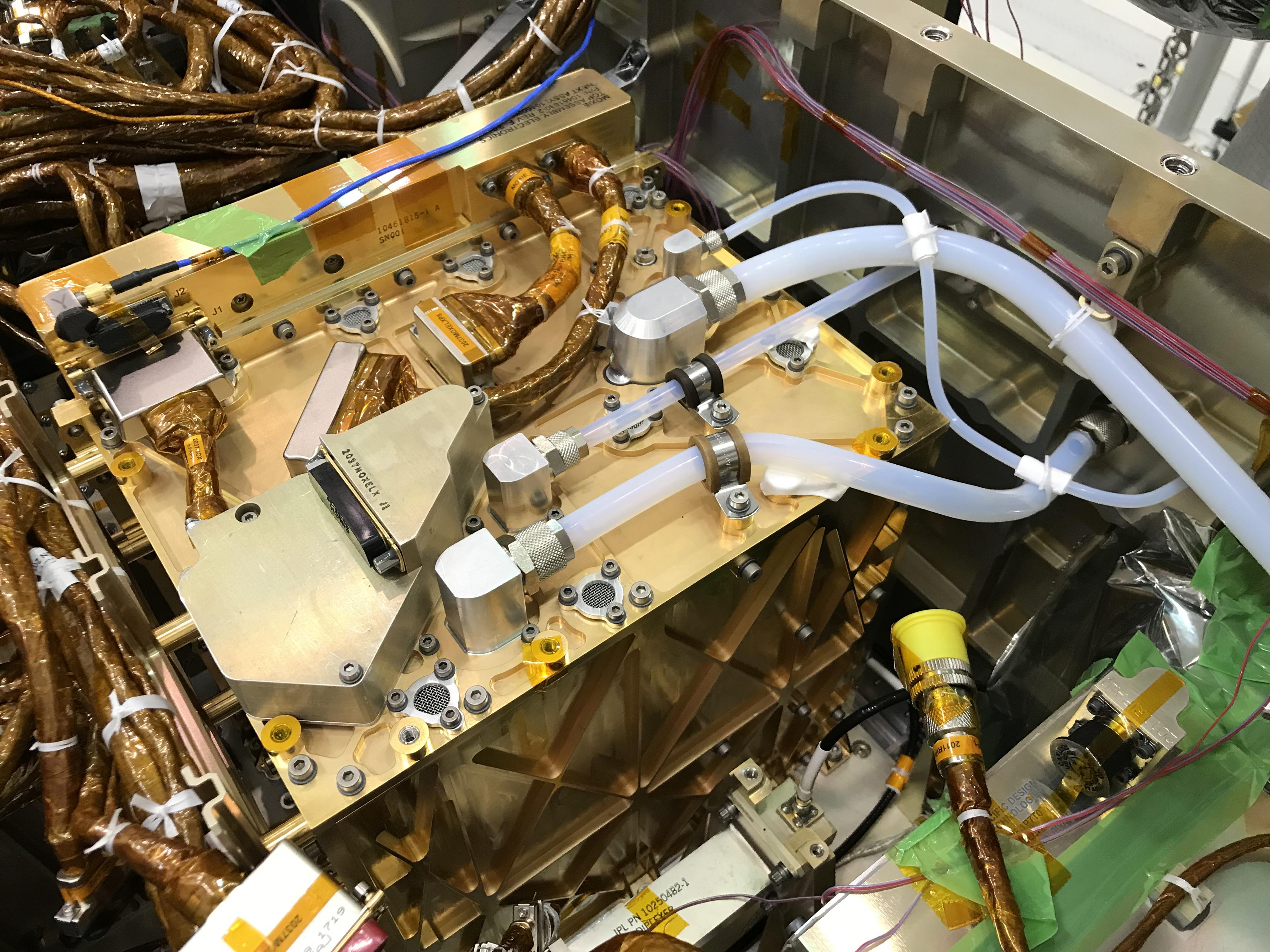
NASA’s September 2023 mission report confirms MOXIE produced 122 grams of oxygen across 16 runs, achieving a peak rate of 12 grams per hour at a purity of at least 98%. The instrument used a solid-oxide electrolyzer operating near 800°C. MOXIE established performance on the Martian surface; the new Chinese approach remains a laboratory experiment. Oxygen also serves as a rocket oxidizer rather than a fuel itself, an important distinction for future ascent vehicles and multistage rocket systems.
From a reactor to a life-support system
The Martian atmosphere contains approximately 95% carbon dioxide, making it a potential local oxygen resource. A plant would nevertheless require gas intake, particulate filtration, separation, purification, compression or liquefaction, storage and reliable power. Mars’s low atmospheric pressure makes collecting adequate gas a separate engineering challenge.
Using a representative astronaut demand of 0.84 kilograms of oxygen per day, four astronauts would require approximately 3.36 kilograms daily, or 140 grams per hour on average. That is nearly twelve times MOXIE’s demonstrated peak production rate, before reserves, leakage and additional mission requirements. Oxygen for propulsion could require considerably greater capacity.
The researchers still need to establish net oxygen output, gas purity and total power consumption, alongside tests under representative Martian conditions. Long-duration reliability and integration with habitats such as those discussed in our lunar habitation analysis also matter. Microwave plasma offers a promising alternative to high-temperature electrolysis, but a sustained, independently validated oxygen supply remains the decisive milestone.


Leave a Reply