
SemiAnalysis’s November 26, 2026, GDPx update reports a leading aggregate score of 19.3% for GPT-6.2 Astra, compared with 16.4% for Claude Fable 5.2. At the November 29 leaderboard snapshot, the corresponding average benchmark costs were $46.76 and $88.15 per task. Comparing score and cost together helps explain why higher-priced models are not necessarily better purchases. Related coverage of PrismML’s compressed coding model illustrates a separate trade-off between local resource requirements and model performance.
How GDPx measures difficult professional work
The evaluation includes 206 tasks developed with 14 domain partners. Eleven fields contribute equally to the aggregate, including chip design, software engineering, finance and materials science. Scores use task-specific grading and average three attempts, so an aggregate percentage is not simply the fraction of 206 tasks completed. The benchmark concentrates on demanding expert work rather than representing the entire economy. Its rankings therefore should not be extrapolated to ordinary consumer interactions or all workplace activities.
The cost-performance frontier
A Pareto frontier identifies alternatives for which no other displayed alternative is both cheaper and at least as capable, or more capable and no more expensive. On the chart below, higher scores and lower dollar costs are preferable. The logarithmic cost axis makes sub-dollar and tens-of-dollars workloads visible together; equal horizontal distances represent equal multiplicative changes.
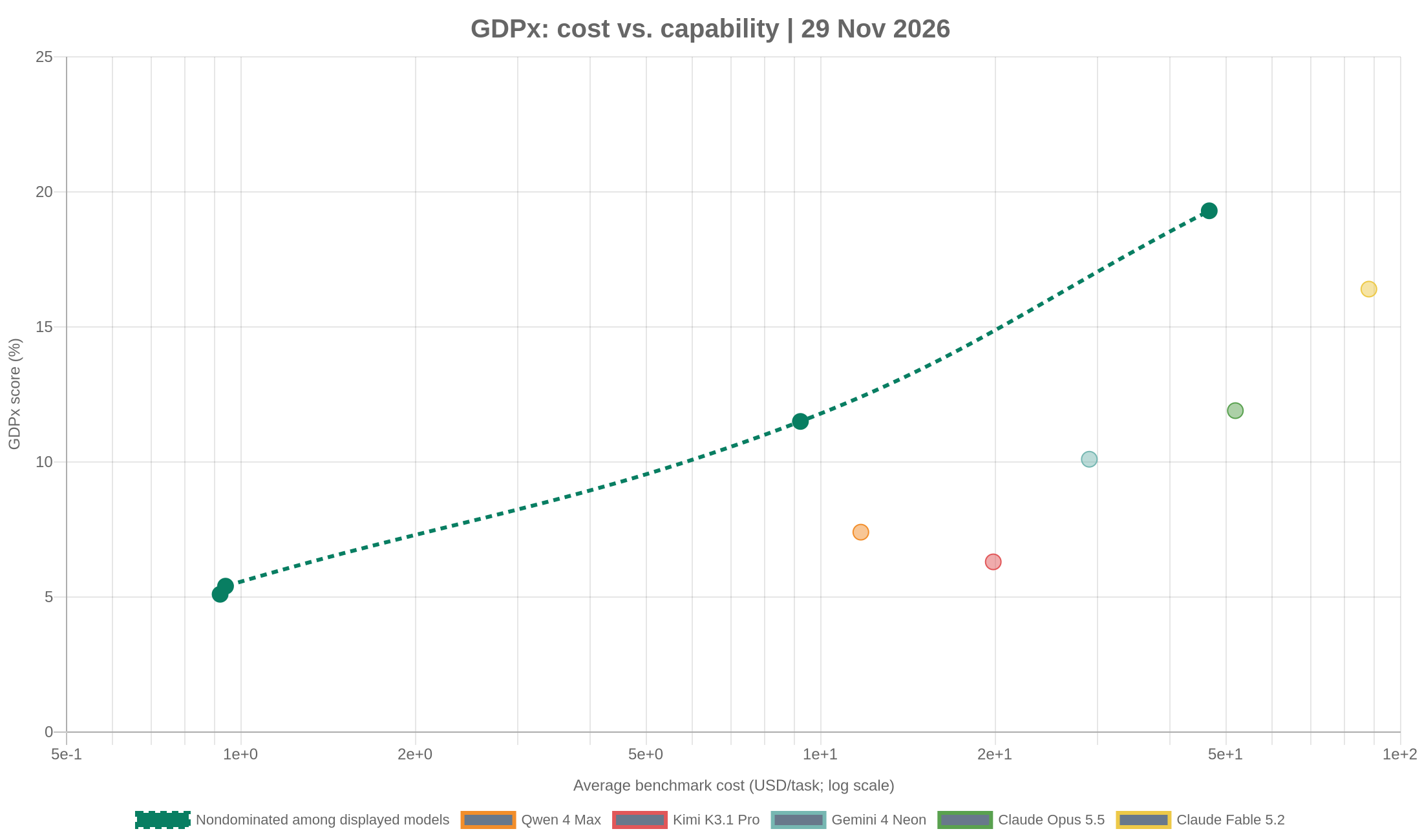
Among the nine plotted alternatives, GPT-6 Luna ($0.92, 5.1%), DeepSeek 4.1 Flash ($0.94, 5.4%), GPT-6.2 Sol ($9.22, 11.5%) and GPT-6.2 Astra ($46.76, 19.3%) form the displayed frontier. Fable’s aggregate score is lower than Astra’s despite a higher measured average cost. That does not rule out Fable as a better option for particular tasks. Models omitted from the chart may alter the frontier; models without a published price cannot be evaluated along both dimensions.
Workload selection matters more than a universal ranking
A company using coding agents must consider repository-specific correctness and the ability to run tests, as described in our Cognition evaluation report. GDPx includes multiple domains whose difficulty, grading and permitted actions vary. Safety-related refusals can also change aggregate outcomes; a refusal is not proof of inability, and aggregate capability is not proof that deployment is safe or appropriate. Cost per benchmark attempt is affected by output length, tool use and caching, not just the advertised token rate. Actual costs vary with provider pricing and workload.
The horizontal-bar and scatter formats in the original chart atlas are useful for single-metric comparisons and associations. SmartChart 79, from the expanded reference atlas, is more appropriate here because a deployment decision has competing objectives. A purchaser should validate candidate models on its own authorized tasks, measure successful completion costs, and treat the observed frontier as a dated benchmark snapshot rather than a permanent ranking.


Leave a Reply