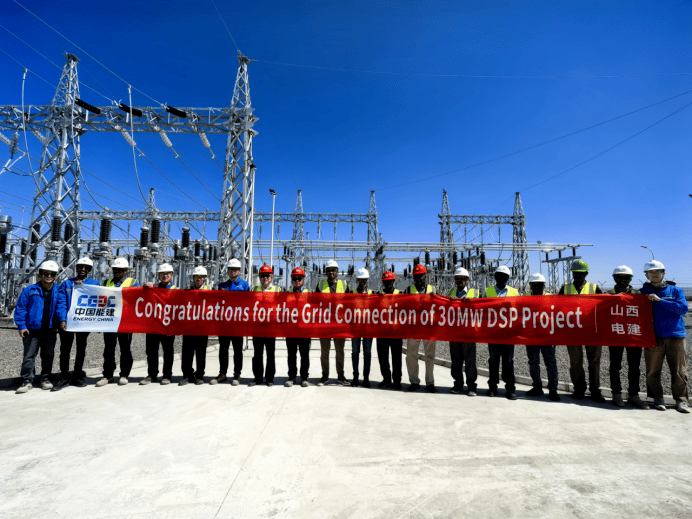
Eritrea’s Dekemhare photovoltaic plant supplied 21 MW out of 56 MW of available generating capacity during an African Development Bank (AfDB) supervision mission in late October 2026, according to Alama Report’s November 26 coverage. The resulting 37.5% share describes the inspection conditions, not an annual renewable-energy share. The bank lists its October implementation progress report publicly; detailed inspection figures are attributed to Alama Report’s account because the original report was inaccessible during editorial review. Unlike the proposed solar expansion in Equatorial Guinea, Dekemhare has reached operation.
Solar generation with two-hour storage
The engineering contractor’s April announcement identifies a 30 MW solar farm, a battery installation rated at 15 MW and 30 MWh, a 15/66 kV substation and a dual-circuit transmission connection extending approximately 750 meters. The battery’s nominal energy-to-power ratio is two hours. Usable duration can differ because of charge limits, conversion losses and auxiliary consumption.
The observed 21 MW equals 70% of the plant’s published 30 MW rating. A single inspection cannot establish annual capacity factor or explain why the plant was below its nameplate rating. Solar output changes with sunlight, temperature and operating constraints, while storage discharge depends on available energy and dispatch decisions. The inspection account does not separate instantaneous photovoltaic production from battery output. Our El Salvador energy-storage analysis explains the difference between energy and power ratings.
Why a remaining capacity shortage matters
Alama Report attributes a decline in unmet peak demand from 30 MW to 16 MW to the AfDB progress assessment. A 14 MW improvement represents approximately 46.7% of the initial shortfall, although individual contributions from solar generation, thermal equipment and changing demand cannot be isolated from the published summary. Reliable service requires adequate generation when customers need electricity, plus functioning transmission lines, protection equipment and distribution substations.
The AfDB project record identifies increased access to reliable electricity as a development objective. Reported discussions about additional substation work illustrate the importance of maintaining the network alongside generation. The Ecuador–Peru interconnection project provides another example of investment in electrical delivery capacity.
Measuring the next improvement
China Energy International expects annual production of 73.89 GWh. Dividing that forecast by 30 MW multiplied by 8,760 hours gives an implied capacity factor of 28.1%, not an observed operating result. Monthly metered output, battery availability, peak demand and outage duration would provide stronger evidence of sustained improvements. The project also matters for communications and digital services, whose infrastructure constraints were examined in our earlier Eritrea connectivity coverage. No dedicated Bitcoin mining or AI computing customer has been established for the plant.


Leave a Reply