
Ethereum Foundation researchers recommended Keccak-256 on November 24, 2026, as the principal hash function for Ethereum’s planned transition toward post-quantum cryptography. The recommendation follows a November 23 roadmap update that prioritizes new cryptographic protections against potential advances in quantum computing and AI-assisted cryptanalysis. Unlike the recent Cosmos security stack update, Ethereum’s proposed migration remains a research and engineering program, not an activated mainnet upgrade.
Why replace elliptic-curve signatures?
Ethereum currently uses elliptic-curve cryptography for transaction authorization and validator signatures, with different schemes in each layer. A sufficiently capable fault-tolerant quantum computer running Shor’s algorithm could undermine the discrete logarithm problems protecting those schemes. A hash-based signature instead relies on properties such as the difficulty of finding a preimage for a hash. The signature protocol still requires careful construction: simply hashing a message does not authenticate its sender.
The proposed program addresses three security boundaries: validator consensus, account authorization and commitments to blob data. Moving only one layer to new cryptography would leave the other layers dependent on older assumptions. The foundation also announced an expansion of its protocol security team to support the work.
Keccak-256 versus the alternatives
The November 24 research note evaluates five candidate families, including Poseidon, BLAKE3, BLAKE2, SHA-256 and Keccak-256. Researchers favored the established cryptanalytic record and integration advantages of Keccak despite its slower performance in some workloads. Keccak already serves Ethereum address derivation and execution-layer state commitments.
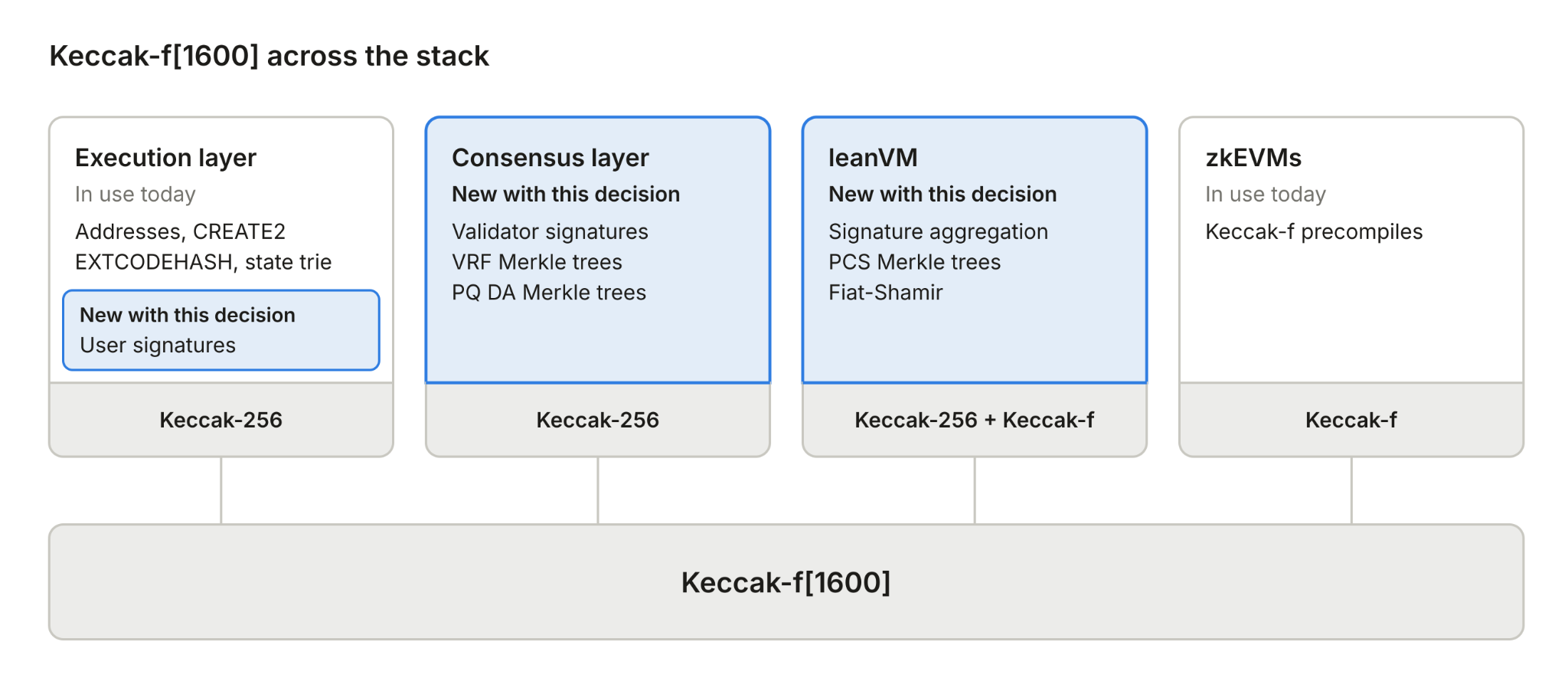
Keccak-f[1600] transforms a 1,600-bit internal state through 24 rounds. A sponge construction absorbs input into part of the state, applies the permutation and extracts output. Keccak-256 and standardized SHA3-256 use the same underlying permutation but differ in domain-separation padding, producing different digests for identical inputs. Software cannot interchange them without breaking compatibility. Unlike the ECDSA exposure discussed in our Bitcoin wallet security report, the planned migration addresses a wider cryptographic assumption.
The computational cost of proving hashes
Zero-knowledge proof systems can aggregate many signature-verification operations into succinct proofs. Conventional hashes once imposed high proving costs relative to algebraic alternatives. Recent proof-system engineering has changed the trade-off. Ethereum researchers report leanVM performance above 500,000 Keccak permutations per second on hardware corresponding to EIP-7870 recommendations. The research note associates its aggregation target with roughly 1,000 validator attestations per second. That figure concerns proof generation, not user transaction throughput or finality.
At 500,000 operations per second, an illustrative workload of one million permutations requires approximately two seconds at a constant rate, before communication, scheduling and other overhead. The example is arithmetic rather than a measured end-to-end validator benchmark. System operators must also account for bandwidth, memory and the increased size of hash-based signatures.
A 2028 target, not a deployment guarantee
The foundation’s November 25 Devcon recap identifies late 2028 as an ambitious target proposed by researcher Justin Drake, with a formal schedule review planned for January 2027. Wallet developers, validators and rollup operators must eventually support compatible formats and migration procedures. The change will require extensive interoperability testing and auditing. Related efforts, including hardware-backed Bitcoin custody and BNB Chain’s proposed architecture, demonstrate different infrastructure and security trade-offs. Ethereum’s recommendation is a design decision under development; it does not establish that existing accounts are already quantum-resistant or that quantum computers have defeated current production signatures.
We volunteer daily to ensure the credibility of the information on our platform is Verifiably True.


Leave a Reply