
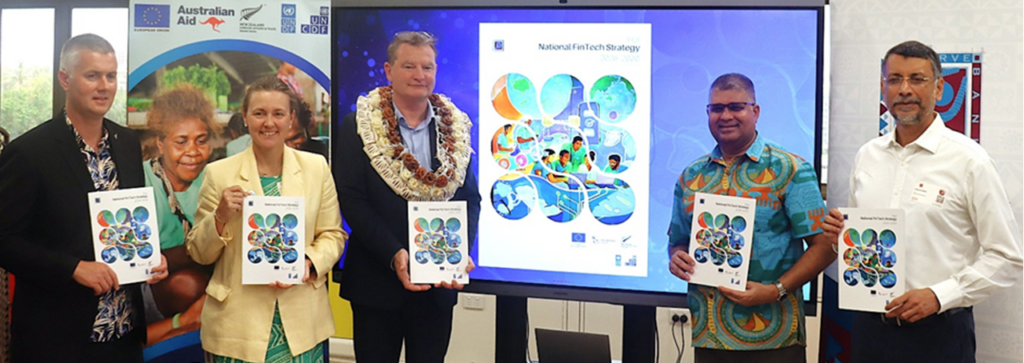
Fiji launched a five-year financial technology strategy on November 25, 2026, while its existing prohibition on virtual-asset service businesses remains an important regulatory boundary for Bitcoin. The Reserve Bank of Fiji announcement identifies payment interoperability, digital identity and financial inclusion as priorities. The roadmap concerns a wider financial technology ecosystem, not the legalization of Bitcoin exchanges. As with Eswatini’s payment modernization, digital financial innovation and cryptocurrency authorization remain separate policy questions.
What the five-year roadmap establishes
The National FinTech Strategy describes three broad workstreams: shared digital infrastructure, financial oversight and institutional capability. Its implementation framework calls for improvements to payment networks, identity verification, complaints handling and financial technology development. The upgraded real-time gross settlement system and mobile-wallet integration with FIJICLEAR began operating in 2024, according to the roadmap. Further interoperability remains an objective rather than a completed nationwide outcome.
Full interoperability across digital payment systems.
Reserve Bank of Fiji, Fiji National FinTech Strategy 2026–2030, launched November 25, 2026, p. 15, Pillar 1, objective 1.
The quoted objective concerns compatibility between payment systems. A QR code may encode a payment destination and other transaction parameters, but scanning the code does not itself settle funds. The participating wallet or bank must recognize the format, authenticate the payer and route the payment through an appropriate network. Common encoding reduces incompatibility at the point of sale without requiring a public blockchain.
Bitcoin service providers remain prohibited
Section 22(2) of the Reserve Bank of Fiji Act was amended with effect from August 30, 2025. The regulator’s September 5 notice explains that businesses providing virtual-asset exchange, transfer or custody services for customers fall within the prohibition. It also addresses related marketing, technical support and payment services directed toward Fiji residents. The notice identifies a maximum penalty upon conviction of FJ$1 million or 14 years of imprisonment. The November 2026 roadmap does not announce a reversal of the restriction.
carry on the business of a virtual asset service provider in Fiji;
Reserve Bank of Fiji, Press Release No. 15/2025, September 5, 2025, p. 1, clause (a), following the prohibition on natural or legal persons.
The prohibition applies to covered business services, including Bitcoin services. It should not be interpreted as a measured count of private Bitcoin holders. Regulatory conditions also differ from Estonia’s licensed provider regime, where authorization requirements changed the reporting population.
Existing digital payment activity
In its April 15, 2026 payment-system update, the central bank reported 957,816 registered e-money users at year-end 2025, including 722,340 active users. The reported annual transaction totals provide a baseline for assessing future network expansion.
| 2025 indicator | Reported value |
|---|---|
| Active e-money users | 722,340 |
| Wallet transactions | 116.4 million |
| Wallet transaction value | FJ$7.3 billion |
| QR payment value | FJ$672.3 million |
Bitcoin’s public consensus mechanism validates transfers without reliance on a domestic payment switch. Conventional wallet balances, by comparison, represent funds accounted for by service providers. A shared QR interface does not change the underlying settlement asset. The distinction also applies to Central Africa’s interoperable payment network and Egypt’s instant-payment expansion. Future evidence of a change in Fiji’s Bitcoin policy would require an applicable legal or regulatory instrument. Financial technology targets alone cannot establish permission to offer prohibited virtual-asset services.
Featured image: Stemoc, Government Buildings in Suva, August 2014, cropped, CC BY-SA 4.0. The video is linked to its original publisher; playback and desktop/mobile presentation were not independently tested.
We volunteer daily to ensure the credibility of the information on our platform is Verifiably True. If you would like to support our independent research, please scan the QR code below.



Leave a Reply