Gabon’s government presented a proposal to tax gas flaring and venting at its October 8, 2026 cabinet meeting. The official communiqué and Agence Gabonaise de Presse report that the measure would apply to gas released during hydrocarbon exploration, production and processing. The proposal comes as Capstone Energy+ prepares a gas-recovery power project for Maurel & Prom in Gabon. The relationship between waste-gas generation and flexible computing loads provides a basis for examining Bitcoin mining, as in our Mexican landfill methane mining analysis. No evidence establishes a Bitcoin mine at the Gabonese installation.
Converting associated gas into electricity
On July 22, Capstone announced a lease-to-own agreement to supply a C600S microturbine for an onshore oilfield. World Oil reported the agreement the same day. The generator is intended to serve the operator’s platform equipment, with commissioning originally expected in November 2026. An independently verified commissioning result was not located. The equipment therefore represents a contracted project, not confirmed available mining power.
Associated gas emerges alongside oil production. Where gathering pipelines or other productive outlets are unavailable, operators may burn the gas in a flare. Recovering it for electricity requires suitable fuel treatment, pressure regulation, combustion control and electrical distribution. Capstone’s C600S specifications list nominal electrical output of 600 kW and electrical efficiency of 33% on a lower-heating-value basis under reference conditions. Actual output varies with ambient temperature, fuel composition and operating conditions.
Manufacturer’s technical animation: Capstone C200 Microturbine Engine Animation. Explains the turbine mechanism; not footage of the Gabon installation. Original-host link used because embedded playback was not independently tested.
What a hypothetical mining load could consume
If a generator delivered 600 kW continuously, its theoretical annual production would be 5.256 GWh. At an illustrative 90% operating factor, the annual figure falls to approximately 4.73 GWh. Neither value establishes the energy available to a third party because platform equipment has its own demand.
Consider a separate hypothetical allocation of 60 kW to SHA-256 ASICs after all industrial demand and auxiliary power requirements are satisfied. At an assumed fleet efficiency of 15 J/TH, the allocation corresponds to 4 PH/s. At 10 J/TH, it corresponds to 6 PH/s. The more efficient fleet performs 50% more hashes per second under the same ASIC power allocation. These calculations assume constant operating efficiency and exclude networking and cooling loads outside that allocation. Our Power Efficiency Theory equations examine the broader relationship between hashrate and energy efficiency.
A mine could potentially reduce demand when platform loads increase or fuel flow declines. Flexible operation still requires a power-management system, protective relays, suitable communications and a documented operating envelope. The economics depend on electricity cost, equipment acquisition, uptime, mining difficulty and transaction-fee revenue. The Luxor variable-power mining analysis illustrates why operating schedules influence financial outcomes.
Gas recovery does not automatically eliminate emissions
The World Bank Global Gas Flaring Tracker 2026 documents flaring through satellite-based estimates. National estimates cannot be treated as an inventory of recoverable fuel at individual facilities. Recovering gas for a generator may reduce waste, but combustion still releases carbon dioxide, and upstream leakage or incomplete combustion can release methane. A credible environmental comparison must account for the original flare performance, generator emissions and the alternative electricity supply.
The IEA Global Methane Tracker also identifies Gabon among participants in the Zero Routine Flaring by 2030 initiative. Gabon’s separate Bitcoin regulatory context must be considered before assuming commercial mining authorization or access to banking services. A genuine mining deployment would require a documented agreement, installed hardware, measured electrical output and independently established hashrate. None was verified for the Maurel & Prom project.
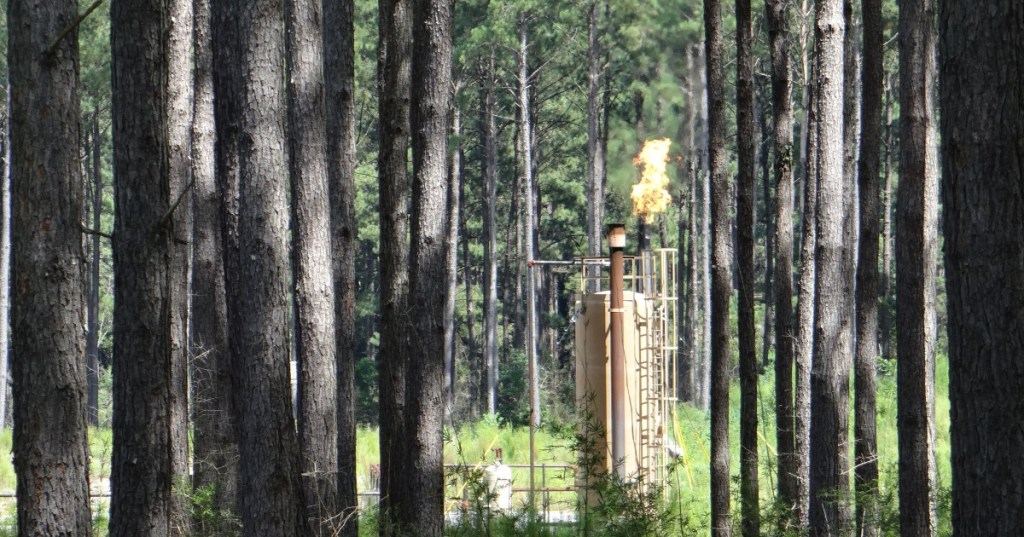
Featured photograph: Alex Demas / USGS, October 20, 2014, CC0, cropped. The pictured flare is in Mississippi, United States, and illustrates the process rather than the Gabonese site.
We volunteer daily to ensure the credibility of the information on our platform is Verifiably True. If you would like to support our independent research, please scan the QR code below.



Leave a Reply