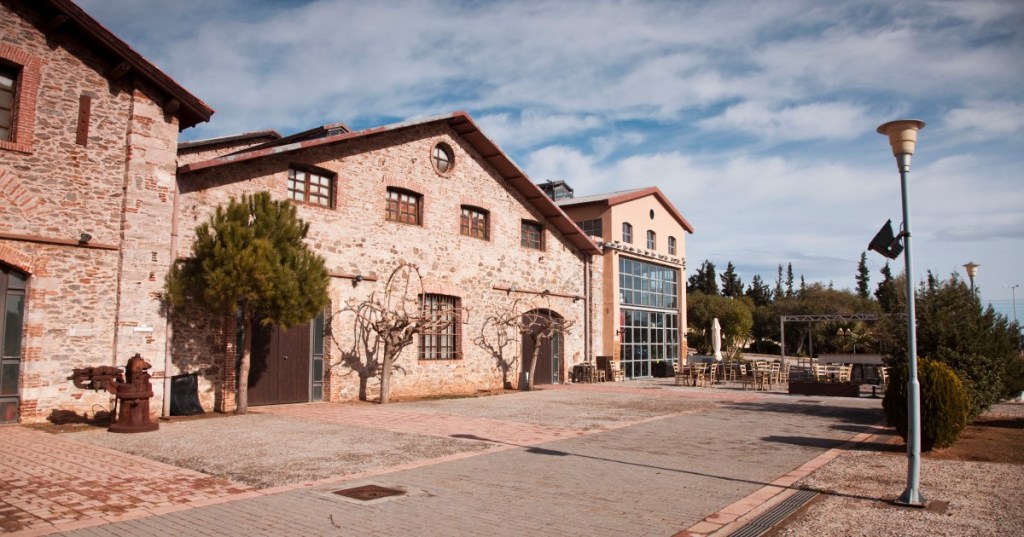
Greece inaugurated its national DAEDALUS supercomputer on October 19, 2026, at the Lavrion Technological Cultural Park. The November TOP500 ranking places the HPE system 34th worldwide, with a sustained benchmark result of 85.69 petaflops. The GRNET announcement identifies a December target for phased user access after configuration and testing. Unlike the still-planned Ghana national AI center, DAEDALUS has already produced published benchmark results.
Measured performance versus theoretical peak
The TOP500 record identifies an HPE Cray EX254n platform with NVIDIA GH200 Grace Hopper Superchips, Slingshot-11 networking and Red Hat Enterprise Linux. The EuroHPC Joint Undertaking reports more than 2,000 GH200 devices. Grace Hopper combines a CPU and accelerator with a high-bandwidth connection, allowing workloads to exchange data across processor and accelerator memory. Large distributed calculations additionally depend on communication between nodes.
The November listing reports a theoretical peak of 115.08 petaflops. Its sustained High Performance Linpack result corresponds to approximately 74.5% of that peak. Linpack evaluates double-precision numerical computation; neither figure measures language-model token throughput or SHA-256 hashrate. Software efficiency depends on algorithms, communication, numerical precision and memory movement. Our November supercomputing rankings analysis provides the broader benchmark context.
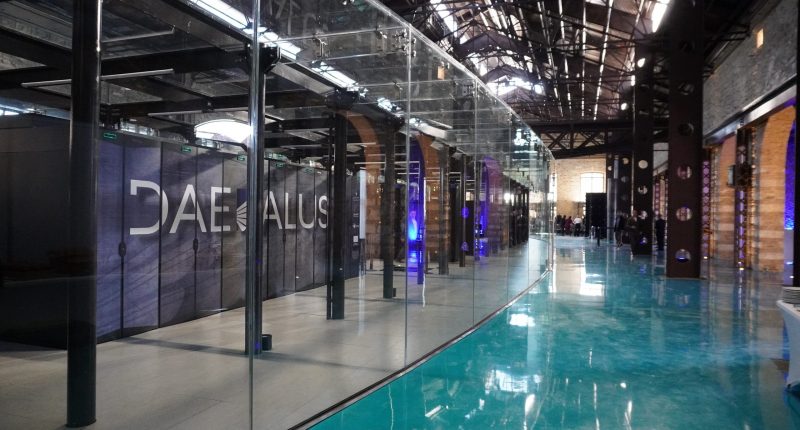
GRNET published a photograph of the actual DAEDALUS cabinets inside the converted industrial building on October 19. The original image is linked rather than reproduced because reuse permission was not established.
Energy efficiency and electrical capacity
The November Green500 lists DAEDALUS in 23rd position at 61.427 gigaflops per watt, with reported benchmark power of 1,395 kW. At that benchmark efficiency, one trillion counted floating-point operations would require approximately 16.3 joules within the reporting boundary. The measure cannot be compared directly with joules per terahash in Bitcoin mining because the underlying operations differ.
The converted Lavrion facility has an electrical capacity rating of 6.3 MVA, according to GRNET. Apparent power in volt-amperes is distinct from real power in watts; their relationship depends on power factor. The rating is also distinct from the benchmark power figure. Direct liquid cooling collects heat near the computing components, while suitable outdoor temperatures permit reduced mechanical cooling. A 2 MWp photovoltaic installation contributes to site self-consumption. Solar peak capacity cannot establish continuous supply or the annual renewable share without generation and demand records. Related cooling and energy accounting issues appear in our Leipzig AI data center coverage.
Funding and access to the PHAROS AI Factory
GRNET reports a total investment of €58.9 million including VAT, covering €41 million for computing, software, storage and training and €17.9 million for facility infrastructure. EuroHPC separately reports a €36 million acquisition cost; the figures have different stated scopes and should not be added. DAEDALUS supplies computing capacity to PHAROS, Greece’s AI Factory, whose focus includes health, language and culture, and sustainability. Prospective users will seek access through allocation calls. Scheduling policies and measured application performance will determine how much scientific work the installation can deliver. Our Georgian AI infrastructure report examines a separate cloud deployment with a newer accelerator architecture.
Further viewing: PHAROS: Greece’s First AI Factory, Athens Investment Summit 2026. Earlier project presentation; the original video is linked because in-page playback could not be independently tested. DAEDALUS is a general-purpose research supercomputer, not a cryptocurrency mining facility.
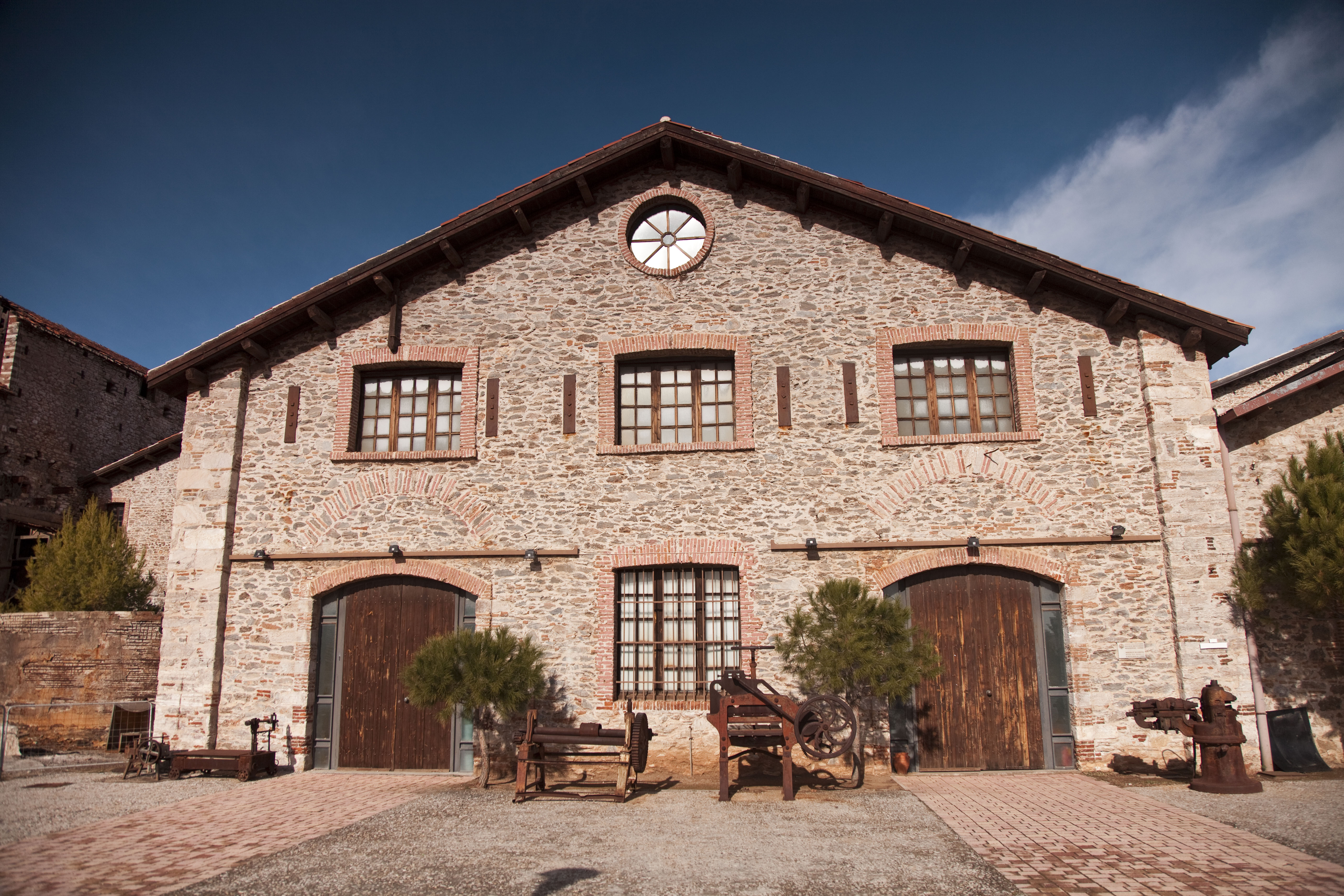
Featured photograph: Dr Tzeferis Petros, Lavrion Technological and Cultural Park, January 4, 2016, cropped, CC BY-SA 4.0.
We volunteer daily to ensure the credibility of the information on our platform is Verifiably True. If you would like to support our independent research, please scan the QR code below.





Leave a Reply