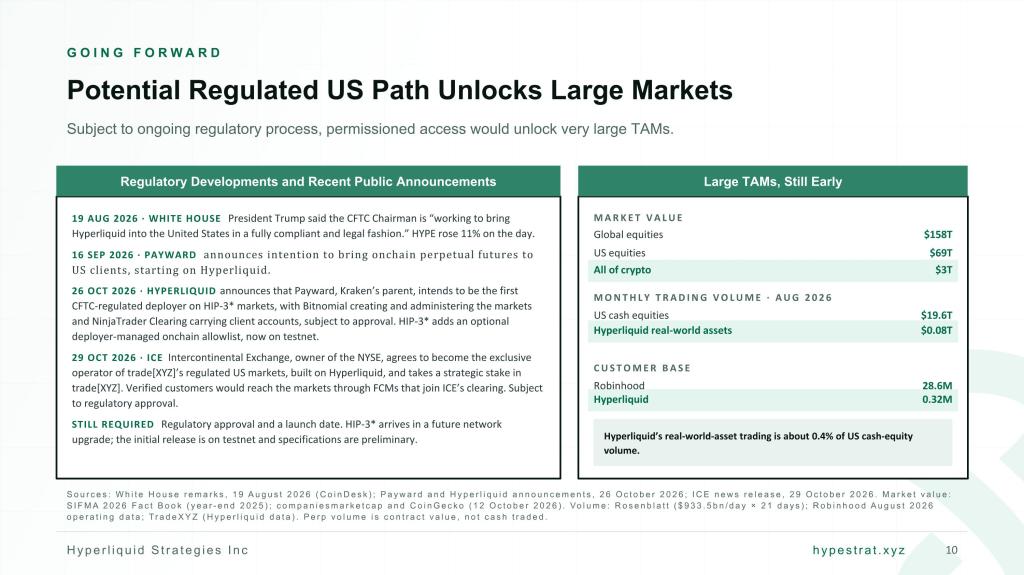
Intercontinental Exchange (ICE), the parent of the New York Stock Exchange, and Trade[XYZ] announced a definitive agreement on October 29, 2026, to develop a U.S. regulated perpetual futures market using Hyperliquid as its underlying blockchain infrastructure. The ICE announcement describes a planned market and clearing structure, not an operational U.S. trading venue. Regulatory approvals remain a prerequisite.
The engineering significance lies in separating financial market administration from transaction execution. Similar separation between institutional interfaces and blockchain settlement appears in PNC’s Ethereum USDC payment pilot, although the proposed Hyperliquid system addresses derivatives rather than corporate payments.
The blockchain beneath the exchange
Hyperliquid combines HyperCore, a specialized trading execution environment, with HyperEVM, an Ethereum-compatible smart-contract environment. Both share the HyperBFT consensus system. According to the protocol documentation, HyperCore handles trading primitives directly, while HyperEVM enables general-purpose applications. An order book maintains outstanding bids and offers; matching pairs compatible orders and updates positions. Margining evaluates collateral relative to risk, and liquidation rules handle positions that fall below required thresholds.
Unlike a conventional exchange that keeps its matching records inside proprietary systems, a blockchain-based market can expose transaction history through shared state. That does not automatically prove fair execution, eliminate latency advantages, or replace legally mandated supervision. Readers comparing execution architectures can also examine BNB Chain’s proposed low-latency layer-one architecture.
HIP-3* adds a market-specific permission layer
A November investor presentation by Hyperliquid Strategies, filed with the SEC, describes HIP-3* as an optional extension that allows market deployers to administer an onchain allowlist. The presentation identifies its initial implementation as testnet software with preliminary specifications. Existing HIP-3 markets are not intended to change under the extension.
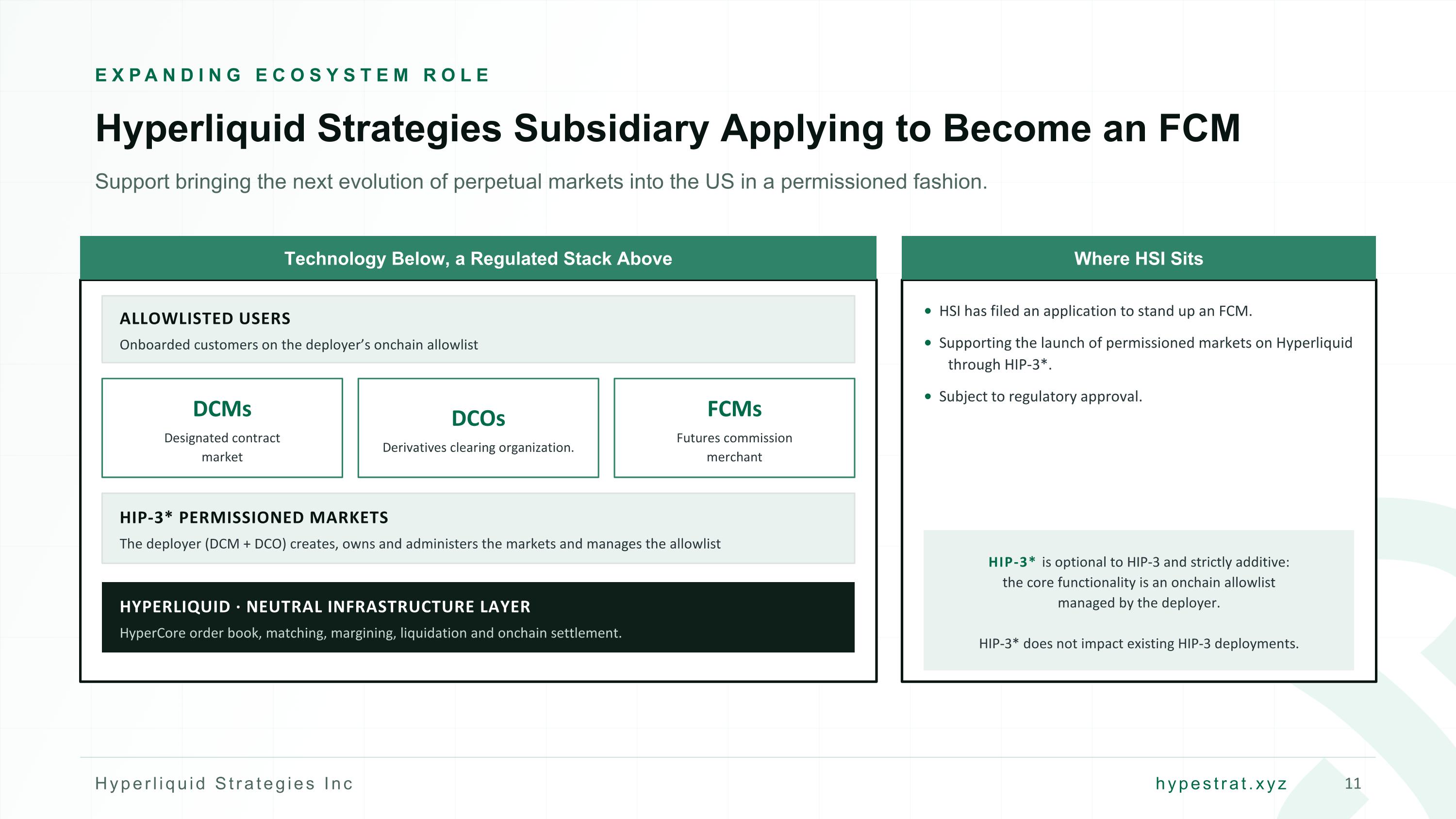
Under the proposed arrangement, eligible customers would access regulated markets through futures commission merchants. Trade[XYZ] supplies product and deployment expertise, ICE intends to administer regulated markets and clearing, and Hyperliquid provides trading infrastructure. An allowlist can restrict market participation at the protocol level, but identity verification, customer asset protection, record retention and regulatory reporting still require operational controls. The distinction between blockchain accessibility and legal authorization is also relevant to Abu Dhabi’s dedicated Bitcoin mining licensing guidance.
What engineers must measure before production
A regulated implementation needs more than a fast matching engine. Engineering validation should quantify order-to-acknowledgment latency, time to consensus finality, rejection rates during peak traffic and recovery after validator or network disruption. Median latency alone can hide severe tail delays; reporting the 95th and 99th percentiles provides a more meaningful view of reliability. A separate reconciliation process must establish that blockchain positions, broker records and clearing balances agree after execution.
Perpetual contracts have no fixed expiration and commonly use funding payments to help keep contract prices near their reference markets. For contracts referencing assets that do not trade continuously, oracle freshness and pricing behavior outside conventional market hours become critical design concerns. A contract referencing equity prices does not necessarily confer ownership of the underlying shares.
The next milestone is verification
Payward, Kraken’s parent company, separately announced its intention to deploy permissioned markets in September. Together, the proposals illustrate interest in shared market infrastructure, but neither corporate announcements nor a testnet specification establish production readiness. As with comparisons of prediction-market outcomes, market structure and measurement boundaries matter more than headline claims. The decisive milestones are regulatory authorization, a confirmed mainnet deployment, documented operational safeguards and independently measured performance.


Leave a Reply