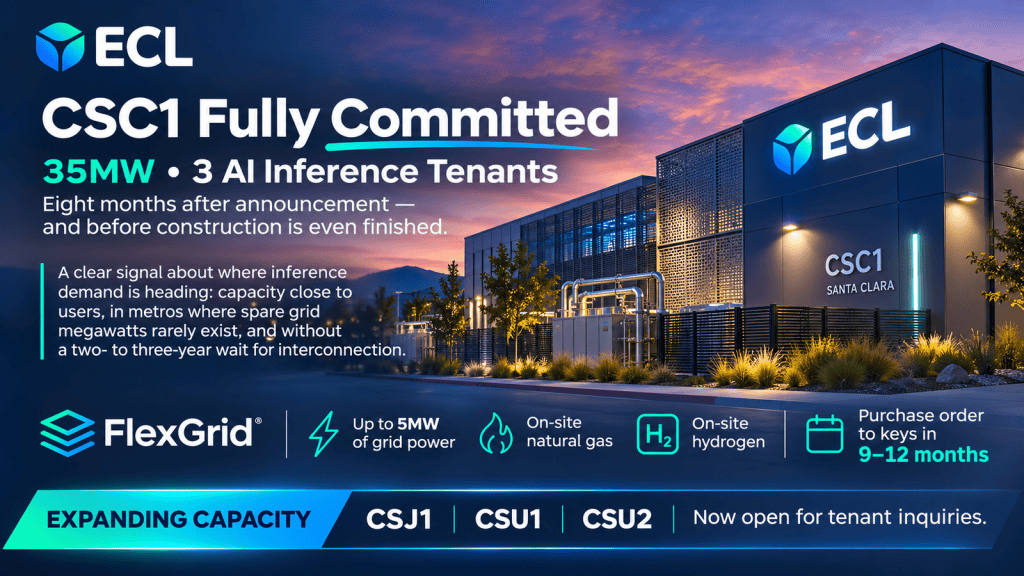
ECL announced on November 3, 2026, that three AI inference customers have reserved the entire advertised capacity of its CSC1 data center in Santa Clara, California. The company announcement describes a 35 MW facility with initial deployment scheduled for the first quarter of 2027 and completion anticipated in the third or fourth quarter. The commitments represent a commercial milestone before construction finishes, not an operating-load measurement. Like the planned Akashi data center, CSC1 is engineered around higher rack densities than many conventional facilities.
A microgrid rather than one power source
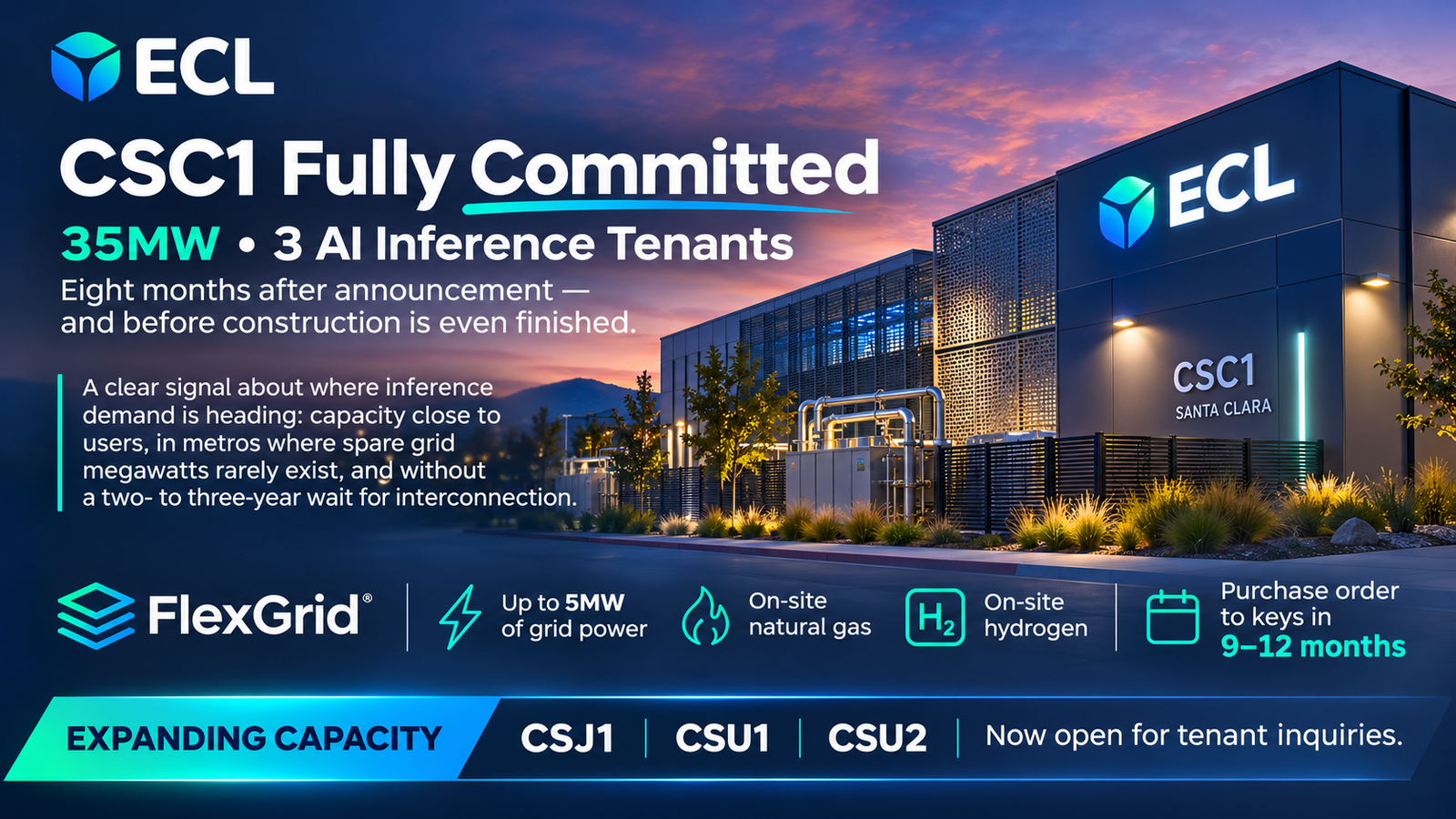
ECL describes a power architecture capable of integrating up to 5 MW of utility electricity, 30 MW of natural-gas generation and 5 MW of hydrogen generation. Batteries support short-duration disturbances and backup requirements. The individual maximum ratings sum to 40 MW, which exceeds the advertised 35 MW campus capacity. The figures represent source limits, not proof that all sources can deliver their maximum simultaneously. The operator has not disclosed a complete one-line diagram or an hourly dispatch schedule.
A microgrid controller must balance generation, consumption and storage while preserving acceptable voltage and frequency at the connected equipment. Batteries can supply rapid changes in demand while slower prime movers adjust output. Sustained operation still requires enough available generation, fuel and reserve capacity. The PJM large-load interconnection coverage illustrates the grid-side constraints that make alternative supply strategies attractive.
Cooling 150 kW racks
CSC1 is designed for initial rack densities reaching 150 kW, with a pathway toward 250 kW and higher, according to ECL. Direct-to-chip cooling carries heat away from processors through cold plates and a circulating fluid. At a hypothetical 150 kW heat load and a water temperature rise of 10 degrees Celsius, the ideal flow rate is about 3.59 kilograms per second, or approximately 215 liters per minute. Actual cold-plate flow depends on the fraction of heat captured by liquid, coolant properties and equipment specifications. The Hitachi cooling project illustrates a separate approach to reducing cooling overhead.
ECL also reports a power usage effectiveness figure below 1.15 for the design. At an illustrative PUE of exactly 1.15, 30 MW of IT demand would correspond to 34.5 MW of total facility demand, leaving 4.5 MW for non-IT loads. The example does not establish CSC1’s actual IT capacity or operating PUE. Fuel conversion losses and upstream hydrogen production are outside the ordinary facility PUE boundary.
What remains to be commissioned
Independent industry reporting corroborates the customer commitments. ECL has also described future Bay Area inference facilities, while PowerCell’s July announcement differentiates a firm fuel-cell order from a separate nonbinding expansion framework. Neither a lease nor a fuel-cell order proves successful integrated operation.
Commissioning evidence should include sustained load testing, cooling-loop performance, electrical transfer behavior, fuel supply resilience and independently measured energy consumption. Onsite natural gas also produces emissions, and hydrogen’s lifecycle footprint depends on production and transport. As with other staged AI infrastructure projects, CSC1’s next meaningful milestone is verified delivery of usable computing capacity rather than an increase in announced megawatts.


Leave a Reply