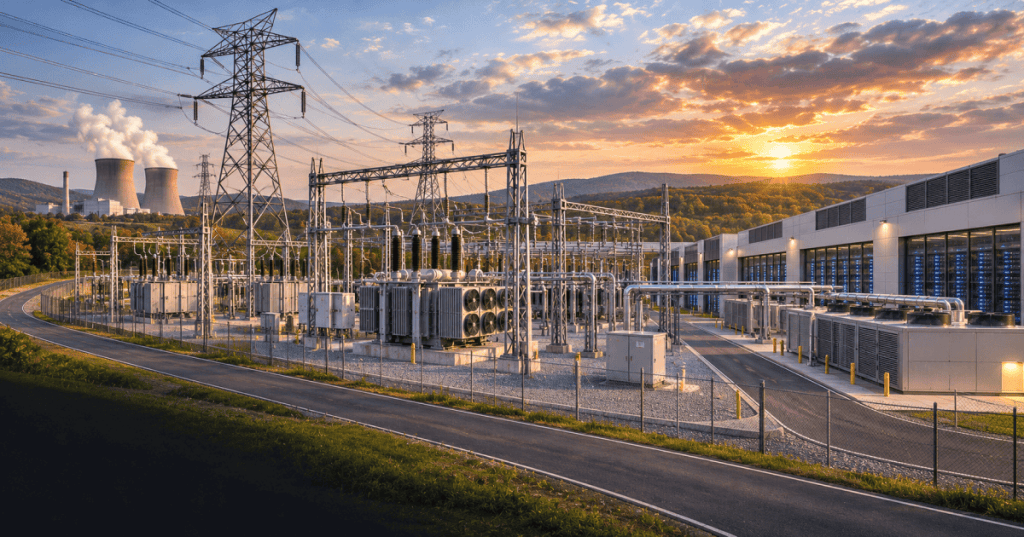
PJM Interconnection submitted a proposal to the Federal Energy Regulatory Commission on November 16, 2026, to combine studies for new electricity generation and major power consumers. Under the proposed Fast Energization Process, the regional grid operator projects a reduction in study duration from two years to one. The PJM announcement describes a change in transmission planning rather than a guarantee of earlier electrical service. Large Bitcoin mining operations and AI campuses compete for many of the same electrical resources, as illustrated by our coverage of Bitdeer’s proposed Ohio AI campus.
Why generation and load need coordinated studies
A utility-scale computing campus creates demand for power, while a generator supplies it. Neither can be evaluated solely by comparing its nameplate megawatt rating with the other. Transmission studies must determine whether lines and transformers can carry the resulting power flows under normal operation and after credible equipment outages. The location of generation, electrical topology and operating schedule can change which equipment requires reinforcement.
PJM proposes to evaluate generation and large-load service requests within a common process, reducing repeated analysis. Its filing is identified as docket ER27-531-000. The operator also proposes earlier readiness and financial requirements to limit speculative applications. A shorter study cannot remove the time needed to obtain permits, manufacture transformers, build transmission facilities or complete commissioning.
Flexible computing and co-located generation
The proposal includes new transmission service options for facilities located alongside generation and for large consumers capable of limiting grid withdrawals. A Bitcoin mine can reduce its electrical demand by shutting down mining equipment or adjusting supported operating parameters. The economic trade-off is forgone mining output during curtailment, which our report on West Texas electricity prices and mining profitability explores in a different regional market.
AI workloads have different flexibility constraints. Training jobs may be checkpointed or scheduled around power availability, while interactive inference services may require continuous availability to satisfy contractual performance requirements. Co-located generation can reduce reliance on external electricity, but a facility must still account for generator outages, maintenance and backup supply. Grid connection is valuable precisely when local generation cannot meet demand.
A shorter study does not guarantee lower costs
PJM says its plan would improve visibility into the transmission improvements attributable to new large consumers. Reuters reported that industry representatives have expressed concern that combining studies could introduce complications and delays. The actual results will depend on implementation, the volume of applications and the engineering work required. A proposed 12-month study is a planning target, not an independently measured completion time.
Separate proposals address how large computational loads behave during electrical disturbances. Our earlier reporting on NERC’s proposed reliability standards explains the distinction between connecting a new facility and operating it reliably. The related ERCOT hardware-model testing illustrates another regional approach to validating load behavior.
PJM requested a 60-day comment period and a regulatory decision within 120 days. Those requests do not establish approval or an implementation date. Developers should continue to distinguish requested power, studied capacity, executed service agreements and energized equipment. The proposal could improve coordination between electricity supply and computing demand, but its effectiveness remains a question for subsequent regulatory decisions and operating evidence.


Leave a Reply