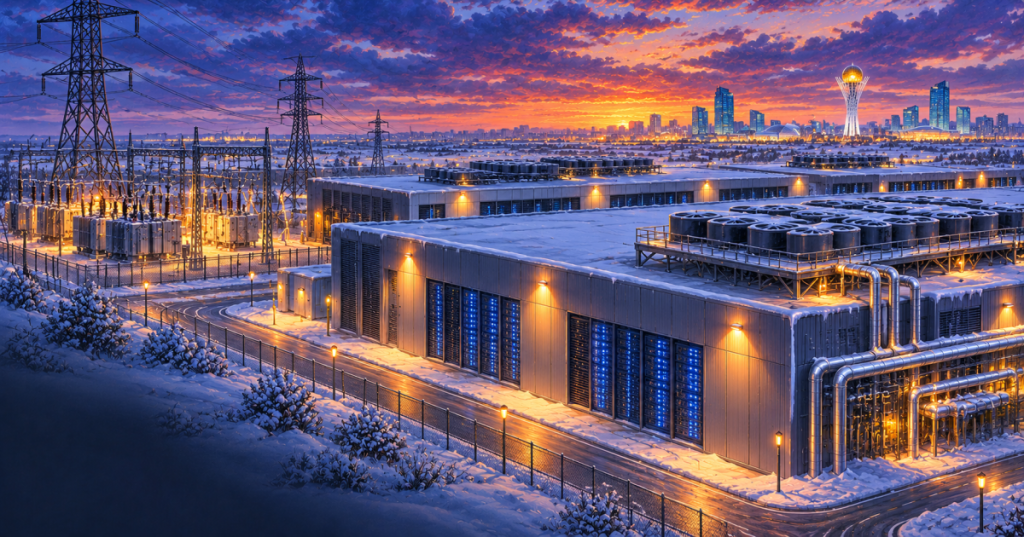
Akashi Data Center PLC is building a four-module campus in Astana, Kazakhstan, with up to 100 MW of allocated electrical capacity. Its November 23 technical disclosure outlines the power system, while a November 27 Data Center Dynamics feature describes plans to recover heat from liquid-cooled accelerators. The approach resembles heat recovery in Nordic Bitcoin mining installations, although the Astana project serves broader computing workloads and has not yet commissioned its AI module.
Design capacity is not operational capacity
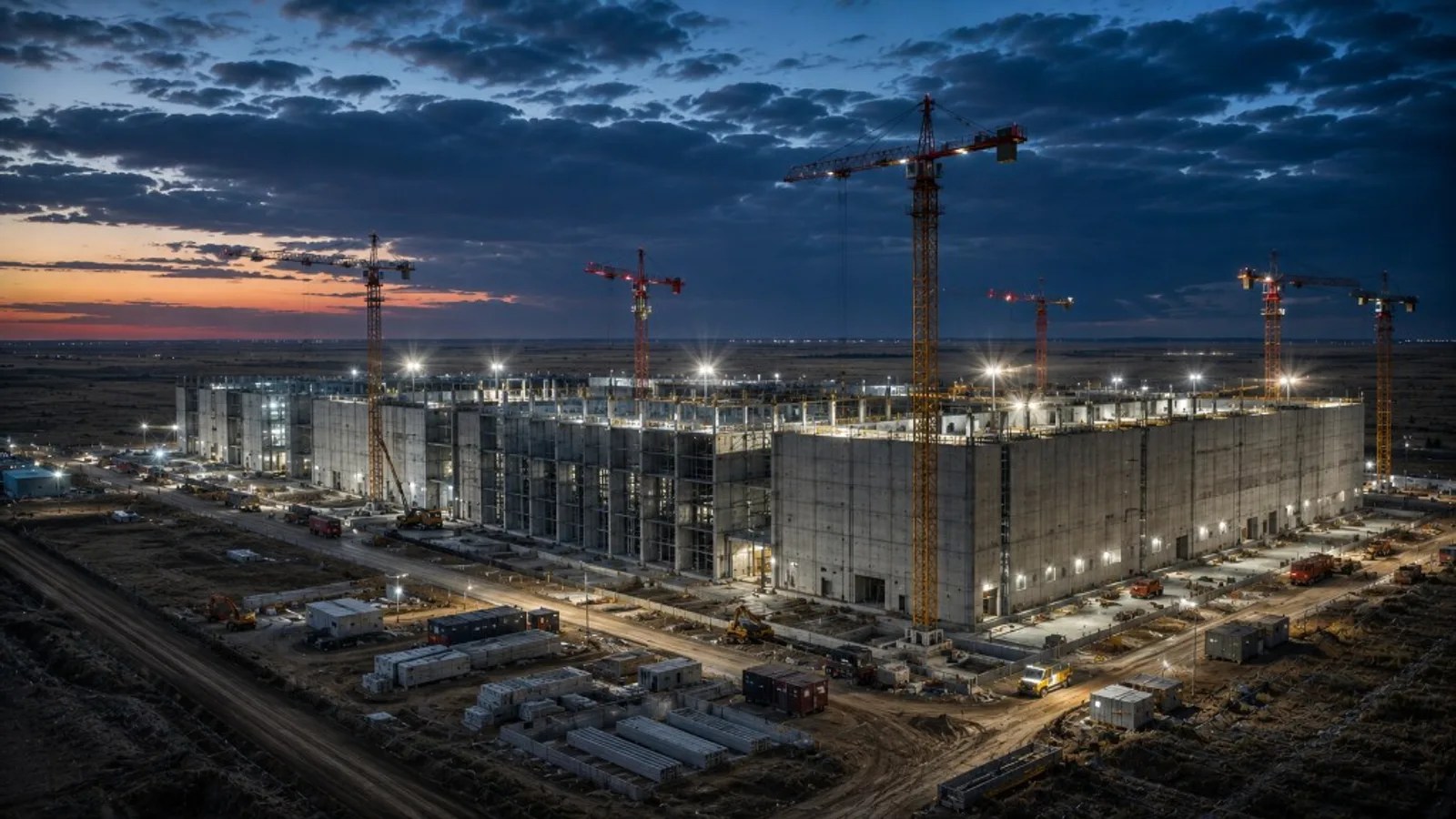
The developer’s September construction report estimates investment at $354 million and describes a potential 4,224 racks across more than 11 hectares. The first module, DC-1, is designed for 5.28 MW of IT load. Its construction tracker targets a May 2027 launch. The 100 MW campus allocation includes power for the overall development and should not be reported as an energized IT load.
Akashi’s November 9 engineering disclosure lists maximum rack densities of 15 kW for DC-1, 30 kW for DC-2 and DC-3, and 150 kW for DC-4. The last figure represents ten times the first module’s design ceiling. Actual installed rack density will depend on customer equipment, cooling arrangements and electrical distribution. The developer lists up to 30 MW of IT load for DC-4; the November 27 feature gives 45–50 MW without clearly establishing the same measurement boundary. The figures cannot be reconciled as equivalent IT capacity on available evidence.
Using climate and coolant to manage heat
The November feature describes plans to use low outdoor temperatures for compressor-free cooling during approximately seven to eight months annually. Free cooling reduces reliance on refrigeration compressors when outdoor conditions permit, although pumps and fans still consume electricity. The expected availability is an engineering projection rather than a measured annual energy saving.
The proposed AI hall will transfer heat from accelerator equipment into a liquid circuit. Warm coolant approaching 60°C could support building heating through heat exchangers. Whether the recovered energy displaces conventional heating depends on the temperature requirements of receiving systems, seasonal demand, heat losses and the utilization of computing equipment. A similar challenge is discussed in our report on Empire AI’s Buffalo heat-recovery plans.
Electrical redundancy and commissioning
Akashi’s November 23 power-system description specifies two 110 kV utility feeds, five UPS modules for a four-module load, battery autonomy of up to ten minutes and generator fuel capacity for twelve hours at full load. Losing one UPS module would leave four available in the stated arrangement. Successful failover still depends on the distribution topology, protection coordination and integrated system testing, as explained in our UPS commissioning lesson.
The first module has Tier IV design-document certification, according to Akashi. Certification of the constructed facility remains a separate milestone. As with the Odessa AI campus development, the relevant evidence will be commissioned equipment, accepted customer capacity and operational performance. Until those milestones are documented, power redundancy, heat recovery and rack density remain design specifications rather than demonstrated operating results.


Leave a Reply