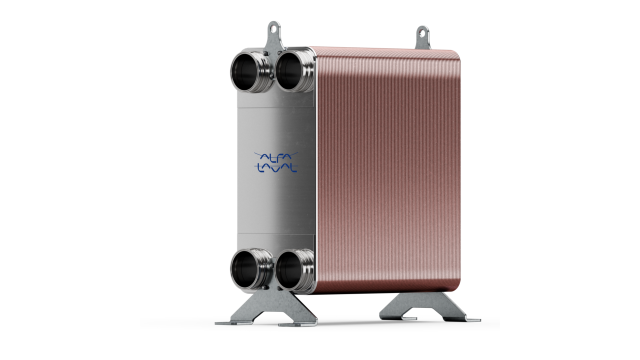
Alfa Laval published a November 20, 2026 product announcement for the CB450, its largest copper-brazed plate heat exchanger, with a manufacturer-rated liquid cooling duty of up to 2.5 MW. The announcement targets coolant distribution systems, industrial heat pumps and district heating. Thermal management is an increasingly important infrastructure constraint for dense computing installations, including the 22.5 MW Finnish data center opened by XTX Markets. No deployment of the CB450 at that facility has been established.
How brazed plates transfer heat
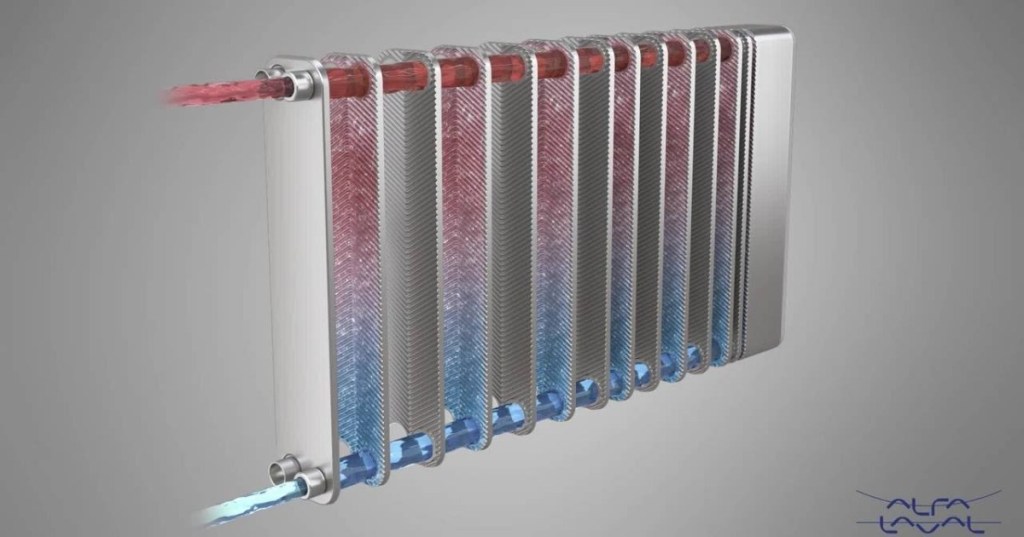
A plate heat exchanger separates two fluid streams with thin metal walls. Corrugations create additional surface area and influence flow behavior, helping transfer energy between the streams without intentionally mixing them. Copper brazing joins adjacent plates and seals the flow channels. Unlike a gasketed exchanger, a brazed assembly generally cannot be opened for individual plate cleaning. Fluid chemistry, filtration and maintenance planning therefore influence equipment selection.
Countercurrent flow places the incoming hot fluid near the outgoing cooler stream, maintaining a useful temperature difference along the exchanger. A larger temperature difference can reduce the required transfer surface for a given duty, but fluid velocity, pressure drop and fouling also affect performance. The relationship complements our explanation of heat-pump temperature lift.
What 2.5 MW means for cooling water
Thermal duty is the rate at which heat moves between fluids, not the exchanger’s electricity consumption. For an illustrative water loop, the energy balance is Q = ṁ × cp × ΔT. Using an assumed specific heat of 4.18 kJ/(kg·K) and a 10 K water-temperature rise, transferring 2.5 MW requires approximately 59.8 kg/s of water, or about 215 cubic meters per hour at an assumed density of 1,000 kg/m³. At a 5 K rise, the corresponding flow doubles to about 119.6 kg/s. Neither calculation is a manufacturer-specified flow rating or a measured result.
The same energy balance governs liquid cooling for specialized computing equipment, including hydro-cooled Bitcoin mining infrastructure. A heat exchanger alone cannot reject heat to the environment without a suitable downstream sink. Pumping energy and facility-level cooling efficiency depend on the complete system.
Industrial applications and commissioning
The CB450 product specification identifies connections up to six inches and applications in district heating substations with duties of approximately 2–5 MW. Those ratings depend on the selected service conditions and should not be substituted for the liquid-cooling rating. Refrigeration Industry’s November 18 coverage also reports the product launch. Heat recovery proposals such as Sweden’s proposed AI factory and district heating integration illustrate another potential application of exchanger technology.
Before procurement, engineers should obtain duty-specific selection data, verify allowable pressure and temperature, assess fluid compatibility and evaluate pressure losses on both sides. A larger unit may simplify piping, but redundancy and serviceability remain important. The announced capacity represents an equipment offering rather than independently verified operating performance.
We volunteer daily to ensure the credibility of the information on this platform is Verifiably True. If you would like to support to help further secure the integrity of our research initiative, please scan the QR code below.



Leave a Reply