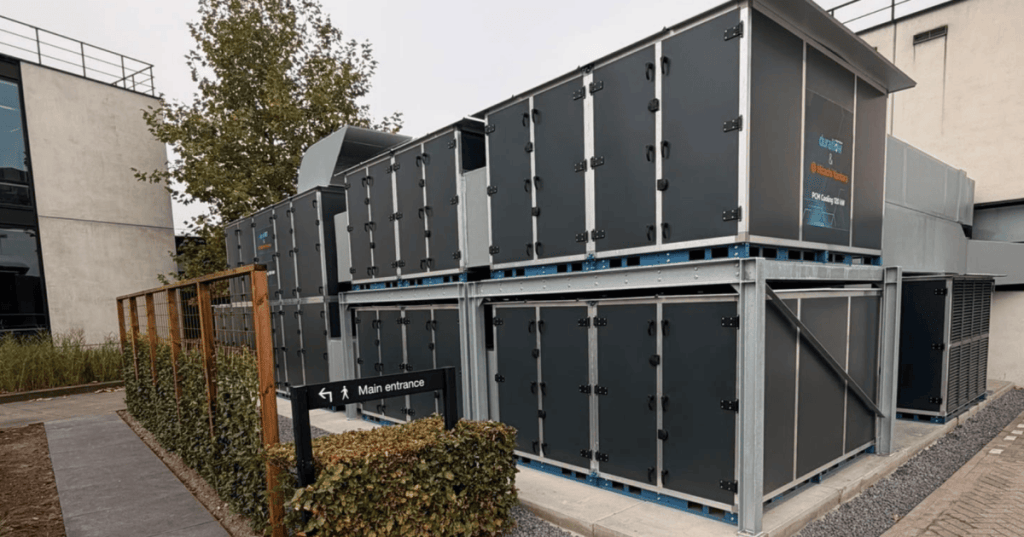
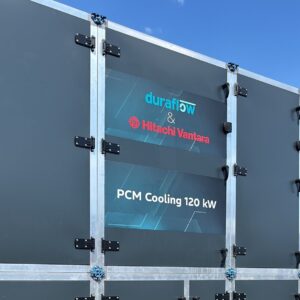
Hitachi Vantara has installed thermal-energy storage equipment at its Zaltbommel data center in the Netherlands to reduce the electricity diverted from computing to cooling. Its October 27, 2026 announcement describes two 120 kW cooling units from Dutch specialist Duraflow. Company monitoring indicates that the pair draws 5–8 kW of electricity. The companies estimate conventional direct-expansion refrigeration would require 60–80 kW of compressor power for comparable cooling capacity. The conventional baseline is estimated rather than separately metered.
Why thermal storage can reduce electricity costs
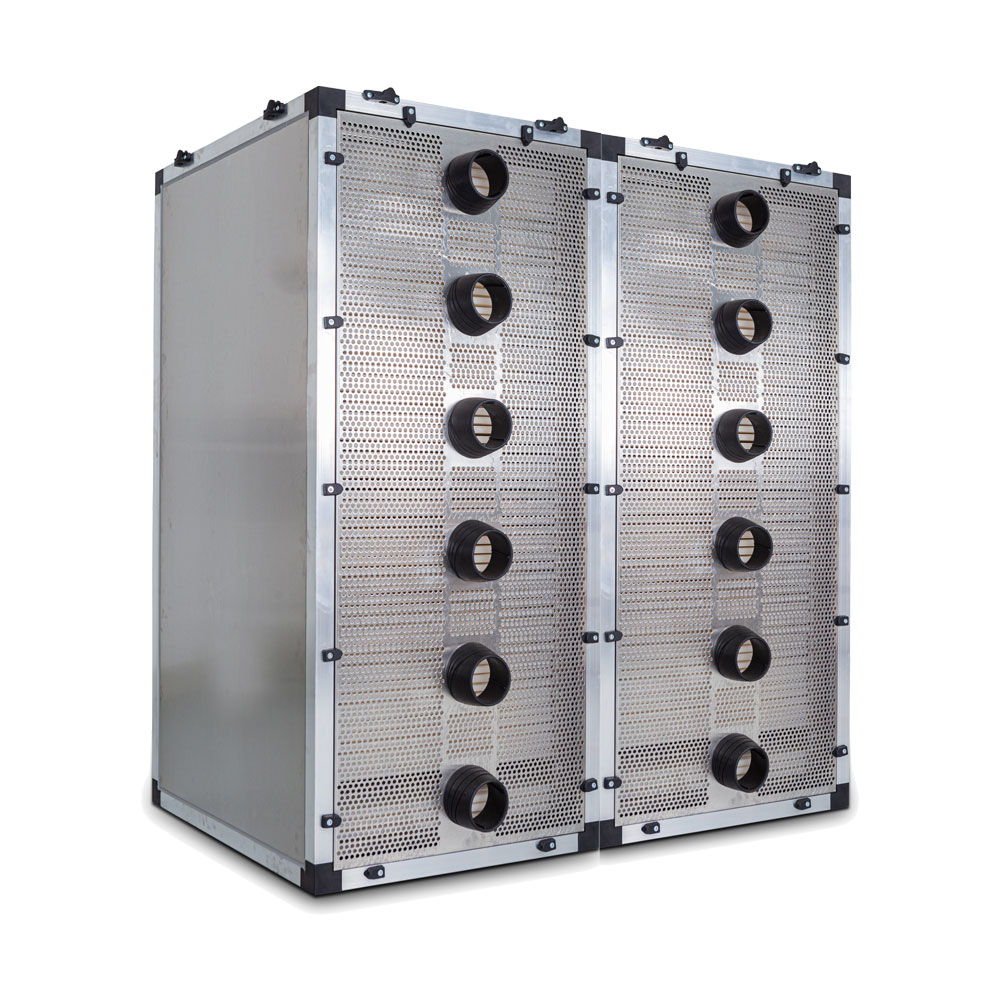
A conventional refrigeration system uses a compressor to raise refrigerant pressure and temperature so heat can be rejected outside the conditioned space. Phase-change materials absorb thermal energy as they melt and release energy when they solidify. Their latent heat capacity lets them absorb substantial heat over a relatively narrow temperature range. Favorable outdoor conditions can allow regeneration of the storage material with less mechanical refrigeration. Fans and other auxiliary equipment still consume electricity, and accumulated heat must eventually leave the facility.
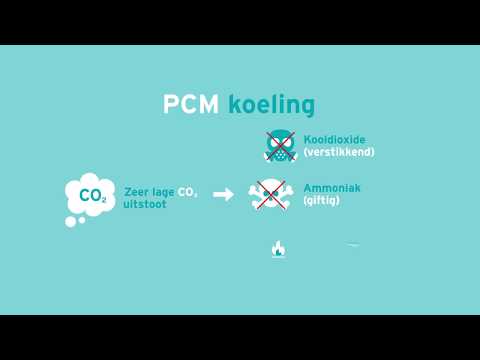
Duraflow’s design addresses the timing and electrical expense of heat removal. The companies describe water-free operation for the installed cooling equipment, not necessarily for every other system at the facility. Their claimed reduction of up to 90% concerns thermal management, not total data-center electricity consumption.
What the project could save in dollars
Subtracting the reported equipment draw from the estimated compressor requirement gives a conditional difference of 52–75 kW. If maintained for 8,760 hours annually, it would represent 455,520–657,000 kWh. At a hypothetical electricity price of $0.07/kWh, the gross electricity expense avoided would be $31,886–$45,990 per year. At $0.10/kWh, the corresponding range would be $45,552–$65,700.
The annualized calculations are scenarios, not verified utility savings. They exclude installation expense, regeneration energy outside the monitored boundary, maintenance, demand charges and differences in auxiliary consumption. Industry reporting also distinguishes operational measurements from the modeled baseline. A payback calculation requires capital cost and year-round comparable measurements, which were not disclosed.
More computing without buying more grid capacity
A grid-constrained facility can use reduced auxiliary demand to lower electricity expenses or allocate additional electrical capacity to computing. Both benefits cannot be counted in full if new equipment consumes the released power. Bitcoin miners face the same choice. An illustrative 60 kW of released capacity could support 6 PH/s of ASIC equipment rated at 10 J/TH, before additional overhead. The Dutch installation itself is not a Bitcoin mining project.
Related engineering coverage includes Alfa Laval’s 2.5 MW heat exchanger, planned heat recovery at Kazakhstan’s Akashi campus, CryptoStar’s mining shutdown amid rising power costs and LuxOS idle recovery power reductions. Each illustrates a different way infrastructure efficiency influences the economics of computation.
The next engineering question is whether the thermal store can sustain savings during hot weather and prolonged utilization without exhausting its storage capacity. Fair comparisons require equivalent cooling loads, climate conditions, reliability requirements and complete electrical measurement boundaries. The operating example is promising, but does not establish a 90% reduction in every AI facility’s total electricity bill.
Featured image: Duraflow project publicity image, cropped to landscape.
We volunteer daily to ensure the credibility of the information on our platform is Verifiably True. If you would like to support our independent research, please scan the QR code below.



Leave a Reply