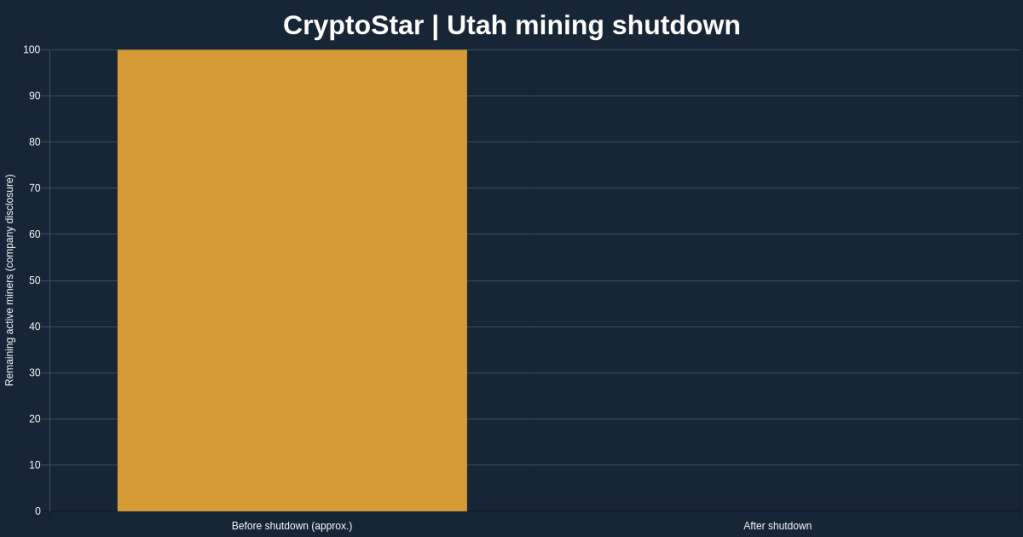
CryptoStar switched off approximately 100 remaining operating Bitcoin miners in Utah on November 23, 2026, after higher electricity costs and weaker Bitcoin prices made the machines unprofitable. Its November 27 shareholder announcement also confirms that associated cooling and networking equipment was shut down. Essential protective systems remain active. The decision illustrates the sensitivity of mining operations to electricity pricing, particularly following the recent Bitcoin difficulty increase.
How a tariff change affects mining economics
Mining revenue depends on delivered hashrate, network competition, transaction fees and Bitcoin’s exchange value. Electrical expense depends on total power draw, operating hours and the applicable tariff. Even before overhead is considered, an increase in the energy rate can eliminate the margin available to support a marginally profitable fleet. The company did not disclose the revised tariff or the specifications of the remaining machines.
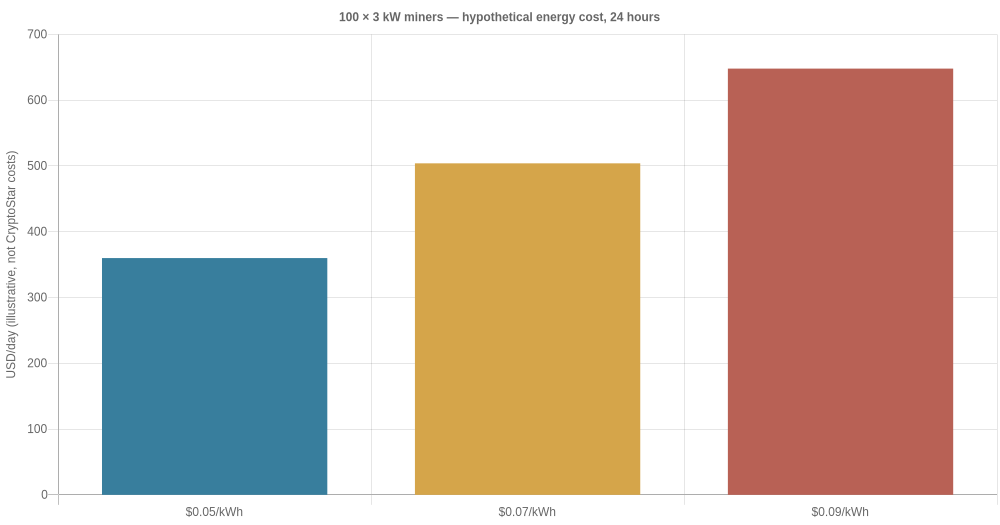
For illustration, 100 machines consuming 3 kW each would draw 300 kW and use 7,200 kWh over 24 hours. Energy expense would be $360, $504 or $648 per day at respective tariffs of five, seven or nine cents per kWh. The difference between the lowest and highest rates is $288 daily. Real costs also depend on demand charges, power factor, cooling and uptime. Our Sterling West Texas mining report provides a separate example of power procurement economics.
A historical precedent in Quebec
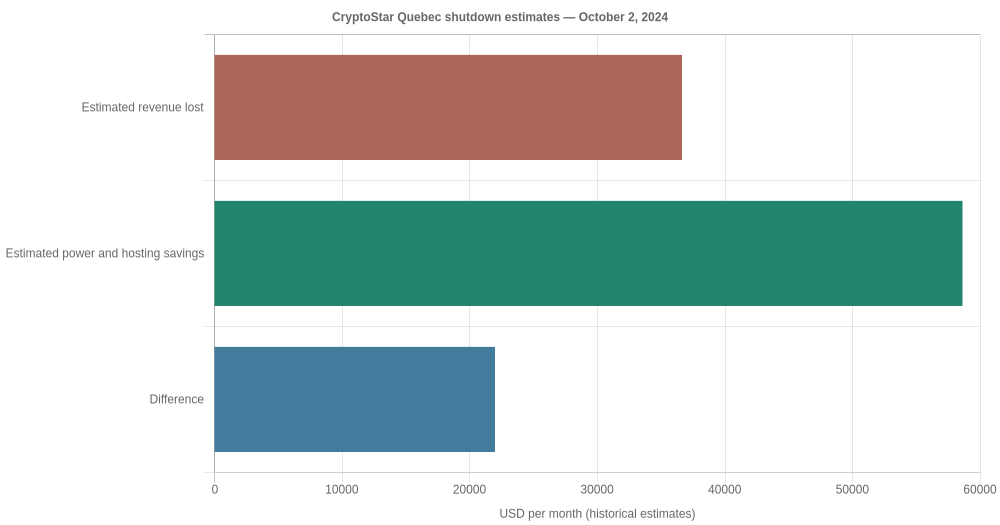
CryptoStar’s October 2, 2024 operations report estimated that shutting down its Quebec ASIC fleet reduced monthly revenue by $36,630 but saved $58,603 in hosting and electricity expenses. The arithmetic difference was $21,973 per month before other changes. It is not an audited profit figure or an estimate for Utah. Modular facilities, such as the 96-ASIC mobile mining infrastructure covered earlier, face related utilization and operating-cost decisions.
AI hosting remains conditional
CryptoStar signed a strategic partnership on November 19 with an unnamed US AI infrastructure provider. The proposed Utah hosting business requires project funding, municipal and licensing approvals, signed project schedules and applicable landlord consent. The agreement itself provides neither working capital nor customer revenue. As with the proposed Québec mining-to-HPC conversion, available electrical infrastructure does not guarantee an operational AI facility.
CryptoStar also reports limited liquidity and a need for new funding or payment deferrals to meet December obligations. The temporary local data-center regulation is expected to expire in March 2027, but expiry does not confer approval. Independent reporting by Crypto Briefing corroborates the shutdown. The immediate operational fact is the cessation of remaining self-mining; financing and the replacement hosting business remain unresolved.
We volunteer daily to ensure the credibility of the information on this platform is Verifiably True. If you would like to support to help further secure the integrity of our research initiative, please scan the QR code below.



Leave a Reply