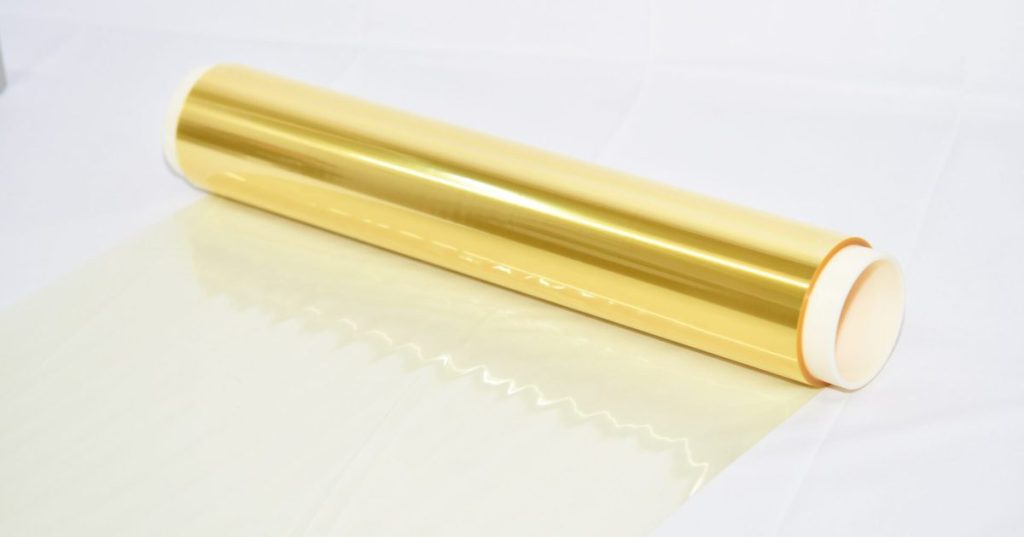
Japanese materials supplier Resonac announced its RR-X photosensitive dielectric film on November 25, 2026, targeting mass production in 2027. The company’s development report describes electrical insulation tests on conductors measuring 1.5 micrometers in width and separation, alongside thermal cycling tests on 10-micrometer vias. The material is intended for panel-level semiconductor packaging, a manufacturing approach covered in our analysis of advanced packaging investment.
Packaging beyond the silicon wafer
Chiplets allow designers to combine separately fabricated dies in a single package. An interposer provides electrical pathways between those dies, enabling communication across distances greater than the wiring inside an individual processor. Our reporting on IBM and Micron’s hybrid-bonded memory research illustrates another way of combining distinct semiconductor structures.
Manufacturers can process organic interposers on rectangular panels instead of circular wafers. The potential advantage is more efficient placement of large rectangular structures, although yield, flatness, thermal expansion and alignment accuracy remain decisive. Wafer dimensions matter for material economics as well, as discussed in our aluminum nitride wafer comparison. Larger processing surfaces alone do not guarantee lower cost per good package.
Fine wiring and aqueous development
RR-X is supplied as a photosensitive film that can be laminated, patterned by light exposure, developed in an aqueous alkaline solution and cured. The stated cured thickness spans 5–20 micrometers. Patterning removes selected material to form openings for electrical connections between layers. Using a process familiar to printed circuit board manufacturers may simplify integration, but the material still requires process-specific qualification.
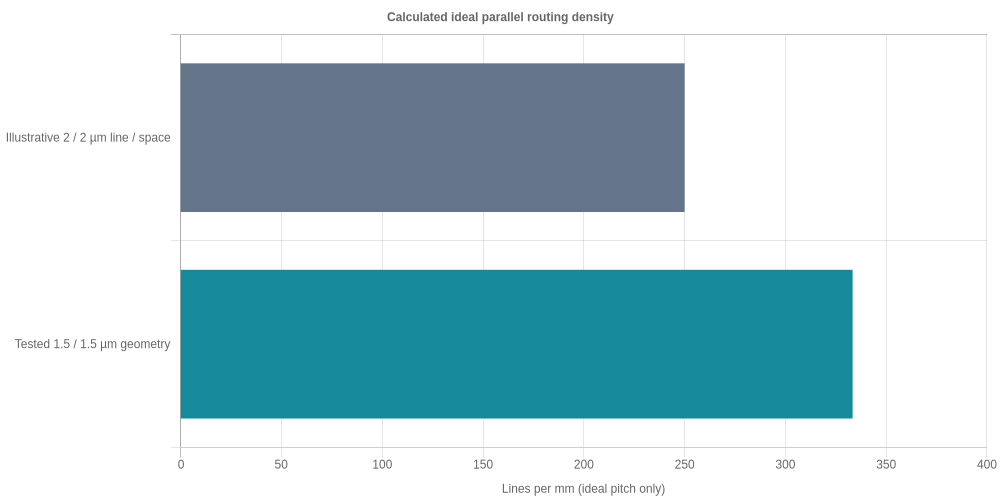
A repeated pattern of 1.5-micrometer conductors separated by 1.5-micrometer gaps has a 3-micrometer pitch. Ignoring edge effects, one millimeter could accommodate approximately 333 parallel routing pitches. An illustrative 2-micrometer conductor with a 2-micrometer gap gives 250 pitches per millimeter. The finer geometry therefore offers approximately 33.3% more ideal linear routing density. Neither calculation measures production yield or achievable routing capacity in a complete package.
Reliability under electrical and thermal stress
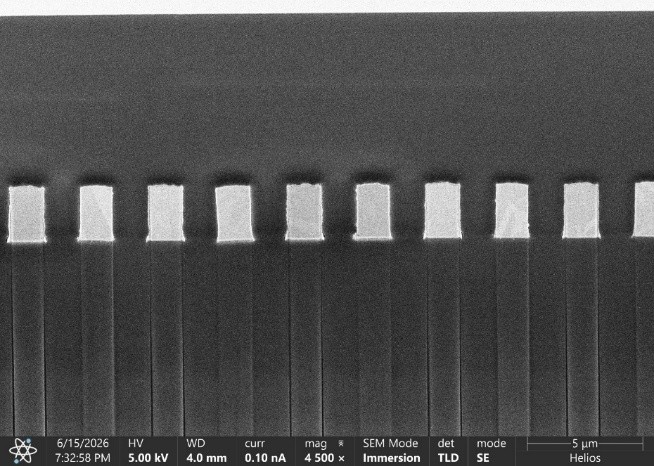
Resonac reports that its biased accelerated humidity test ran for 192 hours at 130°C, 85% relative humidity and 3.3 V without observed migration or delamination. Electrical bias in a humid environment can encourage conductive paths to develop across dielectric gaps, so testing the narrow spacing is important.
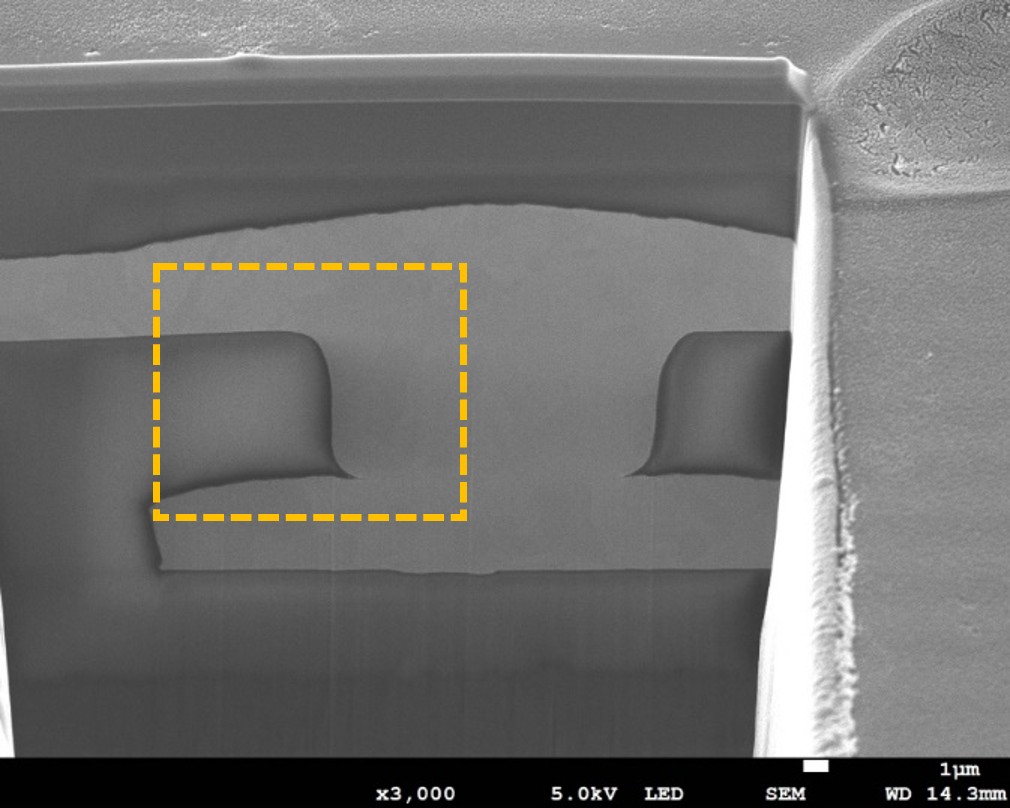
Separate testing of 10-micrometer vias involved 1,000 temperature cycles between −65°C and 150°C. Resonac reports resistance variation below 2%, with no observed cracking or delamination. The VLSI Korea technical analysis notes that customer qualification and production scale remain undisclosed.
As advanced assembly research expands, including the Applied Materials and Intel research collaboration, dielectric reliability becomes an increasingly important part of system performance. RR-X offers promising laboratory evidence, but commercial adoption will depend on manufacturing repeatability, independent qualification and the ability to preserve fine geometry across large panels. The 2027 production date remains a target, not confirmation of current volume shipments.
Featured photograph: Resonac RR-X film, official November 25 announcement, cropped.
We volunteer daily to ensure the credibility of the information on this platform is Verifiably True. If you would like to support to help further secure the integrity of our research initiative, please scan the QR code below.



Leave a Reply