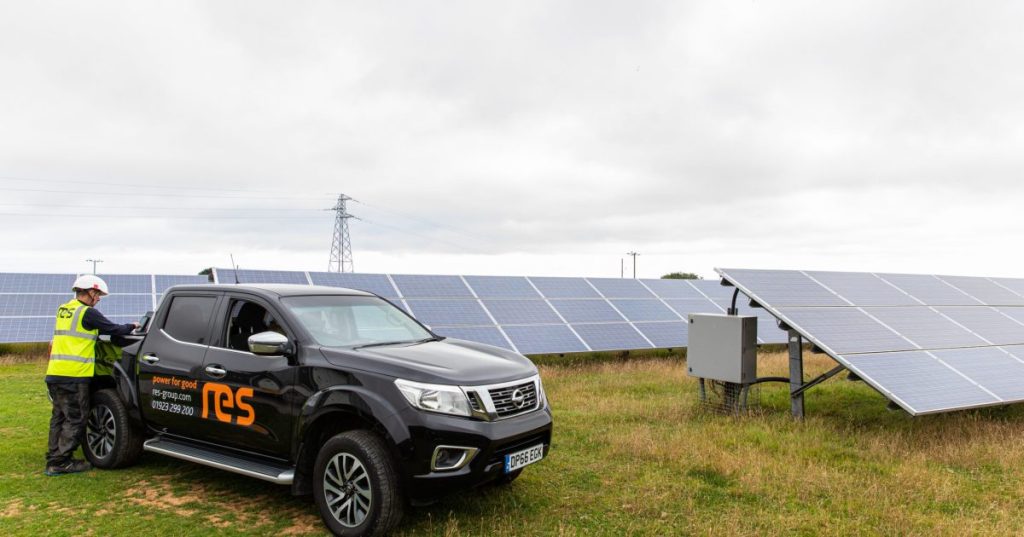
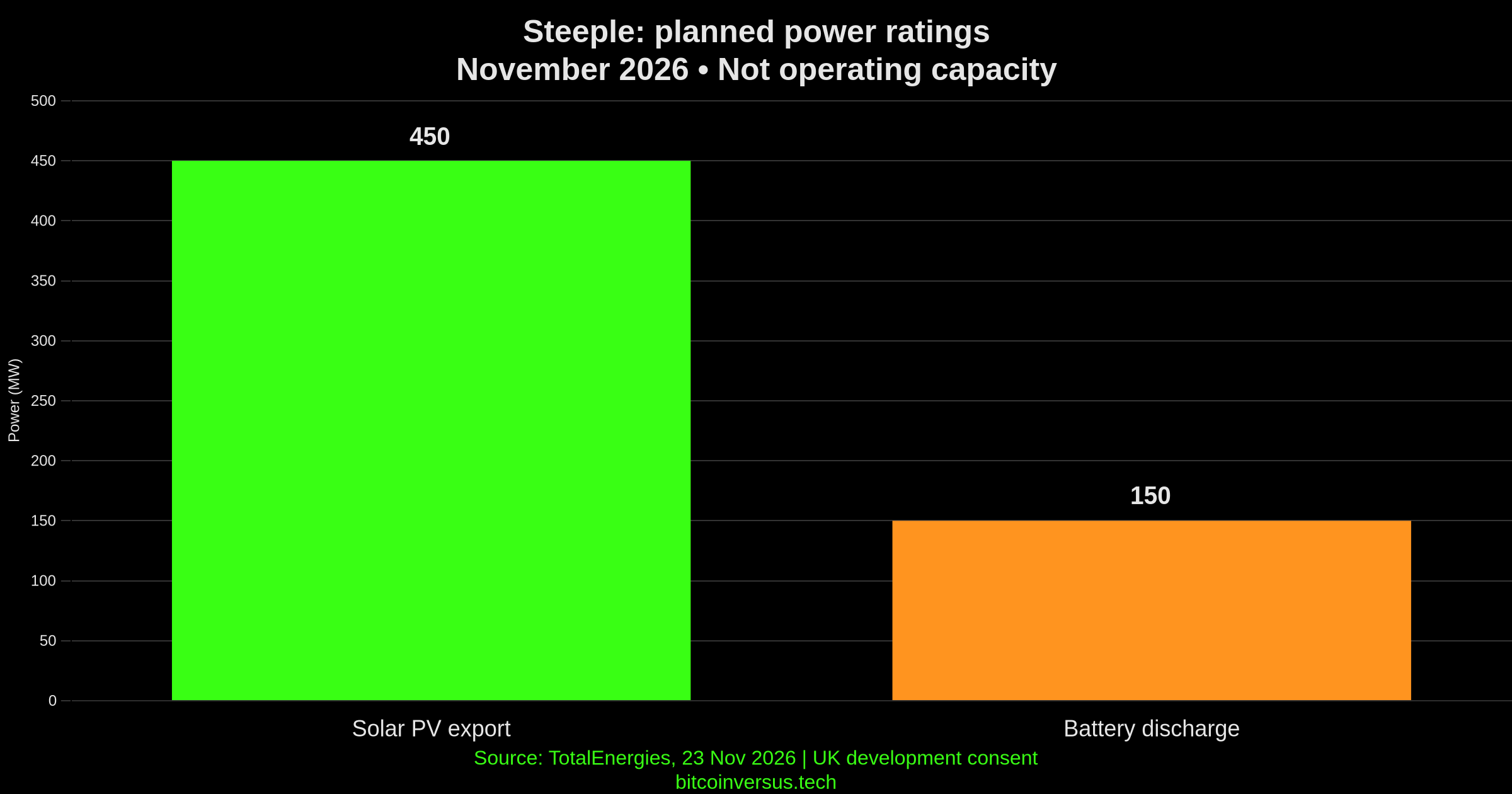
TotalEnergies announced on November 23, 2026 that it had completed its acquisition of the Steeple Renewables Project from RES. The proposed development in Nottinghamshire combines approximately 450 MW of solar export capacity with 150 MW of battery power. The acquisition follows the government’s October 9 development consent and targets operation by the end of 2030. Unlike the Finnish gas-engine balancing project, Steeple would rely on photovoltaic generation and stored electricity rather than combustion for its planned production and flexibility.
Reusing a former coal power connection
RES developed the scheme near Sturton-le-Steeple, adjacent to the retired West Burton power station. The developer identifies the existing electricity transmission capacity released by the retirement as an opportunity for the new installation. Its October announcement specifies a grid connection of up to 600 MW. Reusing an established connection can reduce the need to establish an entirely new transmission corridor, although new transformers, protection systems, switching equipment and commissioning may still be necessary.
The UK government consent decision confirms the planned solar and storage ratings. A related example of converting previously used land into electricity infrastructure appears in our New York flooded-quarry solar report. The relevant constraint for either development is not land alone, but the ability to transfer electricity to the wider network.
Power capacity is not stored energy
Solar photovoltaic modules produce direct current, which inverters convert to alternating current for the grid. A battery system exchanges power through bidirectional conversion equipment, charging when electricity is available and discharging when requested. The planned battery power rating is one-third of the solar export rating. The 150 MW specification describes the rate of energy transfer, not the energy stored in megawatt-hours. The acquisition announcement does not state the battery’s MWh capacity, so discharge duration cannot be calculated from the announced figures.
Battery dispatch and solar output must be coordinated with connection limits and grid instructions. A battery can shift some daytime electricity into later hours but cannot create additional net energy. Charging and conversion losses reduce the amount recovered. Grid-support capabilities also depend on inverter design and control settings, as explored in our Scotland grid-forming battery coverage. Steeple’s announcement does not establish comparable grid-forming functionality.
Annual energy and industrial demand
TotalEnergies estimates that the project’s yearly generation could match the consumption of approximately 180,000 British households, using 3,323 kWh per household per year. Multiplying those assumptions implies roughly 598 GWh of annual generation, not a measured result. A household-equivalence estimate represents annual energy rather than a guarantee of continuous supply. Seasonal sunlight, weather, equipment availability and export restrictions will affect the actual production.
For data centers and Bitcoin mining operators, the distinction between annual electricity generation and uninterrupted power delivery is critical. A continuous computing load may need additional supply during low solar output, whereas a flexible load can adapt its operating schedule. Our British wind curtailment analysis examines the potential role of adaptable demand. No computing customer is identified in the Steeple acquisition announcement.
The next evidence to examine will be construction milestones, final battery energy capacity, connection commissioning and verified generation records. Independent reporting by Solar Power Portal corroborates the acquisition and project ratings. Until commissioning, the planned capacities remain development specifications.
Featured reference photograph: Keith Arkins / RES, depicting an existing solar farm rather than completed Steeple infrastructure.


Leave a Reply