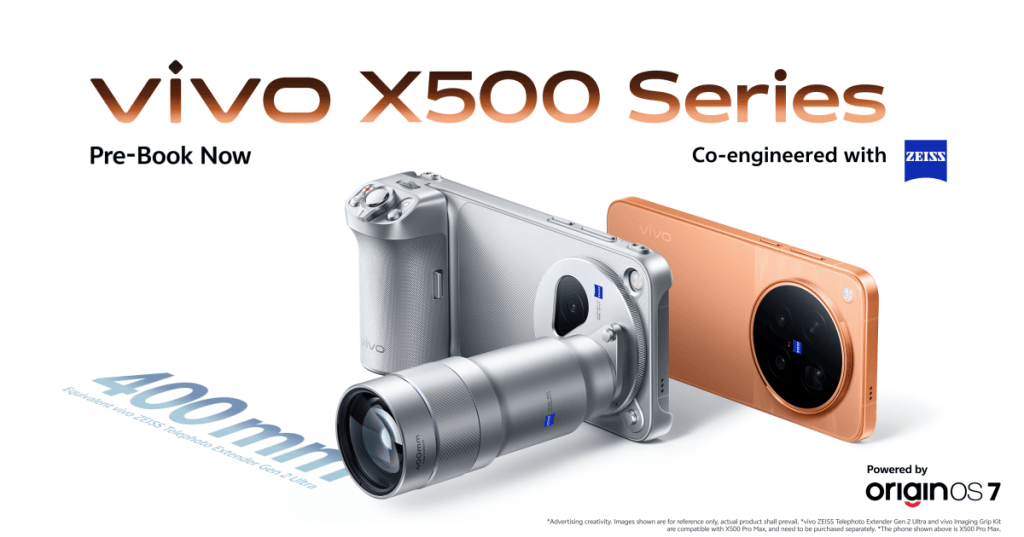
Vivo announced the Indian launch of its X500 smartphone family on November 26, 2026, following earlier international introductions. The manufacturer’s Indian announcement identifies three models, with preorders opening November 26 and retail availability scheduled for December 3. The X500 Pro Max emphasizes motion photography, a 200-megapixel telephoto camera and an optional optical extender. The imaging competition follows recent developments such as the HONOR Magic9 Pro Max’s cinema-oriented recording capabilities.
Recording motion at 240 frames per second
Vivo specifies native 4K recording at 240 frames per second on the main cameras of the X500 Pro and Pro Max. At a nominal 3840 × 2160 frame size, that corresponds to nearly two billion pixel positions each second before compression. The calculation does not establish the internal sensor readout method, encoded bit rate or memory bandwidth. Playing the footage at 30 frames per second produces eightfold slow motion without requiring additional interpolated frames. Higher capture rates typically require shorter exposures and adequate illumination, while recording duration can be limited by thermal and storage constraints.
A dedicated cinema camera such as the Panasonic LUMIX SHX1 illustrates why resolution and frame rate alone cannot establish equivalent imaging performance. Sensor area, lens aperture, processing, recording formats and dynamic range must be considered together.
Optical reach and dynamic range

The Pro Max supports a separately purchased 400 mm-equivalent telephoto extender, while a 200 mm-equivalent accessory is available across the series. Equivalent focal length expresses field of view relative to a 35 mm reference format, not the physical length of the smartphone lens. Vivo also reports up to 60 autofocus adjustments per second in supported modes. Tracking performance depends on lighting, subject motion and the selected recording format.
The company’s stated 17 EV dynamic range applies to main-camera Log recording. A Log transfer curve allocates code values differently from conventional display-ready video. It does not create additional sensor information. The distinction matters when comparing claims about sensor architectures, including the Xiaomi 18 Pro Max overflow-capacitor imaging system. Independent testing would require comparable exposure, noise thresholds and processing conditions.
Energy capacity and availability
According to the Indian specifications, the Pro Max contains a battery with typical energy of 28.94 Wh, compared with 24.48 Wh for the Pro and 28.20 Wh for the base X500. Energy capacity alone cannot establish endurance during intensive video capture. The Indian Express independently reported the launch. Announced starting prices range from ₹119,999 for the X500 to ₹164,999 for the Pro Max, before optional accessories. As with the camera-related engineering changes in Apple’s iPhone Duo, the important question is whether specialized hardware and software produce reliable results in actual use. Sustained recording and controlled image-quality measurements remain necessary.


Leave a Reply