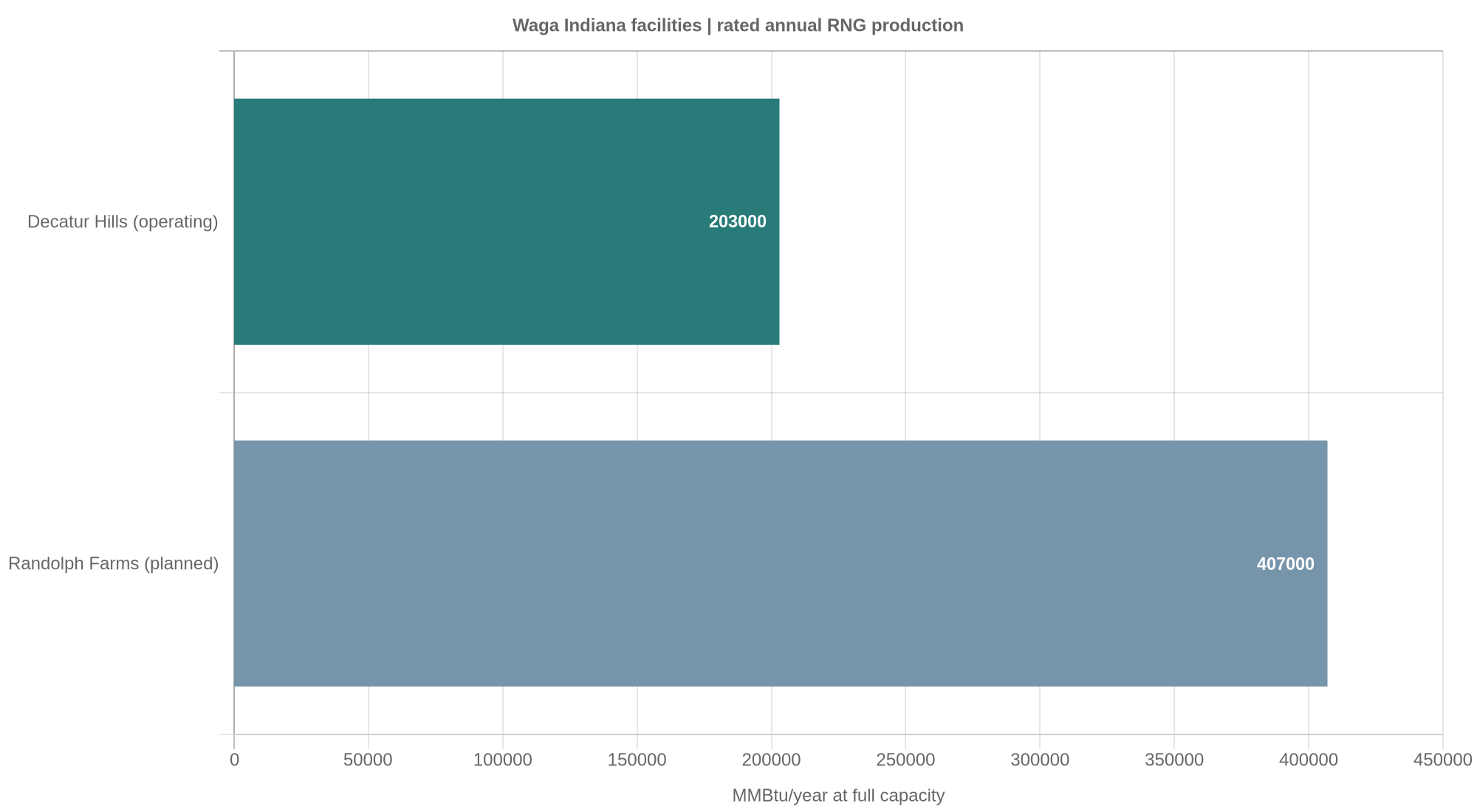
Waga Energy has agreed to develop a larger renewable natural gas (RNG) installation at Randolph Farms Landfill in Modoc, Indiana. The November 23, 2026 announcement identifies a planned processing capacity of 2,000 standard cubic feet per minute of raw landfill gas and annual output of up to 407,000 MMBtu of upgraded gas. Waga will replace existing upgrading equipment and direct the fuel to an interstate pipeline. The project represents a different feedstock strategy from Reliance’s agricultural biogas development plans. Commissioning is targeted for early 2028.
Nearly twice the capacity of the partners’ first installation
The partners inaugurated an RNG facility at Decatur Hills Landfill in Greensburg, Indiana, in October. Waga’s October 22 announcement specifies approximately 203,000 MMBtu of annual output at full capacity and a raw gas intake limit of 1,000 standard cubic feet per minute. The planned Randolph Farms facility therefore has roughly twice the intake and rated annual fuel output of its predecessor. The operating facility’s nameplate production is not a measurement of its actual annual deliveries.
Separating methane from landfill gas
Organic matter decomposes inside landfills under oxygen-limited conditions, generating methane and carbon dioxide alongside other compounds. A collection system routes the gas to treatment equipment. Waga’s process combines selective membrane separation with low-temperature distillation to produce gas suitable for pipeline delivery. Unlike the direct combustion of agricultural residues at Côte d’Ivoire’s Biovéa biomass power plant, the Indiana installation produces a combustible gaseous fuel rather than electricity.
Annual production of 407,000 MMBtu corresponds to approximately 119.3 GWh of fuel energy using 293.071 kWh per MMBtu. Dividing the annual energy by 8,760 hours yields approximately 13.6 MW of average thermal-energy delivery at the stated annual output. An electricity generator would recover only a fraction of that fuel energy, so the calculation does not establish 13.6 MW of electrical capacity.
From local vehicle fuel to an interstate pipeline
Existing production at Randolph Farms serves an onsite fleet-fueling operation. The new arrangement expands the market through pipeline access. The developer will own and operate the new equipment under a contract extending for at least two decades, while the landfill operator retains responsibility for gas collection. Such arrangements highlight the distinction between fuel production and electricity infrastructure, also evident in Alaska’s proposed gas-powered computing campus.
Methane capture can reduce climate impacts when it displaces otherwise emitted methane or fossil gas, but the net result depends on collection efficiency, leakage and the alternative use of the waste gas. Waga estimates avoided emissions of approximately 31,700 tons of carbon dioxide equivalent annually; the figure is a company estimate, not a measured lifecycle assessment. No dedicated computing customer has been announced. Unlike Saskatchewan’s proposed off-grid Bitcoin mine, Randolph Farms is designed to supply fuel into a shared network. Its importance is the potential to recover a waste-derived energy resource through established gas infrastructure.
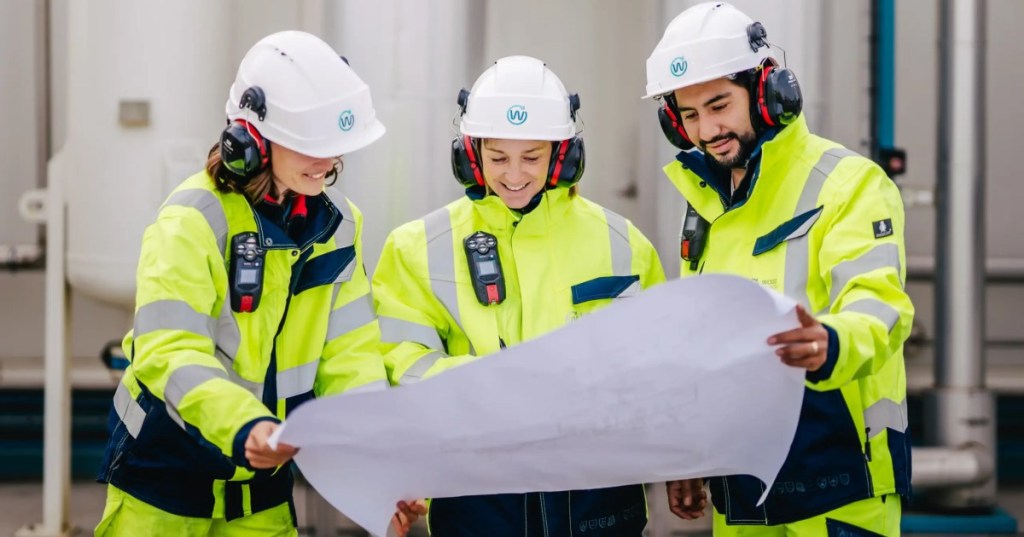
Featured photograph: Waga Energy, accompanying its November 23 announcement. The image shows personnel at Chatuzange, not the proposed Indiana facility.
We volunteer daily to ensure the credibility of the information on this platform is Verifiably True. If you would like to support to help further secure the integrity of our research initiative, please scan the QR code below.

For mobile scanning, open the article on another display and scan the QR code with a Bitcoin wallet. The voluntary donation amount is 5,000 sats. Verify the receiving address 3C9o19EH5HSiwEPyCTmEKzxhNCbo2X6TTb before sending.
BitcoinVersus.tech is not a financial advisor. This media platform reports on financial subjects purely for informational purposes.


Leave a Reply