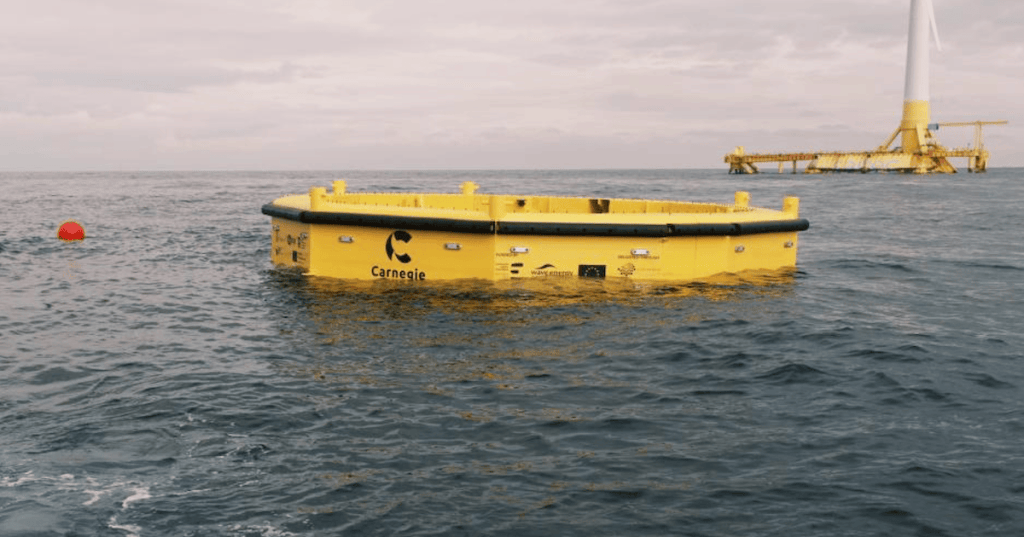
Carnegie Clean Energy has completed the first offshore deployment of the buoyant actuator for its CETO wave-energy prototype in Spain. The November 16, 2026 announcement confirms that the component was connected to a mooring system at the Biscay Marine Energy Platform (BiMEP), near Armintza. The campaign precedes the installation of an integrated, grid-connected prototype targeted for spring 2027. Like the WEDUSEA demonstration planned in Scotland, the Spanish project is intended to validate marine energy technology under real ocean conditions.
Testing offshore logistics before generating electricity
The November campaign focused on the floating structural component rather than the complete electrical generation system. Locally fabricated modular sections were brought to Bilbao and joined at the port. The assembled structure was lifted into the water, transported offshore and secured to its berth. Ocean Energy Europe’s November 16 publication describes the temporary campaign as a means of evaluating procedures for towing, installation and recovery.
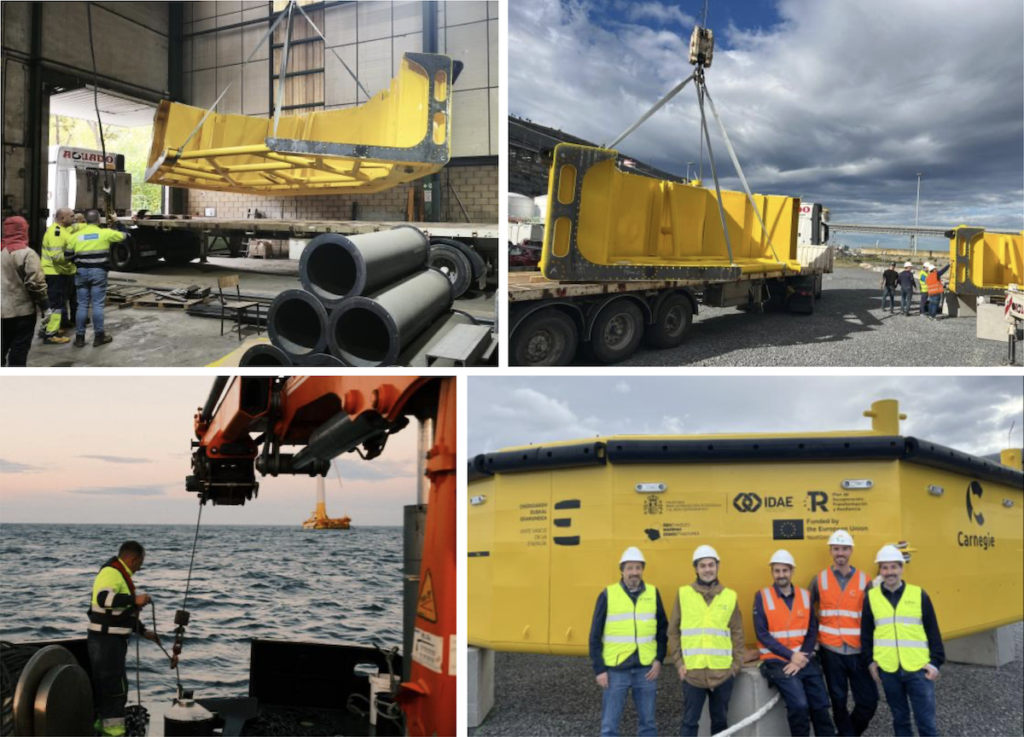
Port access, equipment lifting, vessel availability and suitable sea conditions all affect deployment schedules. Testing those operations separately reduces integration risk before the generating modules are installed. Comparable challenges arise in floating tidal power developments, although tidal currents and wave motion require different energy-capture mechanisms.
How a submerged point absorber works
CETO uses a buoyant body that moves in response to wave-induced forces. Relative motion between the body and its seabed-linked system provides mechanical input to the power take-off. The integrated equipment converts mechanical movement into electricity, conditions electrical output and transfers energy through a subsea connection. The technology is designed for submerged operation, unlike a surface-mounted demonstration buoy. The actuator’s temporary surface deployment does not establish electrical performance under its intended operating configuration.
Control systems can adjust mechanical resistance to incoming waves in an effort to increase useful energy capture. They must balance production against mechanical loads and the electricity required by sensors, computing and control equipment. An energy system intended for offshore computing, such as Panthalassa’s proposed wave-powered AI nodes, likewise depends on demonstrable energy conversion and reliable marine operations rather than resource potential alone.
The next milestone is an integrated sea trial
Carnegie plans to recover the actuator and perform additional tests of the power take-off and electrical modules before the second offshore campaign. The November 25 Ocean Science & Technology report describes testing that will reproduce ocean-induced mechanical conditions onshore. Full-system installation and electrical grid connection remain scheduled for European spring 2027, subject to execution and weather conditions.
For prospective marine-powered computing infrastructure, including the offshore AI concepts proposed by Stratum and Ocean Power Technologies, a critical question is how much dependable energy can be supplied over time. The current CETO announcement does not disclose a measured generation series or demonstrated capacity factor. A quantitative performance chart would therefore imply evidence not yet available. The achievement is validation of marine logistics, with electrical generation and reliability testing still to follow.
Featured photograph: Carnegie Clean Energy’s actuator at BiMEP, via Ocean Science & Technology, November 25, 2026.
We volunteer daily to ensure the credibility of the information on this platform is Verifiably True. If you would like to support to help further secure the integrity of our research initiative, please scan the QR code below.

For mobile scanning, open the article on another display and scan the QR code with a Bitcoin wallet. The voluntary donation amount is 5,000 sats. Verify the receiving address 3C9o19EH5HSiwEPyCTmEKzxhNCbo2X6TTb before sending.
BitcoinVersus.tech is not a financial advisor. This media platform reports on financial subjects purely for informational purposes.


Leave a Reply