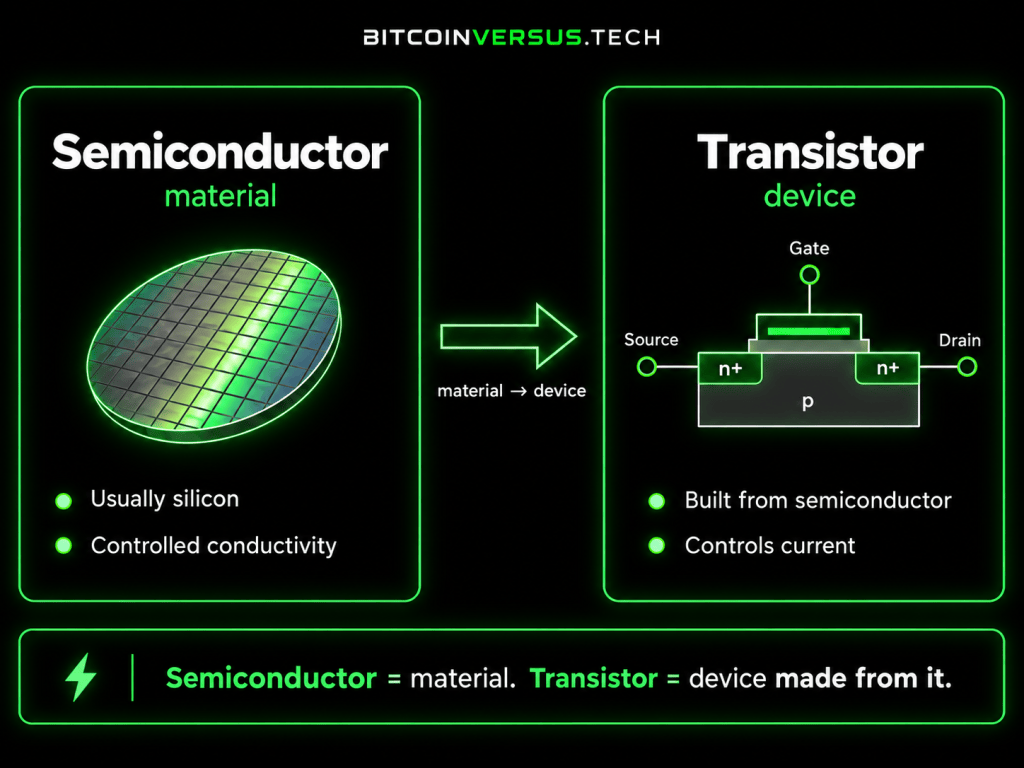
A semiconductor and a transistor are closely related, but they are not the same thing.
A semiconductor is a class of material—most commonly silicon—whose electrical conductivity can be precisely controlled.
By modifying semiconductor material through processes such as doping, engineers can create regions that either provide or restrict the movement of electrical charge. These properties make semiconductor materials the foundation for modern electronic devices.
A transistor is an electronic component built from semiconductor material.
Its primary function is to control electrical current, allowing it to operate as either a switch or an amplifier. In digital electronics, transistors rapidly switch between electrical states that represent binary information.
When engineers combine many transistors together, they can create logic gates, processors, memory, controllers, and specialized computing hardware.
The relationship can therefore be understood simply: the semiconductor is the material, while the transistor is a device constructed from that material.
Silicon provides the physical platform, while transistor structures such as MOSFETs turn that material into controllable electronic switches.
A single modern CPU, GPU, or ASIC can contain billions of these transistor structures operating together.
This distinction becomes especially important when studying semiconductor manufacturing and chip architecture.
Semiconductor fabrication involves building extremely small transistor structures across silicon wafers through repeated processes including lithography, deposition, etching, ion implantation, and metallization.
As transistor dimensions shrink, manufacturers can place more computing capability into a given area while attempting to improve performance, power efficiency, and computational density.
From smartphones and automobiles to artificial intelligence accelerators and Bitcoin mining ASICs, modern computing ultimately depends on the same hierarchy: semiconductor materials form transistors, transistors form logic circuits, and logic circuits form integrated chips.
Understanding that progression provides one of the clearest starting points for studying electronics, semiconductor engineering, and modern computer architecture.
BitcoinVersus.Tech Editor’s Note:
We volunteer daily to ensure the credibility of the information on this platform is Verifiably True. If you would like to support to help further secure the integrity of our research initiatives, please donate here: 3C9o19EH5HSiwEPyCTmEKzxhNCbo2X6TTb
BitcoinVersus.tech is not a financial advisor. This media platform reports on financial subjects purely for informational purposes.
Disclaimer: The underlying inputs, calculations, and mathematical relationships used in the Power Efficiency Index are intended to be transparent and verifiable. The math is verifiable; the interpretation is experimental. PEI is a research framework, not a prediction of future price, guaranteed fair value, or financial advice. Actual market prices are influenced by many variables outside the model, including supply, demand, liquidity, regulation, adoption, speculation, and broader economic conditions.


Leave a Reply