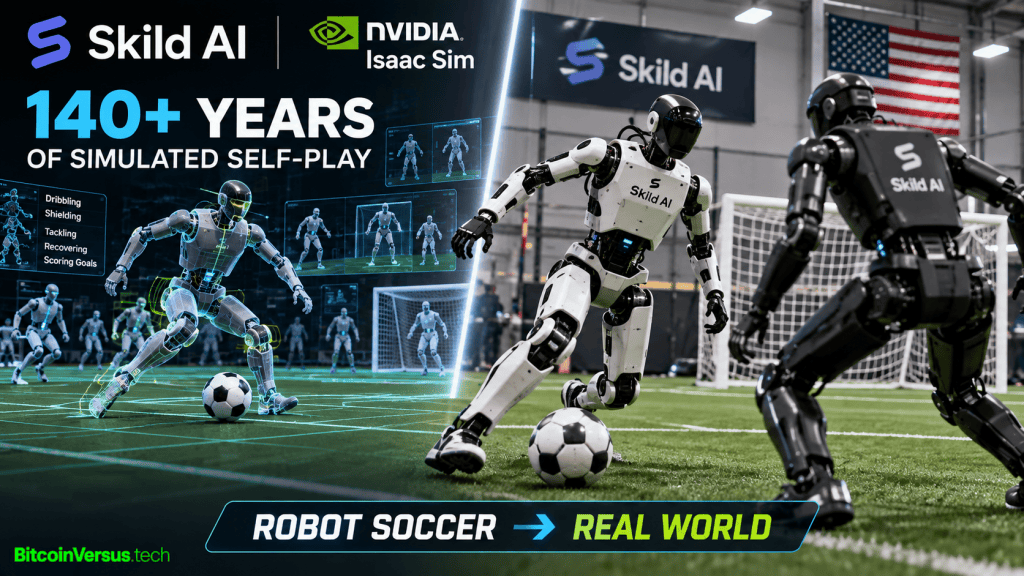
Skild AI says it trained a humanoid robot to play soccer after more than 140 simulated years of self-play, then transferred the learned policy from NVIDIA Isaac Sim into a physical robot.
In a September 23 research update, the company describes a deliberately simple objective: score goals. Rather than hand-programming rewards for every useful behavior, the robot repeatedly competed against recent versions of itself and developed tactics that helped it win.
Meet the “Messinator”
In the team’s widely viewed demonstration, Skild shows the resulting robot moving from accelerated simulation into a real soccer match. The clip is important because it shows both sides of the experiment: the virtual training environment and the physical transfer.
The company nicknamed the soccer robot the “Messinator”. The joke combines Lionel Messi’s name with a machine-learning experiment, but the technical objective is serious: test whether reinforcement learning through self-play can generate complex physical behaviors without individually rewarding every move.
140 years of soccer inside NVIDIA Isaac Sim
Skild says the policy accumulated more than 140 years of simulated play inside NVIDIA Isaac Sim. Early in the virtual training process the robot struggled to walk. As the self-play loop progressed, behaviors including dribbling, shielding the ball, tackling opponents and recovering from falls emerged because they improved its chance of scoring.
That makes the experiment a useful companion to BitcoinVersus.tech’s coverage of NVIDIA Isaac ROS 5.0, QBit’s robot “cerebellum” chip and Qualcomm’s deeper move into robotics.
Self-play creates its own escalating opponent
The central idea resembles self-play methods that became famous in game-playing AI. A policy competes against versions of itself. When the current policy improves, the opponent becomes harder too, creating an automatically escalating curriculum.
Skild began from its S1 robotics foundation-model work rather than from an untrained robot. The self-play phase therefore sits after broad pretraining and uses reinforcement learning to push a capable base policy toward a dynamic skill.
NVIDIA previously detailed how S1 uses its infrastructure across simulation, training and deployment. NVIDIA says S1 can learn previously unseen multistep tasks from a single video demonstration, providing the broader foundation for the newer self-play work. citeturn3search4
Simulation to physical robot is the critical step
A robot becoming good at simulated soccer would be less interesting if the behavior collapsed when transferred to real hardware. Skild says it transferred the trained policy to a humanoid and challenged it to a physical match.
Simulation-to-reality transfer remains one of robotics’ central engineering problems because a simulator cannot perfectly reproduce contact, friction, latency, motor response, sensing and unexpected disturbances. BitcoinVersus.tech has been tracking related physical-AI work through NEURA and SECO’s physical-AI hardware, Cognex’s RealSense acquisition and the Feather developer robot.
What the demonstration does not prove
The result is a research demonstration, not evidence that humanoids can suddenly perform arbitrary factory or household work. Skild has not published a quantitative benchmark showing that soccer self-play improves unrelated commercial tasks, and broader transfer remains a research direction.
That limitation is important. Soccer offers a clean objective, immediate feedback and measurable wins. Construction, manufacturing and household work often have fuzzier objectives and much higher penalties for mistakes.
Still, the experiment illustrates a potentially powerful training loop. Human demonstrations can establish broad capabilities, simulation can generate enormous quantities of additional experience, and self-play can produce increasingly difficult challenges without requiring a person to demonstrate every new tactic.
From robot soccer toward collaborative machines
Skild says it is extending the approach beyond one-on-one soccer. Early four-agent experiments are showing coordination behaviors, and the company points toward future work in collaborative manipulation, social navigation, factories, construction sites and homes.
For physical AI, the long-term question is whether useful robot experience can scale more like compute. If millions of accelerated simulated interactions can reliably produce skills that survive deployment on hardware, robotics development could depend less on manually collecting every training example in the physical world.
Advertisement:
BitcoinVersus.Tech Editor’s Note & Disclaimer:
We volunteer daily to ensure the credibility of the information on this platform is Verifiably True. BitcoinVersus.tech provides news, technical analysis and educational information and does not provide financial or investment advice. Verify technical specifications and operational requirements with the manufacturer before making purchasing, deployment or investment decisions. If you would like to support to help further secure the integrity of our research initiatives, please donate here: 3C9o19EH5HSiwEPyCTmEKzxhNCbo2X6TTb


Leave a comment