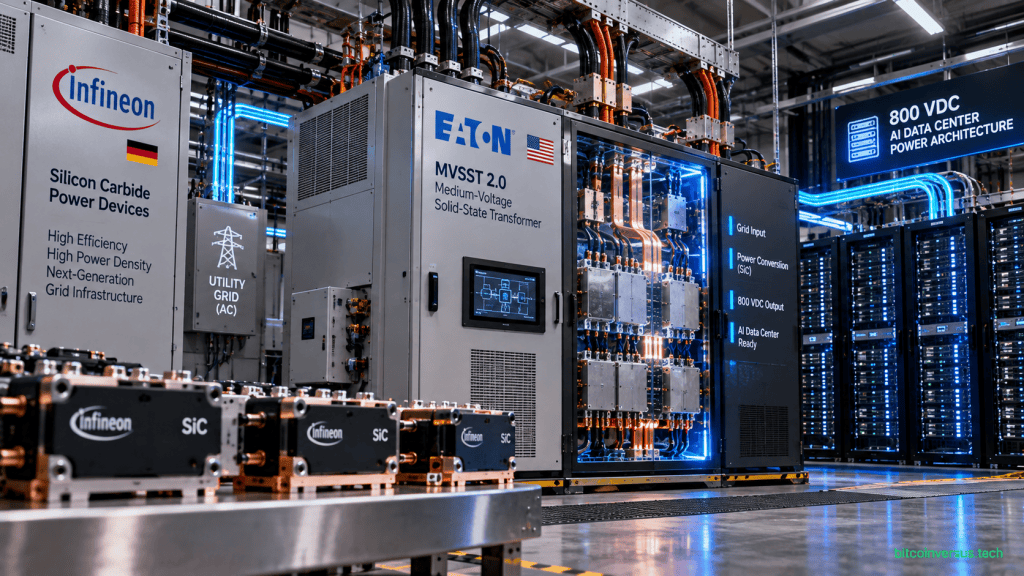
Infineon and Eaton are pushing silicon-carbide power electronics deeper into the AI data center, pairing Infineon SiC devices with Eaton’s MVSST 2.0 medium-voltage solid-state transformer for emerging 800 VDC power architectures.
In the companies’ September 29 announcement, Infineon said it will supply SiC power devices for Eaton’s MVSST 2.0 platform targeting deployments in Asia-Pacific and Europe, the Middle East and Africa. The design is intended to connect medium-voltage grid power more directly to the DC electrical architecture feeding high-density AI computing.
Solid-state transformers remove conversion steps
Conventional data-center power paths can pass electricity through several stages before it reaches server racks. Eaton’s solid-state approach uses high-frequency power electronics instead of relying only on traditional low-frequency magnetic conversion, allowing the platform to reduce conversion stages while controlling voltage electronically.
Infineon’s role is at the semiconductor layer. Silicon-carbide switches can operate at higher voltages and switching frequencies than conventional silicon devices, helping power-conversion systems increase power density while reducing losses and the size of some passive components.
Eaton is moving MVSST hardware toward live data-center trials
The partnership builds on hardware Eaton is already taking toward field validation. In a separate engineering program, Eaton says a 2.5 MW medium-voltage solid-state-transformer container will be installed at Singapore’s Jurong Island for live trials through the Sustainable Tropical Data Centre Testbed.
That scale matters because 800 VDC is moving from a component-level idea toward complete grid-to-rack architectures. BitcoinVersus.Tech recently covered SolarEdge and Infineon’s microsecond protection for 800 VDC AI power, ABB’s 800 VDC data-center distribution system, and Delta’s 800 VDC power and megawatt-scale cooling architecture. Eaton’s transformer addresses a different part of the chain: conversion from medium-voltage infrastructure toward the DC bus.
The next SiC step goes beyond today’s voltage class
Infineon and Eaton say they are also exploring future solid-state-transformer platforms using 2.3 kV and 3.3 kV SiC power modules. Higher-voltage devices could let designers handle more of the conversion task with fewer series-connected components while targeting greater efficiency, density and reliability.
The immediate MVSST 2.0 platform is aimed at high-density computing and emerging 800 VDC distribution. Infineon says the system is among the early medium-voltage solid-state transformer platforms to achieve IEC certification, an important step for equipment intended to sit between utility-scale electrical infrastructure and expensive AI compute.
For AI data centers, the semiconductor race increasingly extends outside the GPU. Power MOSFETs, circuit breakers, transformers, battery systems and cooling hardware all determine how many accelerators a site can reliably energize. The Infineon-Eaton collaboration puts silicon carbide directly into that grid-to-rack competition.
BitcoinVersus.Tech
Advertisement: Follow BitcoinVersus.Tech for independent coverage of semiconductors, data centers, artificial intelligence, Bitcoin mining, power infrastructure and energy.
Disclaimer: BitcoinVersus.Tech provides news, analysis and educational information for general informational purposes. Nothing in this article is financial, investment, legal or professional advice. Readers should independently verify information and make their own decisions.


Leave a Reply