Most CPU projects begin with a foundational decision: x86, Arm, or RISC-V. NUVACORE is trying to reverse that sequence.
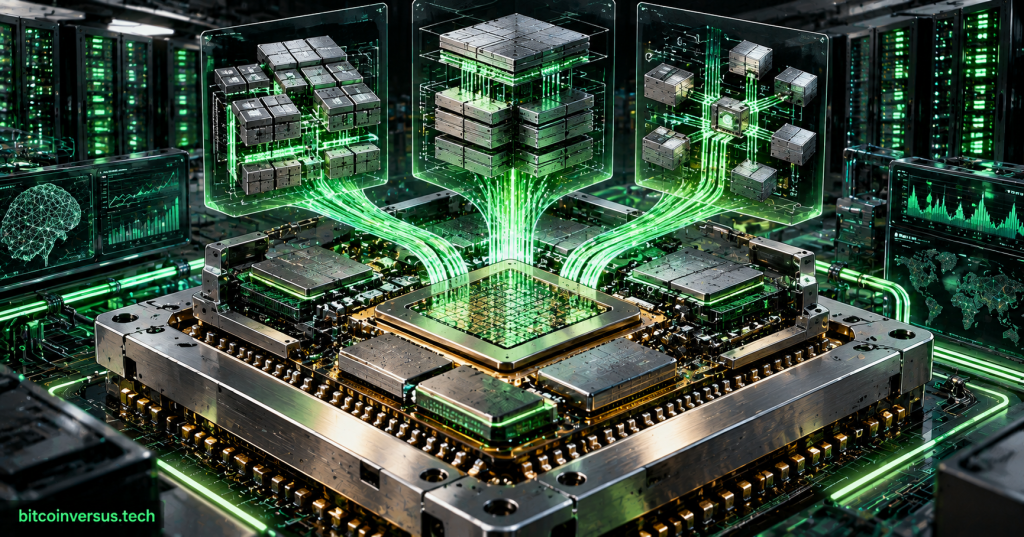
The startup has revealed the first details of a “Core First” design strategy for its WarpCore processor, arguing that a substantial portion of the underlying CPU microarchitecture can be built before the instruction set architecture is locked in. On its official site, NUVACORE says WarpCore is being designed from a clean sheet for sustained, intensive AI infrastructure and hyperscale data-center workloads.
The company summarized the approach in a September 29 X post, saying its engineers can build a significant portion of the foundational CPU core IP before choosing the final instruction set.
Build the Core First, Choose the ISA Later
That sounds backwards because software compatibility is normally one of the earliest constraints in processor design. An x86 CPU, an Arm CPU, and a RISC-V CPU expose different instruction sets to software, so designers usually commit early and build the surrounding architecture around that choice.
NUVACORE is separating that visible instruction layer from as much of the underlying execution engine as possible. The goal is to develop core components such as execution resources, scheduling, caches, memory behavior, branch prediction, and power-management strategy with fewer assumptions about the final ISA.
For readers who want the foundation, BitcoinVersus.Tech’s CPU architecture comparison explains why instruction sets and microarchitecture are related but not the same thing. The ISA defines the contract software sees. The microarchitecture determines how a particular processor actually executes that contract.
The Decoder Is Only One Part of a Modern CPU
Modern high-performance processors already translate software-visible instructions into smaller internal operations before execution. That means many of the structures responsible for performance do not have to map one-to-one with the instruction set itself.
Instruction decoding still matters, and a real commercial implementation would need ISA-specific front-end logic, validation, compilers, firmware, operating-system support, and licensing where applicable. NUVACORE is not claiming those pieces disappear.
Instead, the company is arguing that enough of the expensive core-development work can happen earlier and remain reusable that the ISA decision does not have to dominate the entire project from day one.
AI Data Centers Change What a CPU Has to Optimize For
NUVACORE says WarpCore is being designed for sustained performance rather than short benchmark bursts. That distinction matters in AI infrastructure, where CPUs can spend long periods orchestrating accelerators, moving data, handling storage and networking, running control-plane software, serving inference pipelines, and keeping large clusters fed.
The CPU in an AI rack does not need to beat a GPU at matrix multiplication. It has to handle the work around the accelerator efficiently and continuously.
BitcoinVersus.Tech recently covered AMD’s EPYC Venice server performance claims, another example of how CPU vendors are repositioning general-purpose processors around AI-era data-center workloads rather than treating the CPU as a background component.
Power, Area, and Sustained Throughput Become the Real Tradeoffs
NUVACORE describes the project around three connected constraints: performance, energy efficiency, and silicon-area efficiency. Improving one of those often makes another harder.
A larger core can hold more execution hardware and cache, but it reduces the number of cores that fit on a die. Aggressive frequency can improve peak performance, but it increases power density. Wider execution can increase throughput, but only if the memory and instruction front end can keep the machine supplied with useful work.
That is why the Core First idea is interesting even before NUVACORE publishes detailed specifications. It treats the CPU as a collection of engineering tradeoffs first and a software instruction contract second.
The ISA Choice Still Matters
Core First does not make x86, Arm, and RISC-V interchangeable. Each ecosystem comes with different software compatibility, licensing, toolchains, extensions, privilege models, vector instructions, and validation requirements.
Independent reporting from Tom’s Hardware notes that NUVACORE has not yet disclosed which ISA WarpCore will ultimately use, nor has it published benchmarks or a product-launch schedule.
That uncertainty is important. The project is still a design strategy, not a shipping processor. The company has not yet demonstrated that one back-end architecture can be carried across multiple ISAs without significant redesign or performance compromises.
Server CPUs Are Becoming More Specialized Around Infrastructure
The broader market makes NUVACORE’s timing understandable. Data-center CPUs are increasingly being shaped around specific infrastructure goals: memory bandwidth, coherent fabrics, accelerator orchestration, energy efficiency, security, and sustained workload behavior.
BitcoinVersus.Tech has also covered SiPearl Rhea1 entering the JUPITER supercomputer, showing another path where CPU architecture is tuned around a particular class of high-performance computing deployment.
NUVACORE is taking a different route. Instead of committing the core to one software ecosystem immediately, it wants the core design to preserve as much architectural freedom as possible until later.
The Big Test Comes After the Architecture Diagram
The people behind NUVACORE have serious CPU-design experience, including work associated with Apple, NUVIA, Qualcomm, Arm, and other major processor programs. That makes the Core First idea worth watching.
But the hard part still lies ahead. WarpCore will eventually need an ISA, physical implementation, compiler support, validation, operating-system enablement, memory and I/O integration, manufacturing yield, and production silicon that proves the architectural idea under real workloads.
If NUVACORE succeeds, the interesting result may not be simply another server CPU. It could demonstrate that future processor companies can treat the ISA as a more modular layer while preserving a larger body of reusable high-performance core IP underneath.
For AI data centers, that would make the CPU less about allegiance to one instruction set and more about which architecture can deliver sustained useful work within the rack’s power, cooling, and silicon-area limits.
BitcoinVersus.Tech
Advertisement
Editor’s Note:
We volunteer daily to ensure the credibility of the information on this platform is Verifiably True. If you would like to support our research initiatives, please donate here: 3C9o19EH5HSiwEPyCTmEKzxhNCbo2X6TTb
BitcoinVersus.tech is not a financial advisor. This media platform reports on financial subjects purely for informational purposes.


Leave a comment