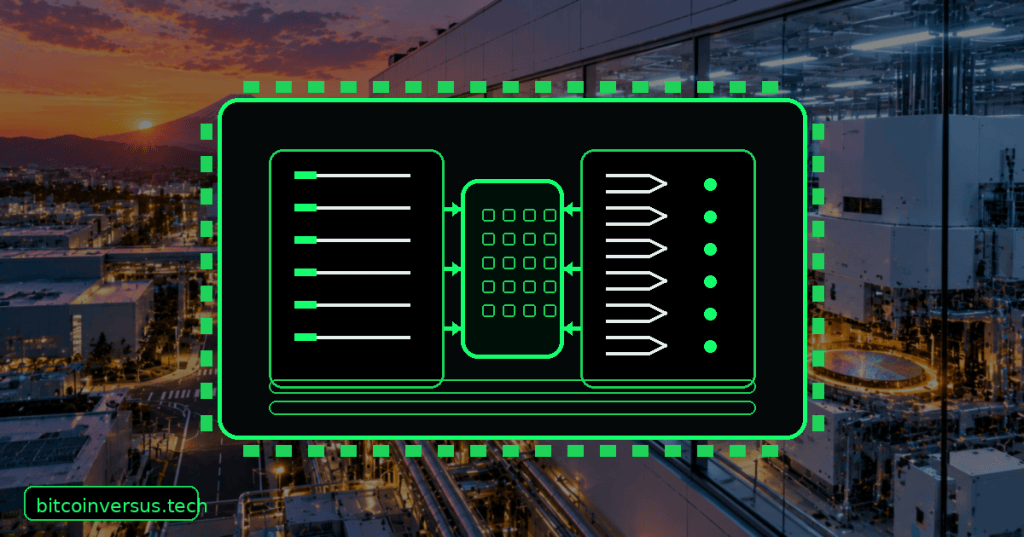
IBM is taking a highly unusual route into the AI-era CPU market: instead of placing a separate Arm processor beside its mainframe CPU, the company is designing one physical core that can natively execute both IBM z/Architecture and Arm instructions.
IBM unveiled the next-generation processor at Hot Chips 2026. In its official announcement, IBM said the chip is being developed for future IBM Z and LinuxONE systems so organizations can run Arm-native Linux environments alongside z/OS and Linux on IBM Z while keeping data close to the systems that already hold it.
IBM later framed the architecture even more directly in a September 2 X post: instead of moving enterprise data out of the mainframe to run modern AI software elsewhere, bring the modern software environment into the processor that already sits beside the data.
Two Instruction Sets, One Physical Core
The unusual part is not simply that one server can support two software ecosystems. Heterogeneous systems have done that for years by combining different processors or accelerators.
IBM is putting both instruction-set paths into the same CPU core. The processor is designed to decode and execute traditional z/Architecture workloads and Arm-native code in hardware rather than handing Arm execution to a separate companion chip.
Tom’s Hardware’s Hot Chips analysis reports that the next-generation processor uses 11 cores, is built on a 2 nm process, and runs its cores at a 5.7 GHz base frequency. More importantly, each core contains native hardware support for both Arm and IBM’s z/Architecture.
That architecture makes this a useful counterpoint to BitcoinVersus.Tech’s recent story on NUVACORE’s Core First CPU strategy. NUVACORE wants to delay choosing an ISA while it develops reusable microarchitecture. IBM is tackling a different problem: carrying two ISA contracts into the finished processor at the same time.
The Decoder Becomes a Gateway Into a Shared Machine
At a simplified level, an instruction set is the software-visible language a processor understands. The execution engine underneath that language contains structures such as schedulers, integer units, floating-point hardware, caches, branch prediction, load/store machinery, and register resources.
A dual-ISA core therefore does not need two completely independent CPUs inside one package. The interesting engineering problem is deciding how much of the front end must remain ISA-specific and how much of the downstream machine can be shared once instructions have been decoded into internal operations.
IBM says its redesigned cores are intended to switch between the two instruction environments on nanosecond timescales. That does not mean one instruction stream magically changes languages in the middle of an instruction. It means the hardware can move between workload contexts without sending Arm applications to an entirely separate processor complex.
Why IBM Wants Arm Inside the Mainframe
Mainframes hold enormous amounts of business-critical data, but much of the modern AI and cloud-native software ecosystem is being developed around Arm and x86 environments rather than IBM Z instruction sets.
The traditional answer is to move data toward the software or attach another compute domain that can run the software. IBM is trying to invert that relationship. If Arm-native Linux applications can execute directly on the same processor complex as z/OS and Linux on IBM Z, the software can move closer to the data instead.
That matters for AI because inference frequently sits downstream from databases, transaction systems, customer records, fraud systems, and other data sources. Every boundary crossed adds networking, copying, serialization, latency, security controls, and operational complexity.
The same pressure is reshaping conventional server CPUs. BitcoinVersus.Tech recently covered AMD’s EPYC Venice server architecture, where core density, memory throughput, and AI-host performance are becoming increasingly central to CPU design.
This Is More Than Compatibility Mode
Software emulation can make one architecture execute code written for another, but emulation introduces translation overhead and often loses access to architecture-specific behavior.
IBM’s design is notable because the two instruction sets are supported natively by the processor core. That shifts the problem from software translation into hardware architecture.
The payoff is potentially much tighter integration, but the cost is complexity. Verification has to cover two architectural contracts. Exception handling, privilege behavior, memory ordering, virtualization, debugging, security, firmware, operating-system interactions, and context switching all become more complicated when one physical machine must correctly behave as two different software-visible architectures.
Mainframe Reliability Meets a Much Larger Software Ecosystem
IBM’s motivation is not simply to make a mainframe act like a generic Arm server. The company wants Arm-native software to inherit access to the reliability, availability, security, and data locality that customers buy IBM Z systems for in the first place.
That creates a different kind of value proposition than simply increasing core count. A bank, insurer, airline, government system, or transaction processor could potentially run newer Arm-native services closer to the same data and transaction environment rather than building another external compute tier.
It also shows how broad the Arm software ecosystem has become. Arm is no longer only an embedded or mobile architecture. Cloud servers, custom hyperscale CPUs, AI control processors, and HPC systems increasingly rely on it.
BitcoinVersus.Tech recently covered SiPearl’s Arm-based Rhea1 CPUs entering the JUPITER supercomputer, another example of Arm moving into infrastructure once dominated by other instruction-set ecosystems.
A Dual-ISA Core Changes the Architecture Conversation
Processor design is often discussed as an ISA competition: x86 versus Arm versus RISC-V versus specialized architectures. IBM’s approach makes that framing less clean.
If one core can implement multiple instruction sets natively, the ISA becomes one layer of the processor rather than the entire identity of the machine. The execution resources, cache hierarchy, branch machinery, memory system, reliability features, and physical implementation can become a shared platform underneath multiple software environments.
There are obvious limits. Supporting two ISAs increases design and validation work, and IBM’s unusual requirements do not automatically make the concept attractive for every CPU vendor. The economics of a hyperscale commodity processor are different from the economics of a mainframe processor built for customers with decades of software and data tied to one platform.
The Most Interesting Feature May Be What IBM Does Not Move
The headline feature is that one CPU core speaks two instruction sets. The deeper architectural idea is data locality.
AI infrastructure increasingly spends enormous engineering effort moving information between CPUs, accelerators, memory pools, networks, storage systems, and software environments. IBM’s mainframe strategy asks whether some of that movement can be eliminated by making the processor itself more linguistically flexible.
The processor is still under development, and production systems will have to prove that dual-ISA execution delivers the software compatibility, performance, isolation, and operational simplicity IBM is promising. But as an architecture experiment, it is one of the more unusual CPU designs of 2026.
Instead of asking which instruction set wins, IBM is building a core that is designed to speak both.
BitcoinVersus.Tech
Advertisement
Editor’s Note:
We volunteer daily to ensure the credibility of the information on this platform is Verifiably True. If you would like to support our research initiatives, please donate here: 3C9o19EH5HSiwEPyCTmEKzxhNCbo2X6TTb
BitcoinVersus.tech is not a financial advisor. This media platform reports on financial subjects purely for informational purposes.


Leave a Reply