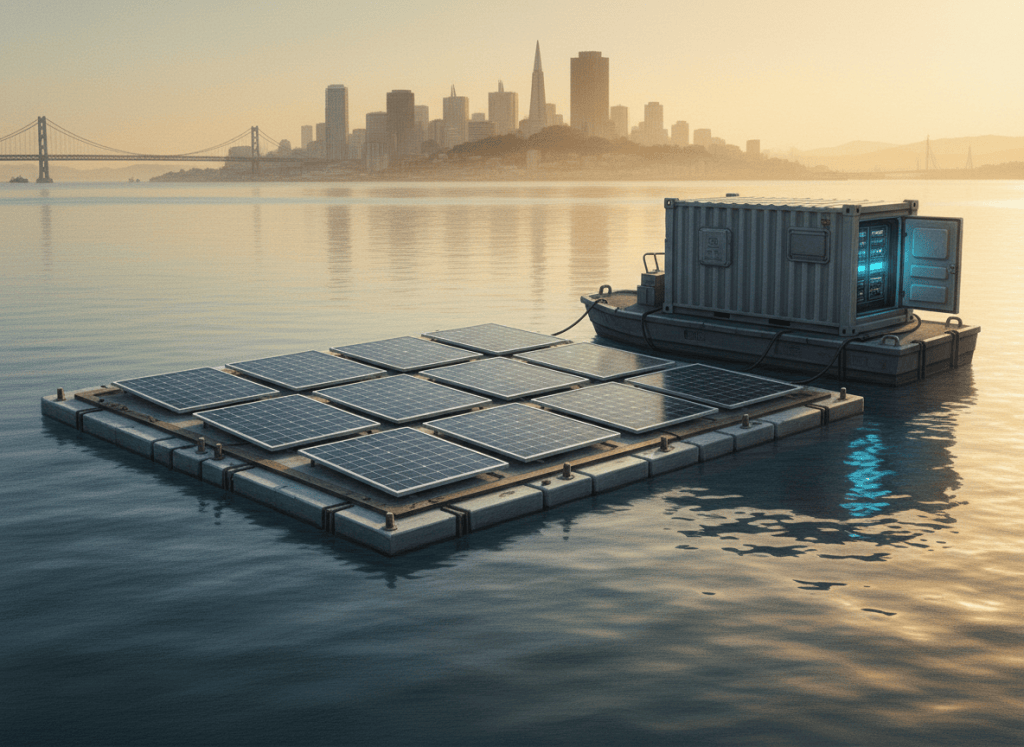
A San Francisco startup has put a new spin on the race for AI power: instead of waiting years for a terrestrial grid connection, NetworkOcean is testing whether compute can move onto the water with its electricity source attached. The company says its first floating solar system has powered an Nvidia H100 GPU while serving a customer AI workload from San Francisco Bay.
NetworkOcean’s project roadmap identifies OASIS-00 as a 2026, 20 kW floating solar array powering an H100 from the ocean. Data Center Dynamics independently reported that the trial used a single H100 and a 20 kW solar array, with footage showing 12 floating panels connected to compute equipment aboard a vessel.
The experiment attacks the time-to-power bottleneck
AI infrastructure is increasingly constrained by more than GPUs. New facilities need generation, substations, transformers, transmission capacity, permits and cooling before accelerators can do useful work. BitcoinVersus.Tech has tracked the same pressure on land, including how small gas turbines are being used to accelerate AI data-center power.
NetworkOcean is attacking that problem from the opposite direction. In his launch post on X, co-founder and CEO Sam Mendel said the company is building floating solar arrays to power data centers at sea, with the goal of bypassing land constraints, grid-connection queues and traditional infrastructure delays.
A 20 kW prototype is small — but the architecture is the story
One H100 is not a hyperscale data center. The importance of the demonstration is architectural: generation and compute are being deployed together as one movable system. NetworkOcean’s roadmap calls for a 1 MW array in 2027 and describes a much larger long-term deployment target, but those future stages remain goals rather than completed capacity.
That distinction matters because AI power announcements can easily outrun physical infrastructure. A live 20 kW array is modest, yet it demonstrates an operating path that does not begin with a multi-year utility interconnection. The broader industry is pursuing other ways to make loads more flexible, including the Nvidia, Google and Emerald AI flexible-power alliance.
Ocean compute trades grid constraints for marine constraints
Moving infrastructure offshore does not make engineering problems disappear. Marine corrosion, storms, anchoring, maintenance access, networking, environmental permitting and equipment replacement all become central design constraints. NetworkOcean itself previously pursued underwater data centers before pivoting toward floating solar-powered systems.
The power-density question is also unavoidable. Hyperscale AI campuses consume orders of magnitude more electricity than this prototype. Scaling from kilowatts to megawatts means expanding generation, power conversion, storage, networking and physical resilience together. That is the same systems problem seen inside conventional facilities, where racks, power, cooling and networking operate as one infrastructure stack.
The most important result is that the GPU actually ran
NetworkOcean’s prototype does not prove that floating solar will replace land-based data centers. It does prove a narrower and more useful point: AI compute can be packaged with floating renewable generation and operated off-grid on the water.
If the company can preserve that deployment speed while moving from 20 kW to materially larger systems, ocean-based compute could become another option in an industry searching almost everywhere for faster access to electricity. For now, the H100 in San Francisco Bay is less a new hyperscale campus than a working experiment in what a data center can physically become.
BitcoinVersus.Tech
Advertisement
Editor’s Note
BitcoinVersus.Tech follows the intersection of energy, computing, infrastructure and open technology.
If you value independent technology reporting, consider supporting BitcoinVersus.Tech with a Bitcoin donation: 3C9o19EH5HSiwEPyCTmEKzxhNCbo2X6TTb
BitcoinVersus.tech is not a financial advisor. This media platform reports on financial subjects purely for informational purposes.


Leave a Reply