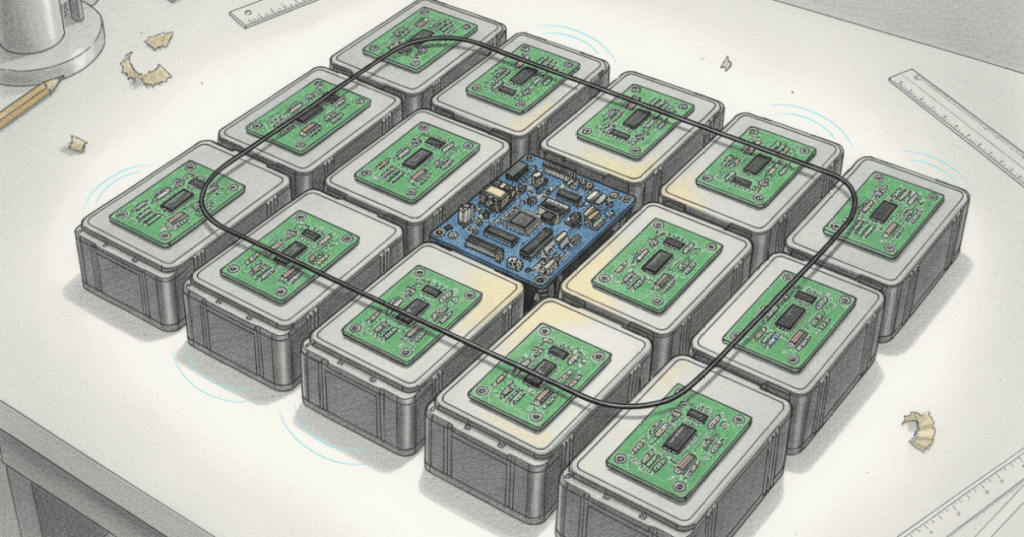
A battery-management system does not have to make the entire battery wireless to eliminate one of its most failure-prone wiring paths.
Dukosi has opened customer sampling of DK-NFLNK, a contactless communication system that replaces the data wiring between conventional battery analog front ends and the BMS host with a single near-field bus antenna.
The battery modules still use conventional monitoring electronics
According to Dukosi’s September 29 release, DK-NFLNK is designed as an upgrade path for modular packs that already use multi-channel analog front ends, or AFEs. That is important because an AFE is the circuitry doing the actual cell-voltage and related analog measurements.
The DK8503 Node connects to an AFE over SPI. Instead of carrying the module’s data onward through a conventional communication harness, the Node communicates through Dukosi’s near-field C-SynQ protocol to a single bus antenna. A DK8203 System Hub then connects that network to the BMS host processor.
This does not make the high-voltage battery wire-free
The distinction matters. DK-NFLNK removes communication wiring and connectors between the monitored modules and the BMS host; it does not eliminate the high-current conductors, busbars, contactors, service disconnects or other electrical connections needed to move power through a battery pack.
Power Electronics News reports that the system is now available for customer sampling and battery-system development. The architecture is AFE-agnostic, so the goal is to let designers evaluate the contactless link without replacing the rest of a conventional modular monitoring architecture.
Why remove the communication harness?
Every connector and cable inside a battery pack creates another mechanical interface that must survive vibration, temperature cycling, assembly variation and years of service. A data harness also consumes routing space and adds manufacturing steps.
Dukosi’s design uses a near-field star network rather than a far-field radio network. The company says that keeps RF power low, provides inherent electrical isolation across the communication link and allows the System Hub to communicate independently with each Node.
For technicians and electrical engineers, the useful question is not whether “wireless” sounds cleaner. It is whether removing connectors reduces actual field failures without introducing synchronization, interference, diagnostics or serviceability problems elsewhere.
Synchronized measurements matter to the BMS
A BMS estimates pack state from measurements distributed across many cells or modules. If measurements representing the same event arrive from meaningfully different moments, fast-changing loads can make comparisons less useful.
DK-NFLNK is therefore designed around synchronized module-level measurements and deterministic communication. The star topology also means a problem at one Node is intended to be identifiable without breaking communication to every other Node in a daisy chain.
Battery architecture is becoming an electrical-engineering bottleneck of its own
The launch arrives as high-power battery systems are scaling in both vehicles and stationary infrastructure. BitcoinVersus.Tech recently covered how Tesla started Megapack 3 production at its 50 GWh Texas Megafactory, putting more attention on the electronics and controls required to operate large battery fleets reliably.
The fundamentals underneath that hardware remain the same ones covered in our electrical-engineering guide to how batteries work. Voltage, current, temperature and cell condition still have to be measured accurately; DK-NFLNK changes how that information travels to the controller.
And as systems grow, distribution and protection become equally important. Our guide to switchgear, switchboards, panelboards and PDUs covers the same broader engineering principle: reliable power systems depend on both the power path and the control/protection architecture around it.
Sampling is not production adoption
DK-NFLNK is now hardware that battery developers can evaluate, but customer sampling is not proof of a production design win. The next meaningful evidence will be integration results, qualification data and named deployments showing that the contactless link survives the electrical, thermal and mechanical environment of a real pack over time.
Still, the engineering idea is straightforward: keep the familiar AFE measurement architecture, remove a complex communication harness, and see whether a near-field bus can carry the same synchronized information with fewer physical failure points.
BitcoinVersus.Tech
Advertisement
Editor’s Note
We volunteer daily to ensure the credibility of the information on this platform is Verifiably True. If you would like to support to help further secure the integrity of our research initiatives, please donate here: 3C9o19EH5HSiwEPyCTmEKzxhNCbo2X6TTb
BitcoinVersus.tech is not a financial advisor. This media platform reports on financial subjects purely for informational purposes.


Leave a Reply