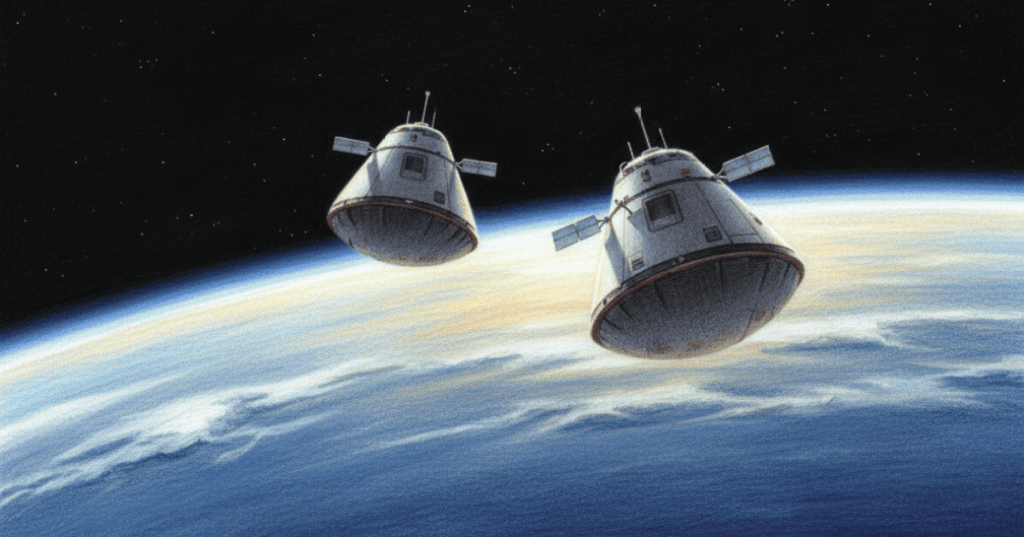
Varda Space Industries has moved its reentry business from one-spacecraft-at-a-time missions toward something that looks more like fleet operations.
On October 1, Varda launched its W-8 and W-9 spacecraft together aboard SpaceX’s Transporter-18 rideshare mission from Vandenberg Space Force Base. It was the first time Varda put two of its W-Series vehicles on the same rocket, with both spacecraft set to be managed in tandem from the company’s expanded mission-operations facility in El Segundo, California.
Two spacecraft on one rocket changes the operating model
Varda said in its official launch announcement that W-8 and W-9 mark a shift toward fleet operations as it increases launch and reentry cadence. The company had already operated two vehicles in orbit at the same time, but had not previously launched two W-Series spacecraft together.
Varda summarized the milestone in its launch-day X post, saying the dual launch represents a move toward higher-cadence fleet operations.
Routine reentry is the part of the space economy Varda is trying to industrialize
Reusable launch vehicles have made reaching orbit more routine, but bringing manufactured materials, experiments and hardware back through the atmosphere is still a specialized operation. Varda’s W-Series combines an orbital spacecraft with a heat-shielded reentry capsule so payloads can be processed or tested in orbit and then returned to Earth.
Varda says it has safely reentered six capsules since 2024. Reuters reported ahead of the dual launch that the company had 28 launch bookings through 2029, giving it a pipeline for testing whether reentry can become a repeatable logistics service rather than a one-off demonstration.
W-8 is turning reentry into a flying heat-shield laboratory
W-8 carries Canopy Aerospace & Defense’s Smart TPS-F payload inside the vehicle. Fiber-optic sensors are designed to measure temperature, heat flux and heat-shield recession during the extreme heating of atmospheric reentry.
Its exterior also carries next-generation thermal-protection materials supported through government hypersonic-testing work and the Air Force Research Laboratory’s Prometheus program. Instead of relying only on wind tunnels or ground testing, those materials can be exposed to a real hypersonic reentry environment.
W-9 is testing navigation and new ablative materials
W-9 carries a navigation system intended to collect data during hypersonic flight. On the exterior, its heatshield includes material samples from Syensqo, including next-generation composites intended to advance ablative thermal-protection technology.
The result is a dual-use operating model. The same basic spacecraft architecture that can return microgravity-processed materials can also expose sensors, navigation hardware and thermal-protection systems to real reentry conditions.
Transporter-18 is becoming a snapshot of the new orbital economy
Varda’s capsules were only part of a much larger rideshare mission. BitcoinVersus.Tech has already covered how Google’s Project Suncatcher put four TPUs in orbit on the same broader wave of orbital-compute experimentation.
Other startups are trying to turn satellites themselves into distributed compute infrastructure. Satlyt is building toward satellite-based AI data centers, while a different part of the market is focusing on keeping spacecraft useful after launch: NASA-backed Otter is designed to inspect dead or uncooperative satellites in orbit.
The milestone is operational, not just visual
Launching two capsules side by side is useful only if Varda can operate, track and return multiple vehicles reliably. The important engineering test now shifts from getting two spacecraft into orbit to running parallel missions without turning each additional vehicle into a proportional increase in operational complexity.
If that model holds, reentry starts to look less like a rare spacecraft event and more like scheduled transportation: more vehicles in orbit, more frequent return opportunities and a larger pipeline for payloads that need to experience space and then come home.
BitcoinVersus.Tech
Advertisement
Editor’s Note
We volunteer daily to ensure the credibility of the information on this platform is Verifiably True. If you would like to support to help further secure the integrity of our research initiatives, please donate here: 3C9o19EH5HSiwEPyCTmEKzxhNCbo2X6TTb
BitcoinVersus.tech is not a financial advisor. This media platform reports on financial subjects purely for informational purposes.


Leave a comment