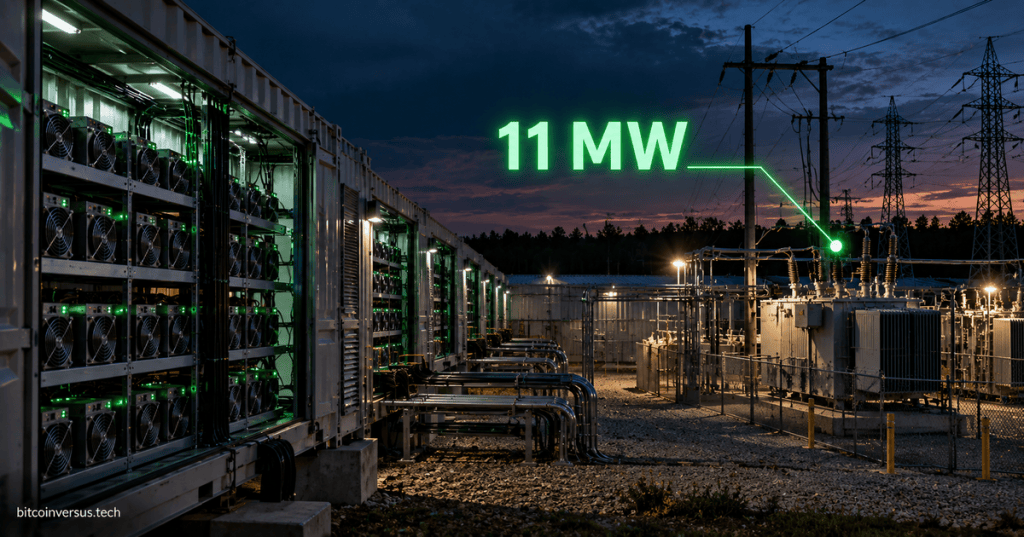
PowerCompute has increased contracted electricity at its Columbus, Mississippi Bitcoin mining site from 8.5 MW to 11 MW, a roughly 29.4% increase in contracted power, while moving the facility onto the Tennessee Valley Authority’s new Large Data Service tariff.
The timing matters. PowerCompute signed the new contract with Columbus Light and Water on Sept. 30, 2026, just before TVA’s fiscal 2027 rules took effect on Oct. 1. The company says none of its 11 MW was assessed TVA’s new capacity-commitment charge, even though new or expanded data-center loads entering under the tariff now face a charge of about $1.5 million per megawatt above the first 5 MW.
For a brand-new 11 MW load, that structure implies roughly $9 million of capacity-commitment charges on the 6 MW above the first 5 MW. PowerCompute’s announcement and its Oct. 6 SEC filing both confirm that the Columbus contract is for up to 11,000 kW of firm power and runs through Sept. 16, 2030. See the company’s official release and SEC filing page.
Why 11 MW Matters
A megawatt is a measure of power capacity, not energy consumed over time. Moving from 8.5 MW to 11 MW gives the site an additional 2.5 MW of contracted demand that can support more ASIC miners, supporting electrical infrastructure, and future compute workloads.
PowerCompute said Columbus Light and Water required no capital contribution for the additional 2.5 MW. The utility is also returning a $300,000 cash deposit, which PowerCompute will replace with a utility bond and says it intends to redirect into the Columbus buildout.
Bitcoin Mining Is Now Explicitly Inside TVA’s Data-Center Rate
TVA adopted the Large Data Service rate in August 2026 as electricity demand from data centers accelerated across the Tennessee Valley. The tariff explicitly treats Bitcoin mining as data-center load.
That change matters because electrical capacity is becoming one of the most valuable assets in both Bitcoin mining and AI/HPC data centers. TVA’s own 2026 Integrated Resource Plan says the region may need an additional 11 to 32 GW of generation capacity through 2040 as demand continues to grow.
TVA’s 2026 Integrated Resource Plan identifies data-center growth as one of the major drivers of future electricity demand and calls for new firm generation, storage, solar, demand-side resources, and distributed generation.
PowerCompute Still Curtails During Peak Hours
The new tariff did not change how PowerCompute operates the Mississippi site during grid peaks. The company says it continues to curtail during on-peak hours and draw its contracted demand during off-peak periods, lowering the demand-charge portion of its electricity cost.
That operating model is one of Bitcoin mining’s key differences from most conventional data centers. ASIC mining loads can be reduced or shut down rapidly when electricity becomes more valuable elsewhere. PowerCompute has increasingly described its business around that flexibility: mine Bitcoin when the economics favor compute, and preserve the option to monetize the same electrical infrastructure through other workloads.
2,373 Antminers Produce About 205 PH/s at Columbus
As of Sept. 30, PowerCompute said the Columbus site had approximately 2,373 installed Antminer machines producing about 205 PH/s of hashrate.
The company has already been refreshing older machines with newer S19 XP miners. BitcoinVersus previously covered PowerCompute’s plan to replace older 95 TH/s units with machines averaging about 132 TH/s, producing nearly 39% more hashrate per machine swap while improving efficiency from roughly 34 J/TH to about 21.5 J/TH.
That is the same basic equation we have been tracking throughout our J/TH efficiency work: a miner that produces more terahashes from the same electrical infrastructure can raise site output without requiring an equal percentage increase in power.
The Site Is Also Positioned for HPC
PowerCompute now owns 26 MW of interconnected capacity across its 15 MW Calumet, Oklahoma site and 11 MW Columbus site. The company says roughly 22.5 MW primarily supports Bitcoin mining, with a smaller portion allocated to an enterprise high-performance computing pilot.
The Columbus tariff classification is therefore strategically important beyond mining. PowerCompute says the site now already carries the rate classification an HPC facility on TVA power would require. That gives the company optionality to treat Bitcoin mining, HPC, and AI compute as competing uses of the same megawatt.
The Bigger Energy Story
This is not simply a 2.5 MW expansion story. It shows how quickly the economics of large electrical loads are changing as utilities respond to AI, data centers, and Bitcoin mining competing for grid capacity.
For miners, securing interconnected power before tariff structures tighten can be almost as important as buying the newest ASIC. The hardware determines how efficiently electricity becomes hashrate; the utility contract determines whether that electricity is available, when it can be used, and what it costs to reserve the capacity in the first place.
The simple takeaway is: PowerCompute did not just add 2.5 MW. It secured 11 MW of TVA-region data-center capacity before a new capacity charge made equivalent new load materially more expensive.
BitcoinVersus.Tech
Advertisement
Editor’s Note
BitcoinVersus.Tech publishes technical explainers and reporting for informational and educational purposes.
BitcoinVersus.tech is not a financial advisor. Content is provided for informational purposes.


Leave a Reply