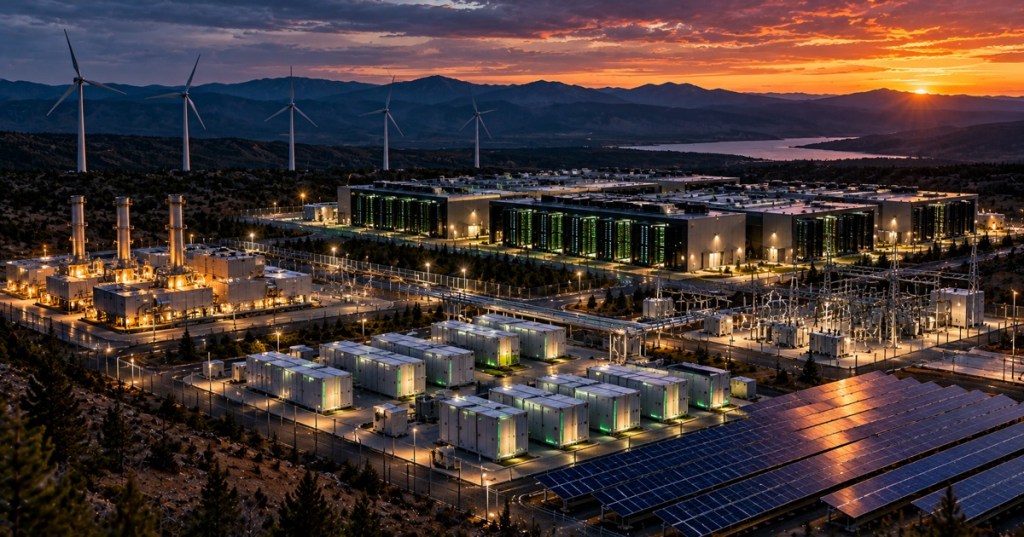
Yes—a data center can run entirely off-grid. But once the facility gets large, the engineering problem changes from “can we make enough electricity?” to “can we make enough electricity every second of every day, through bad weather, equipment failures, maintenance, fuel interruptions, and sudden computing spikes?”
That is why the short answer is not simply yes or no. A remote edge site or modest computing facility can absolutely operate as an islanded microgrid. A hyperscale AI campus drawing hundreds of megawatts can theoretically do the same, but the amount of generation, storage, redundancy, and reserve capacity required makes a permanent grid connection extremely valuable.
The Short Verdict
| Question | Verdict |
|---|---|
| Can a data center operate without the utility grid? | Yes. |
| Can solar plus batteries do it by themselves everywhere? | Usually nah. |
| Can a properly designed microgrid do it? | Yes. |
| Is full off-grid operation normally the cheapest hyperscale design? | Probably nah. |
Off-Grid And Behind-The-Meter Are Not The Same Thing
A facility using onsite generators, solar, batteries, or fuel cells is not automatically off-grid. As BitcoinVersus.Tech explained in our guide to behind-the-meter power, a campus can generate most of its own electricity while keeping a utility connection for backup, balancing, startup power, maintenance, or emergency imports.
A truly off-grid data center has no dependable external utility source. Its local power system has to perform every job the larger grid normally performs: generation, voltage control, frequency control, reserves, black start, fault response, and recovery after equipment trips.
The Microgrid Is The Key
The U.S. Department of Energy says microgrids can support large loads such as data centers by combining local generation, storage, controls, and load management. A microgrid can normally operate while connected to the larger system and can also be designed to island from it.
For a completely off-grid facility, island mode stops being an emergency feature and becomes the normal operating condition. That means the microgrid has to be sized around the worst realistic combination of load, weather, equipment availability, and maintenance—not the average day.
Solar Plus Batteries Sounds Easier Than It Is
Suppose a data center needs 100 MW continuously. That is 2,400 MWh every day before cooling, conversion losses, and reserve margin are added. A solar array might produce enormous power at noon and almost nothing at night, so storage has to move enough daytime energy into the evening and overnight hours.
Then the design has to survive several cloudy days, seasonal changes, battery maintenance, and failures. A project that looks adequate when measured in installed megawatts can still fail when measured in dependable energy over time. That is exactly why capacity factor matters more than nameplate capacity alone.
Firm Generation Makes Off-Grid Operation Much Easier
An isolated data center becomes more practical when variable renewables are paired with a firm power source. Depending on the location, that could mean natural-gas engines or turbines, geothermal, hydro, fuel cells, biomass, or eventually small nuclear reactors.
The storage system then does not have to carry the entire campus through every long-duration energy shortage. It can handle fast load changes, generator transitions, short outages, renewable smoothing, and black-start support while firm generation carries the long-duration load.
Batteries Still Matter Even With Generators
Data centers cannot tolerate casual power quality. Servers, cooling systems, pumps, networking, and power electronics expect tightly controlled voltage and frequency. Batteries can respond much faster than most generators when load changes suddenly.
That is why large computing campuses increasingly combine generation with grid-scale batteries. BitcoinVersus.Tech covered xAI building a large Megapack system behind Colossus 2. A battery does not necessarily replace the primary power plant; it can make the entire local electrical system behave better.
The Hard Part Is Redundancy
A utility grid connects many generators and transmission paths over a huge geographic area. A private off-grid campus has to recreate enough of that redundancy locally.
If the site needs 100 MW, simply installing one 100 MW generator is not enough. Maintenance alone would eventually shut the campus down. Operators need multiple generating units, spare capacity, redundant fuel supply, battery support, multiple electrical paths, and enough reserve to survive the largest expected equipment failure.
Why The Grid Is Still Valuable
The Department of Energy notes that data centers often require firm power because they operate continuously. A utility connection effectively gives the campus access to a much larger pool of generation and reserves than it could economically build for itself.
That is why the most practical architecture for many giant facilities may be a hybrid: large onsite generation plus batteries plus a grid connection. The site can make most of its own electricity, reduce transmission dependence, and even island during disturbances without permanently giving up the grid as another layer of redundancy.
Could A Hyperscale AI Campus Really Do It?
Yes, technically. Give the campus enough land, generation, storage, fuel infrastructure, switchgear, transformers, controls, spare equipment, and money, and there is nothing physically impossible about a large computing campus operating independently.
The question is whether complete isolation provides enough benefit to justify duplicating infrastructure the regional grid already provides. In remote areas, at stranded-energy sites, or where utility interconnection would take years, the answer could be yes. In many established markets, remaining grid-connected while building substantial onsite power will usually be more flexible.
So: Fully Off-Grid Data Centers, Or Nah?
Technically valid? Absolutely. Usually optimal at hyperscale? Nah—not yet.
The interesting part is that the industry is moving closer to the idea anyway. Data centers are adding more onsite generation, more batteries, more microgrid controls, and more ability to operate independently when the utility system is constrained.
The future may therefore be less about choosing between “grid” and “off-grid” and more about building campuses that can do both: use the grid when it is useful, operate themselves when necessary, and treat electricity infrastructure as part of the data-center architecture rather than something that simply arrives at the property line.
BitcoinVersus.Tech
Advertisement
Editor’s Note
We volunteer daily to ensure the credibility of the information on this platform is Verifiably True.
If you would like to support our research and publishing work, please donate here: 3C9o19EH5HSiwEPyCTmEKzxhNCbo2X6TTb
BitcoinVersus.tech is not a financial advisor. This media platform reports on financial and technology subjects purely for informational purposes.


Leave a comment