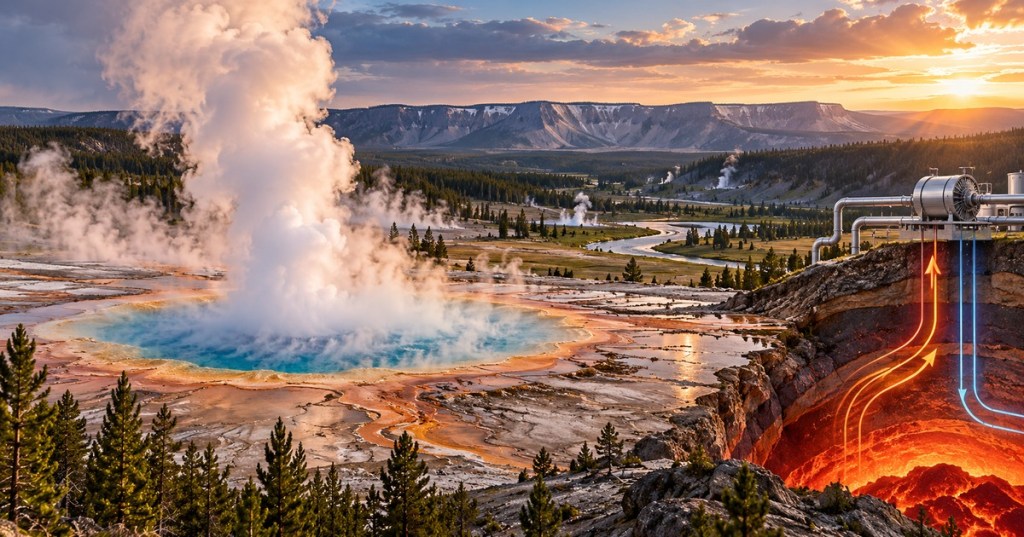
If by “biomass energy from Yellowstone” we mean using the volcano’s heat to make electricity, the correct term is geothermal energy. Biomass comes from organic material such as wood, crop waste, manure, or other biological feedstocks. Yellowstone’s energy comes from heat moving upward from the Earth.
And that heat is absolutely real. Yellowstone sits above a powerful geothermal system that drives geysers, hot springs, mudpots, and fumaroles. The scientific question is not whether the energy exists. It does. The harder question is whether humans should try to industrially extract it.
The Short Verdict
| Question | Verdict |
|---|---|
| Is this biomass energy? | No. It is geothermal energy. |
| Could Yellowstone’s underground heat theoretically generate electricity? | Yes. The physics are valid. |
| Should Yellowstone National Park itself be drilled for commercial power? | No. It is legally protected and the hydrothermal system is too valuable and fragile. |
| Is geothermal energy itself a bad idea? | No. It is already a useful renewable resource in many other locations. |
Why The Physics Are Legit
The U.S. Geological Survey describes Yellowstone as a major magmatic-hydrothermal system. Heat from deep rock warms groundwater, and that hot water rises through fractures toward the surface. USGS says convection carries much of the system’s heat upward and that local thermal areas can produce extraordinarily high heat flow.
That is basically the raw ingredient used by a conventional geothermal power plant: underground heat, water, and permeability. A well can bring hot fluid or steam to the surface, a turbine can convert that thermal energy into electricity, and the cooled fluid can often be reinjected underground.
That also makes geothermal a good example of the distinction BitcoinVersus.Tech covered in clean versus renewable energy. Geothermal is generally treated as renewable because Earth continually supplies heat, but each project still has to be engineered around local geology, water, emissions, and environmental constraints.
Why Yellowstone Is Different
Yellowstone is not just a hot piece of land with unused heat under it. Its underground plumbing is the system that creates Old Faithful, Grand Prismatic Spring, Norris Geyser Basin, and thousands of other hydrothermal features.
Commercial geothermal extraction changes pressure and fluid flow. That can reduce spring discharge, change geyser timing, or cause thermal features to disappear. USGS explicitly warns that extracting heat and fluid from Yellowstone could alter the geysers and hot springs people are trying to preserve.
This is also why “there is lots of heat” does not automatically equal “there is lots of usable electricity.” The same lesson applies to capacity factor and real-world power output: theoretical energy availability is only one part of an operating power system. Conversion efficiency, reservoir behavior, transmission, drilling risk, maintenance, water chemistry, permitting, and environmental limits all determine what can actually be delivered to the grid.
No, The Main Problem Is Not “Waking Up The Supervolcano”
The strongest scientific objection is not a movie-style claim that a few geothermal wells would automatically trigger a Yellowstone supereruption. The deeper magma system is enormous, complex, and mostly crystalline, and USGS says large-scale drilling or magma-quenching schemes would be technically difficult, expensive, and potentially create unintended consequences.
The immediate concern is much more practical: disturbing the shallow hydrothermal plumbing that produces the park’s geysers and hot springs. That system is sensitive enough that pressure changes from development outside the park can also matter if the underground reservoirs are connected.
The Legal Answer Is Also Basically No
Yellowstone National Park is protected from commercial geothermal development. Federal geothermal law requires significant thermal features in national parks to be protected, and projects outside park boundaries can also face restrictions if they are reasonably likely to damage those features.
That policy makes scientific sense. Once a geyser system loses the pressure, permeability, or fluid pathway that makes it work, engineers cannot simply promise to rebuild the exact natural feature later.
The Ethical Question Goes Beyond Electricity
Yellowstone is also not empty industrial land. It is a protected ecosystem, a scientific observatory, a public landscape, and the traditional homeland of many Tribal Nations. The National Park Service recognizes continuing Indigenous connections to Yellowstone and consults associated Tribes when decisions could affect culturally significant resources.
That changes the ethical calculation. If the United States can produce geothermal electricity at other sites without risking one of the world’s most unusual hydrothermal systems, destroying or degrading Yellowstone’s features for marginally more power would be difficult to justify.
What About Drilling Outside The Park?
This is the more serious engineering question. In principle, geothermal resources outside Yellowstone could be used if developers could demonstrate that the target reservoir is not hydraulically connected to protected park features and that induced seismicity, water loss, subsidence, and thermal depletion are acceptably controlled.
But the burden of proof should be high. Yellowstone’s underground water pathways do not stop neatly at the park boundary. A project several miles away could still affect the same broader hydrothermal system.
This is similar to the logic behind using stranded energy: finding an underused energy resource can be economically attractive, but the fact that energy is available does not erase environmental, engineering, or social constraints on how it should be developed.
So: Valid Or Nah?
The geothermal idea is scientifically valid. The Yellowstone project idea is mostly a nah.
There is enough heat beneath Yellowstone to make geothermal power an obvious thought experiment. But the park’s hydrothermal system is the resource being protected, not wasted energy waiting for a developer. The same heat that looks attractive on an engineering diagram is what keeps the geysers, hot springs, microbial ecosystems, and cultural landscape alive.
The smarter energy strategy is to take the geothermal technology and use it where extraction does not threaten a globally unique protected system. Yellowstone is better treated as a natural laboratory that teaches us how geothermal systems work than as a power plant waiting to be drilled.
BitcoinVersus.Tech
Advertisement
Editor’s Note
We volunteer daily to ensure the credibility of the information on this platform is Verifiably True.
If you would like to support our research and publishing work, please donate here: 3C9o19EH5HSiwEPyCTmEKzxhNCbo2X6TTb
BitcoinVersus.tech is not a financial advisor. This media platform reports on financial and technology subjects purely for informational purposes.


Leave a Reply