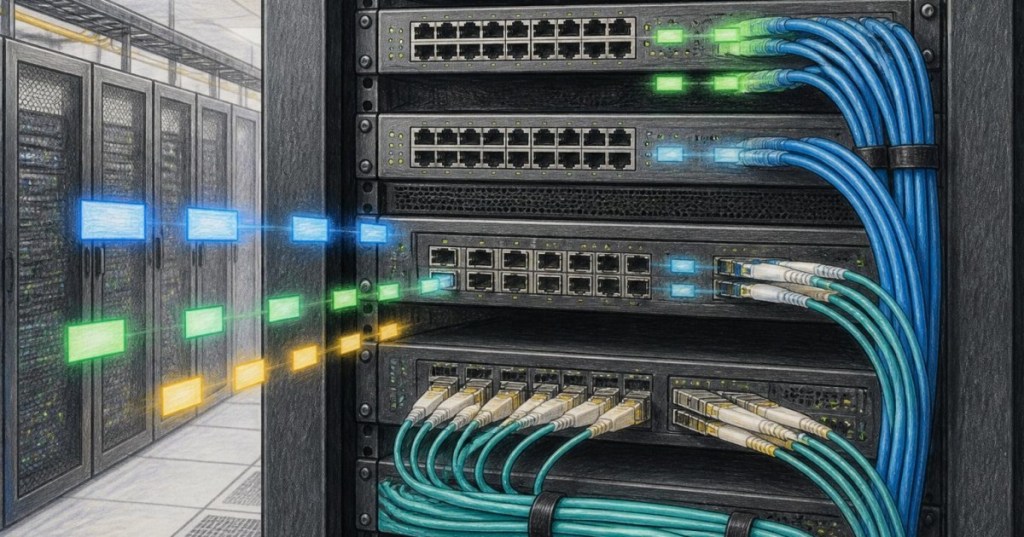
MTU means Maximum Transmission Unit: the largest network-layer packet an interface can carry without requiring fragmentation. On ordinary Ethernet networks, 1,500 bytes is the familiar IP MTU. “Jumbo frames” raise that ceiling, commonly to around 9,000 bytes.
The idea is simple: larger packets can move the same amount of application data with fewer packets. But every device along the path has to support the chosen size, which is why an MTU mismatch can create surprisingly confusing network failures.
Why Ethernet Usually Uses A 1,500-Byte MTU
Ethernet carries frames, while IP carries packets inside those frames. The standard Ethernet payload can carry a 1,500-byte IP packet, so operating systems commonly configure Ethernet interfaces with an MTU of 1,500.
The full Ethernet frame is larger because it also includes Ethernet headers and a frame check sequence. MTU therefore does not mean “total number of bits placed on the wire.” It describes the maximum payload at the network-layer boundary being discussed.
What Jumbo Frames Change
A jumbo-frame network permits Ethernet payloads larger than the conventional 1,500-byte size. A value near 9,000 bytes is common in data-center environments, although “jumbo frame” is an operational term rather than one universal Ethernet size that every vendor implements identically.
Larger packets mean fewer packet headers and fewer packets for network interfaces and CPUs to process when transferring the same amount of data. That can be useful for storage, virtualization, high-performance computing and other controlled high-throughput networks.
Why Bigger Is Not Automatically Better
The problem appears when one part of the path accepts a large packet and another does not. Switch ports, routers, virtual switches, network-interface cards and tunnels may all have their own MTU limits. A network works best when the path is designed consistently rather than when one server simply enables a larger number.
That is closely related to the troubleshooting ideas in our packet loss and jitter guide: link speed alone does not guarantee good application behavior when packets are being dropped, delayed or handled incorrectly.
IPv4 Can Fragment; IPv6 Routers Do Not
With IPv4, a router may fragment a packet when the next link cannot carry it, unless the packet’s Don’t Fragment behavior prevents that. Fragmentation adds work and makes troubleshooting harder, so modern networks generally try to discover the usable path MTU instead.
IPv6 handles this differently: routers do not fragment packets in transit. The sending host is expected to use Path MTU Discovery and reduce packet size when necessary. That makes correct ICMP handling important to reliable IPv6 connectivity.
How To Test MTU
One useful diagnostic is a ping that asks the operating system not to fragment the packet. On Linux, the following command sends a 1,472-byte ICMP payload; after adding the 20-byte IPv4 header and 8-byte ICMP header, the IP packet reaches 1,500 bytes.
ping -M do -s 1472 example.comIf that works but a larger probe fails, the path may be telling you where its packet-size ceiling sits. Exact command syntax differs across operating systems, and tunnels such as VPNs add their own headers, reducing the amount of original traffic that fits inside the outer packet.
Where MTU Fits In A Data Center
Data-center networks connect servers through switches, optical links and structured cabling. Our top-of-rack switch explainer shows the first switching layer many servers encounter, while our data-center cabling guide covers the physical copper and fiber underneath those logical packet settings.
For operators, the practical rule is straightforward: use the standard MTU unless the network has a specific reason to use jumbo frames, and change it as a designed end-to-end configuration rather than as an isolated server tweak.
The Easy Mental Model
Think of MTU as the size limit on a package moving through a delivery system. Larger boxes can reduce the number of trips, but the advantage disappears if one doorway along the route is too small. Jumbo frames work the same way: they are useful when the entire intended path is built to carry them.
Sources
Technical references: RFC 1191: Path MTU Discovery and RFC 8201: Path MTU Discovery for IPv6.
BitcoinVersus.Tech
Advertisement
Editor’s Note
We volunteer daily to help keep the information on this platform verifiably accurate. If you would like to support our independent research, please donate here: 3C9o19EH5HSiwEPyCTmEKzxhNCbo2X6TTb
BitcoinVersus.tech is not a financial advisor. Content is provided for informational purposes.


Leave a Reply