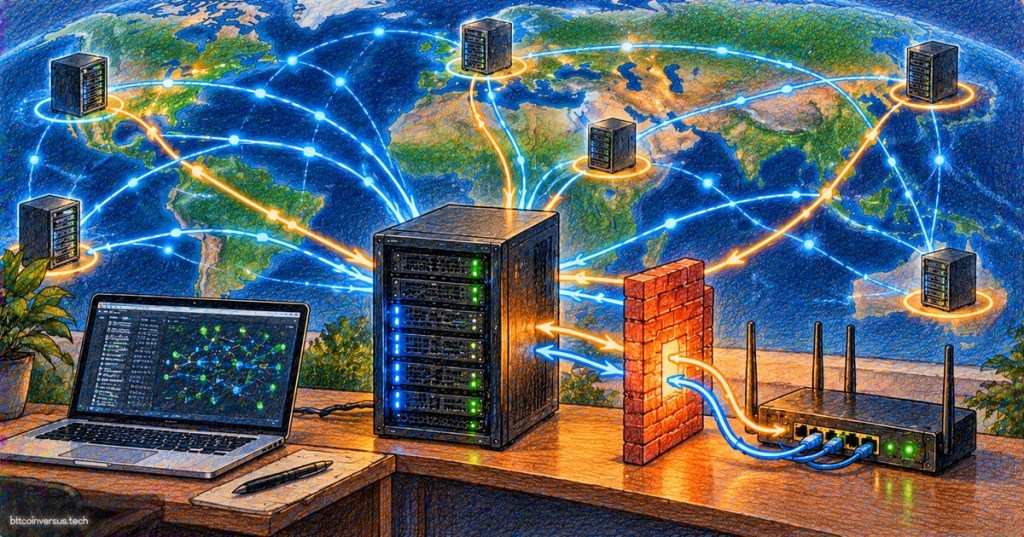
Bitcoin’s peer-to-peer network normally uses TCP port 8333 on mainnet. That is the network path Bitcoin nodes use to discover one another, exchange version information, relay transactions, announce blocks, request missing data, and keep thousands of independent copies of the blockchain synchronized.
Port 8333 is not a wallet login, web page, mining-pool port, or Bitcoin Core administration interface. It is the default peer-to-peer listening port defined for Bitcoin mainnet. Bitcoin’s developer documentation states that normal P2P communication runs over TCP, with 8333 as the mainnet default.
Bitcoin Nodes Form a Peer-to-Peer Network
Bitcoin does not have one central blockchain server. A full node connects to several other nodes, validates data it receives, and independently decides whether transactions and blocks satisfy the consensus rules.
This architecture resembles other distributed systems, but Bitcoin’s trust model is different from ordinary client-server software. A node does not accept a block merely because a trusted server sent it. It checks proof of work, transaction validity, block structure, subsidy rules, scripts, and the chain of previous headers for itself.
That same validation model is why BitcoinVersus.Tech’s coinbase transaction and block subsidy explainers emphasize that miners propose blocks while full nodes enforce the rules.
Port 8333 Is Bitcoin Mainnet P2P Traffic
The Bitcoin developer reference lists 8333/TCP as the default mainnet P2P port. Test networks use different defaults so test traffic is separated from production Bitcoin traffic.
A node can initiate an outbound TCP connection from an ephemeral local port to another node listening on 8333. If the local node is publicly reachable and configured to accept inbound peers, remote nodes can also initiate connections to its listening port.
This is ordinary networking underneath the Bitcoin protocol. The operating system creates TCP sockets through a network interface card, routes packets toward a gateway, and may cross NAT/PAT before reaching the public internet.
8333 and 8332 Are Not the Same Thing
One of the most important Bitcoin IT distinctions is 8333 vs. 8332. Port 8333 is used for P2P node traffic. Port 8332 is commonly associated with Bitcoin Core’s mainnet JSON-RPC interface when RPC is enabled.
BitcoinVersus.Tech’s Bitcoin Core RPC explainer covers commands such as getblockchaininfo, getpeerinfo, and getblock. RPC is an administrative/programmatic interface and should not be treated like a public P2P service.
Opening port 8333 does not require exposing RPC. A correctly designed node can accept Bitcoin peers on 8333 while keeping RPC bound to localhost or another tightly controlled management network.
A Brand-New Node Has to Find Its First Peers
A fresh Bitcoin Core installation begins with a practical networking problem: it does not yet know the IP addresses of active Bitcoin peers. There is no central account server that hands it a membership list.
One bootstrap mechanism is a set of DNS seeds. Bitcoin Core includes the domain names of independently operated seed services. A new node can query those names through the normal DNS system and receive IP addresses of nodes that are likely to be reachable.
The Bitcoin developer guide explains that DNS seeds are a starting point rather than a permanent central dependency. Once a node has connected to peers, it learns additional addresses directly from the network and stores peer-address information locally for later use.
DNS Seeds Are Not Trusted Consensus Servers
A DNS seed can help a node locate possible peers, but it does not tell the node which transactions or blocks are valid. The node still validates everything it receives.
This separation matters. A malicious or compromised seed could attempt to return attacker-controlled peers, but it cannot simply redefine Bitcoin’s block subsidy, signatures, proof-of-work requirement, or transaction rules. Bitcoin implementations also use multiple discovery mechanisms and do not rely on one seed forever.
Peers Tell Peers About Other Peers
After joining the network, a node can receive peer-address announcements and discover more nodes without repeatedly depending on DNS seeds. Bitcoin’s P2P protocol includes messages for exchanging network addresses so the graph grows organically.
This is what turns a few bootstrap connections into a decentralized peer mesh. One node learns several addresses, tries selected candidates, records useful peers, drops broken or misbehaving connections, and continues discovering alternatives over time.
The Version/Verack Handshake Comes First
Once the TCP connection is established, Bitcoin peers do not immediately start throwing blocks at each other. They first perform a protocol handshake.
A peer sends a version message containing information such as protocol version, supported service flags, node software identification, and blockchain height information. A compatible remote peer responds and acknowledges the connection with verack.
This resembles application-layer negotiation in other network protocols: TCP creates the transport connection first, then Bitcoin software determines what the remote endpoint can actually do.
Service Flags Tell Peers What a Node Can Provide
Bitcoin nodes can advertise capability flags. A peer may indicate that it can serve blockchain data, understands witness data, supports limited historical serving behavior, or supports newer P2P features.
These flags help Bitcoin Core decide which peers are suitable for different tasks. A node trying to complete initial synchronization needs peers capable of serving the necessary block data, while another connection may be useful primarily for block relay.
Initial Block Download Starts With Headers
When a node is far behind the network tip, it performs Initial Block Download, commonly shortened to IBD. The process is not simply “download one giant blockchain file.”
The node first learns about the chain of block headers. Headers are compact—Bitcoin block headers are only 80 bytes—and contain the previous-block hash, Merkle root, timestamp, difficulty target representation, version, and nonce.
Once the node has identified the best valid header chain, it requests full blocks from peers and validates them. This design lets the node reason about proof of work and chain structure before every transaction in every missing block has arrived.
Transactions and Blocks Are Announced Before They Are Requested
Bitcoin’s network tries to avoid blindly sending every possible object to every peer. Nodes announce inventory and peers request data they do not already have.
For transactions, the process feeds the local mempool. For blocks, the process keeps the node synchronized with new proof of work. Miners and pools ultimately depend on this propagation because new transactions create fee opportunities and new blocks determine the chain tip they should build on.
Compact Block Relay Reduces Bandwidth
Modern Bitcoin nodes often already have most of the transactions contained in a newly mined block sitting in their mempools. Sending the entire block again would waste bandwidth.
Compact block relay allows peers to describe much of a new block using short transaction identifiers and request only the pieces they are missing. Faster block propagation reduces the amount of time miners spend building on an outdated tip and therefore helps reduce stale-block risk.
You Do Not Need Inbound Port 8333 to Validate Bitcoin
A node can initiate outbound peer connections and validate Bitcoin without being publicly reachable for inbound connections. Opening or forwarding port 8333 mainly allows other nodes to initiate connections to you.
That makes inbound reachability useful to the broader network because it increases the pool of nodes available to other peers, but it is not a prerequisite for independently verifying your own transactions and blocks.
Why Home Routers Complicate Inbound Connections
Most home networks use private IPv4 addresses behind a router performing NAT/PAT. The Bitcoin node may be listening on 192.168.x.x:8333, but internet peers cannot directly initiate a connection to that private address.
A port-forwarding rule maps public TCP 8333 to the node’s private address and port. The host router and firewall must also permit the traffic.
Carrier-grade NAT can complicate this further because the subscriber may not control the public IPv4 address at all. IPv6, Tor, VPN-based forwarding, or ISP-provided public addressing can change the available options.
A Firewall Can Block 8333 Even When Bitcoin Core Is Listening
There are several separate layers that must agree before an inbound peer reaches Bitcoin Core: the application must listen, the operating-system firewall must allow it, the router must forward it when NAT is present, and the ISP path must permit inbound connectivity.
This is why “Bitcoin Core says listening” does not necessarily mean “the internet can reach my node.” A technician should troubleshoot each layer separately instead of changing application settings at random.
Use getpeerinfo to See the Actual Connections
Bitcoin Core’s getpeerinfo RPC command provides detailed information about connected peers. Depending on the current Bitcoin Core release, fields can include remote address, inbound/outbound direction, connection duration, services, protocol version, synchronization height, bytes sent and received, ping time, and connection type.
This makes bitcoin-cli and JSON-RPC useful networking tools, not just blockchain-query tools. If a node appears stuck, getpeerinfo can show whether it has usable peers and whether those peers are actually exchanging data.
Peer Addresses Are Cached Locally
Bitcoin Core does not need to start from zero every time it restarts. It maintains local peer-address information so previously learned network knowledge can be reused. Modern Bitcoin Core data directories include files such as peers.dat, and specialized anchor information can help preserve useful block-relay connectivity between restarts.
This is why DNS seeds are most important during bootstrap and recovery. A node that has been running for months already knows about many potential peers from direct network interaction.
Modern Bitcoin Can Use P2P v2 Transport
Recent Bitcoin Core releases can negotiate the newer BIP324 v2 transport with compatible peers. The v2 transport changes how P2P messages are carried on the wire and adds encrypted transport with traffic-shaping benefits compared with the original plaintext framing.
This is not the same thing as HTTPS/TLS, and it does not turn an arbitrary peer into a trusted authority. Bitcoin’s consensus security still comes from independently validating the data.
Tor Changes the Addressing, Not the Consensus Rules
Bitcoin Core can connect through Tor and communicate with onion peers. In that configuration, a node may not expose the same public IPv4 address or conventional port-forwarding path used by clearnet peers.
Tor changes how peers reach each other and can improve network-level privacy, but the Bitcoin messages and consensus validation remain Bitcoin. A node still verifies transactions and blocks rather than trusting the transport network.
Port 8333 Is Not a Mining-Pool Stratum Port
ASIC miners usually do not point directly at random Bitcoin nodes on port 8333. They connect to a mining pool using a mining protocol such as Stratum, often on a pool-specific TCP port.
The pool or mining server then communicates with Bitcoin full-node software to obtain block templates, monitor the chain tip, and broadcast valid blocks. This separation is why a mining operation may have ASIC VLANs, Stratum servers, and Bitcoin Core nodes performing different network roles.
A Simple Troubleshooting Sequence
- Confirm Bitcoin Core is running and has completed enough startup work to establish peers.
- Use getpeerinfo or getconnectioncount to confirm whether connections exist.
- Verify the host has working DNS and general internet connectivity.
- Check whether outbound TCP traffic is allowed.
- Verify the configured Bitcoin network: mainnet, testnet, signet, or regtest.
- For inbound reachability, confirm Bitcoin Core is listening on the expected interface and port.
- Check the operating-system firewall.
- If using IPv4 NAT, verify the router’s port-forwarding/NAT rule.
- Determine whether the ISP uses carrier-grade NAT.
- Inspect peer logs and RPC data before resetting configuration or deleting peer databases.
The Simple Way to Remember It
Port 8333 is where Bitcoin nodes talk to Bitcoin nodes. DNS seeds help a new node find a few starting peers, peer gossip expands that address book, the version/verack handshake establishes compatibility, and Bitcoin Core then exchanges headers, transactions, and blocks while validating everything locally.
For Bitcoin IT work, the key distinction is operational: P2P networking, RPC administration, and mining-pool Stratum traffic are three different interfaces. Mixing them together is one of the easiest ways to misconfigure a node or expose something that should have stayed private.
References
- Bitcoin Developer Reference — P2P Networking
- Bitcoin Developer Guide — P2P Network and Peer Discovery
- Mastering Bitcoin — The Bitcoin Network
- BIP324 — Version 2 P2P Encrypted Transport Protocol
BitcoinVersus.Tech
Advertisement
BitcoinVersus.Tech covers Bitcoin, Bitcoin mining, networking, Linux, data centers, ASIC hardware, energy, semiconductors, and the infrastructure behind decentralized computing.
Editor’s Note
Bitcoin Core connection defaults, transport features, peer-selection logic, data-directory formats, and network options evolve across releases. Confirm behavior against the exact Bitcoin Core version and operating-system/network configuration used in production.
We volunteer daily to help keep the information on this platform verifiably accurate. Support our independent research through the support options available on BitcoinVersus.Tech.
BitcoinVersus.tech is not a financial advisor. Content is provided for informational purposes.


Leave a comment