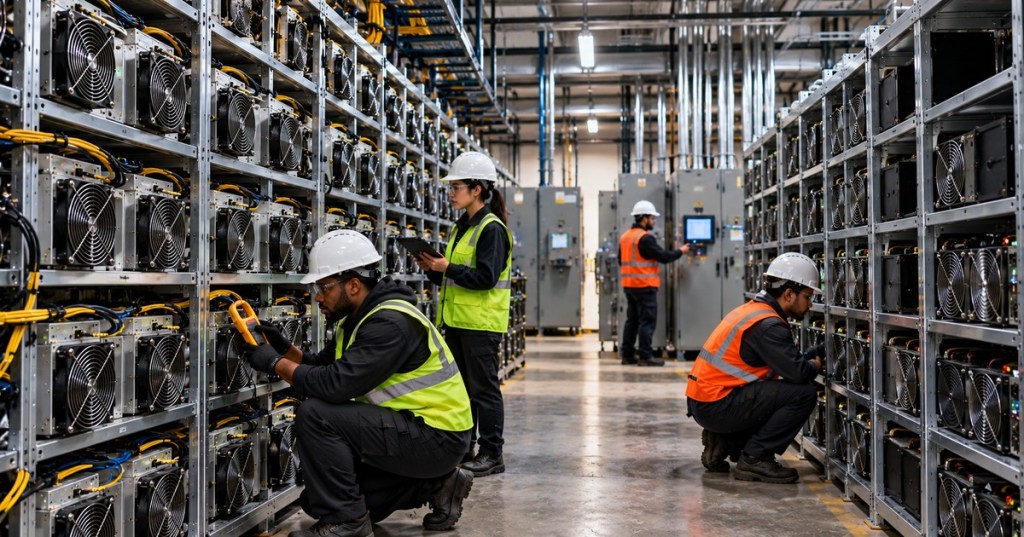
A fresh field report from a long-running Bitcoin mining operation shows how small efficiency gaps become operating decisions when hashprice compresses. Two Canaan Avalon miners launched on the same day in 2022—the 130 TH/s A1366 at 25 J/TH and the 110 TH/s A1346 at 30 J/TH—were bought only weeks apart. When mining economics deteriorated, the more efficient A1366 kept hashing while the A1346 spent roughly two months offline.
The October 7 field report from Firsthand Bitcoin is useful because it turns joules per terahash from a specification-sheet number into a real fleet decision. Five joules separated two machines from the same generation, and that gap was enough to change which one could economically stay online.
Canaan Launched Both A13 Miners on the Same Day
Canaan introduced the A13 series on October 24, 2022. Its original launch announcement listed the A1346 at 110 TH/s and 30 J/TH, while the A1366 was rated at 130 TH/s and 25 J/TH.
The difference sounds modest when written as a single line in a spec table. The A1366 uses about 17% less energy per terahash than the A1346. But because Bitcoin mining revenue is earned per unit of hashrate while electricity is paid per kilowatt-hour, that efficiency difference compounds every hour the machine runs.
Canaan’s current product references still show the same basic profiles: the A1346 at roughly 3,310 W and the A1366 around 3,250 W for its higher hashrate. That means the A1366 produces more Bitcoin-mining work while drawing slightly less total power.
At Today’s Hashprice, Five Joules Can Cross the Break-Even Line
Using the roughly $39.14/PH/s/day spot hashprice BitcoinVersus tracked today, the nominal 130 TH/s A1366 grosses about $5.09 per day before pool fees and site overhead. The 110 TH/s A1346 grosses about $4.31 per day.
At 6¢/kWh, the A1366’s 3.25 kW draw costs about $4.68 per day, leaving roughly 41¢ before every non-electric operating expense. The A1346’s 3.31 kW draw costs about $4.77 per day, putting it roughly 46¢ underwater on electricity alone.
Put another way, using the same hashprice and nameplate power, the electricity-only break-even rate is about 6.5¢/kWh for the A1366 versus about 5.4¢/kWh for the A1346. Pool fees, cooling, labor, networking, downtime, repairs and financing all push the real site break-even lower.
This is why BitcoinVersus recently argued that an ASIC’s J/TH is not the same as a mine’s total J/TH. Nameplate efficiency defines the starting point, but the facility still has to pay for every watt around the machine.
The A1366 Banked More of Its Lifetime Bitcoin Before the Halving
Firsthand Bitcoin reports that its A1366 began hashing in January 2023, 445 days before the April 2024 halving. During that pre-halving stretch, the machine mined about 0.1350 BTC—roughly 71% of the Bitcoin it had mined by October 2026.
That result illustrates a second lesson: lifetime machine economics depend heavily on when the hardware enters service. The same ASIC can look excellent during a high-subsidy, high-hashprice period and marginal after a halving plus several years of difficulty growth.
The network environment changed dramatically around these machines. Bitcoin’s global hashrate rose from roughly 274 EH/s in early 2023 to near the 1 ZH/s range in October 2026. The machine did not become slower, but its share of the network’s total work became much smaller.
Older ASICs Do Not All Age at the Same Speed
ASIC obsolescence is not a calendar date. A machine becomes economically obsolete when the value of its hashrate no longer clears the operator’s marginal cost structure. That can happen years apart for two miners launched together if their efficiencies are different enough.
The A1366 and A1346 make that visible. Both are now far behind Canaan’s current A16 generation, which has moved the company’s air-cooled fleet into roughly the 12.8–13.8 J/TH range. BitcoinVersus recently covered how newer Canaan hardware compares across air, hydro and immersion fleets.
Canaan’s 2025 annual filing shows the generational curve clearly: A13 hardware at 25–30 J/TH, A14 around 21.5 J/TH, A15 around 16.8–19 J/TH, and A16 around 12.8–13.8 J/TH. The direction is simple even when the economics are not—newer machines need fewer joules to produce the same terahash.
Watch the A1366 Run in a Lower-Power Mode
The video below shows an A1366 being tested in a reduced-power “silent mode,” demonstrating how operators can trade hashrate for lower wattage and noise when full-power operation is not the best economic choice.
What This Means for Fleet Operators
- Track machine-level J/TH and site-level J/TH separately.
- Build curtailment order from marginal profit, not machine age alone.
- Use electricity-only break-even as a ceiling, not as true profitability.
- Include pool fees, cooling, maintenance, labor and downtime before deciding whether to keep an older ASIC online.
- Compare replacement hardware by incremental watts saved per terahash, not only by sticker price.
- Preserve historical operating data; real machine history is often more useful than a launch-day specification.
The A13 comparison is a simple case study, but the lesson scales to an entire mine. At 10,000 machines, a few joules per terahash can represent megawatts of difference. When hashprice falls toward the margin, efficiency stops being a marketing number and becomes the order in which machines stay on—or go dark.


Leave a Reply