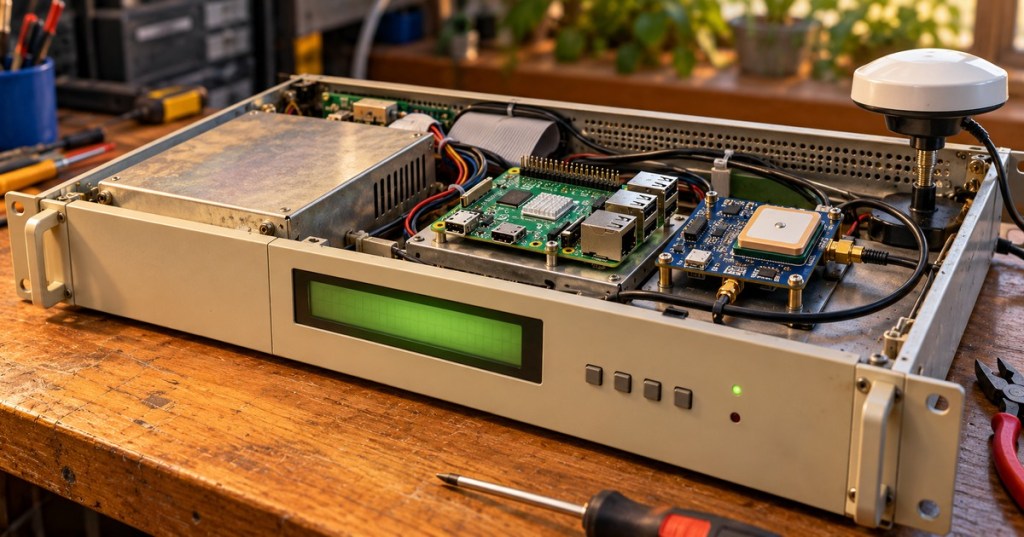
A beige GPS time server built in 1995 is back on the network in 2026, but the electronics doing the real work inside it are now a Raspberry Pi 5 and a modern GNSS timing board.
Maker and engineer Jeff Geerling rebuilt a TrueTime XL-AK as a Stratum 1 Network Time Protocol server while preserving much of the machine’s original personality: its rackmount case, 16×2 LCD, status light and front-panel hardware. The result is part restoration, part modern infrastructure project, and a useful reminder that accurate time is something computers quietly depend on all day.

The old box got a new clock brain
Inside the chassis, Geerling installed a Raspberry Pi 5 and Jimmy Paputto L1 GNSS HAT. The receiver gets satellite timing information and produces a pulse-per-second signal, while NTP software distributes that time to other machines on the network.
That distinction matters. GPS and other GNSS systems are not just navigation tools; their satellites also carry highly accurate time. A Stratum 1 NTP server sits one step away from a reference clock, so the Pi can turn that satellite-derived timing into something ordinary computers, servers and vintage machines can use over a network.
Geerling used Chrony to combine the GNSS data with the precise PPS edge. He also tuned the Pi for steadier timing by running the fan at a consistent speed, keeping the processor frequency fixed, insulating the area around the oscillator and dedicating a CPU core to PPS interrupt handling. Those are unusually obsessive tweaks for a Raspberry Pi, but clock stability is exactly the point of the project.
Why a time server suddenly became a big story
The restoration landed just weeks after a separate real-world failure made network time impossible to dismiss as background plumbing. On July 8, Australia’s Telstra suffered a major mobile outage after incorrect date information propagated through parts of its network following maintenance on a timing system. An external investigation released by Telstra later found that network timing had not been treated as a sufficiently critical capability, with gaps in ownership, expertise, documentation and change discipline.
The Telstra equipment was not Geerling’s TrueTime XL-AK, and the two projects should not be conflated. The connection is the lesson: if a network trusts the wrong date, failures can spread far beyond a clock display. ABC’s report on the review said the July incident began after a faulty power supply was replaced and a GPS card reset its date to 2006.
The best part is how much old technology still works
Geerling did not simply hide a new computer inside an old shell. He mapped the Pi’s GPIO to the original Densitron display, reused the bicolor status LED and used wire wrapping where normal jumper connectors would not fit. He also made the conversion reversible: the original TrueTime electronics can be restored by reconnecting two internal connectors.
Then he went further backward. The server can provide the pre-NTP RFC 867 and RFC 868 Time and Daytime services, and it can serve AppleTalk time through Netatalk’s Timelord so old Macintosh computers can synchronize too. A machine that began life when Windows 95 was new can now bridge satellite timing, Linux, modern Ethernet and classic Macs.
It has already gone back to work
This was not only a bench demo. In a follow-up from Vintage Computer Festival Midwest, Geerling said the TrueTime Pi served as the GNSS reference and Stratum 1 NTP server for his timekeeping exhibit, with additional vintage protocols available on the show network.
That is what makes the project more interesting than a simple retro-computing makeover. The chassis is nostalgic, but the service it provides is current. Modern networks still need trustworthy time, and this 31-year-old box now has a second career delivering it with hardware that costs a fraction of what specialized timing systems once did.


Leave a Reply