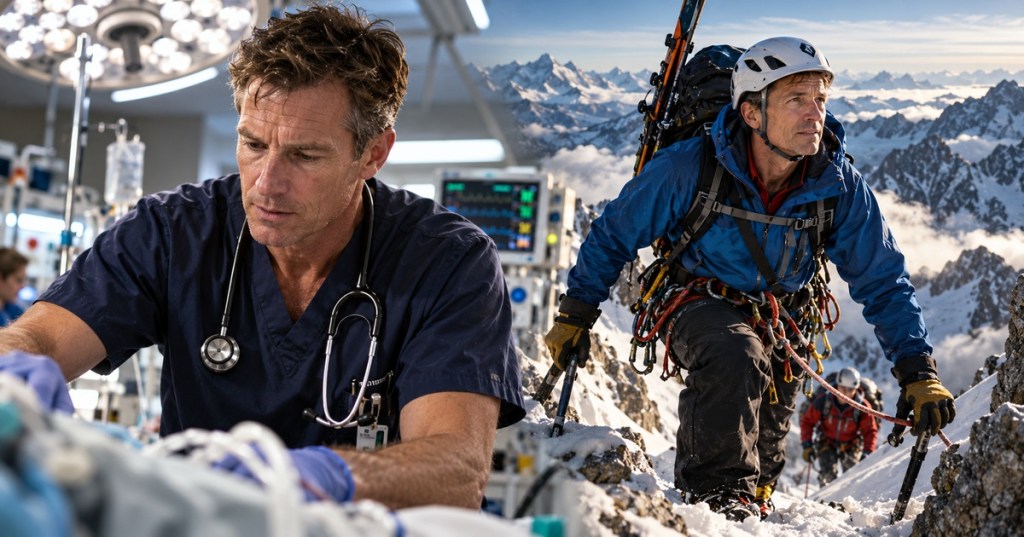
Alan Oram built two careers where bad decisions can become emergencies very quickly.
He is a board-certified emergency medicine physician and an internationally licensed mountain guide. That combination puts him squarely inside the kind of Career Journalist profile we are looking for: one demanding profession layered on top of another that requires its own years of training, certification and judgment.
Oram says on his public professional biography that he graduated from medical school in 1992, completed residencies in both family practice and emergency medicine, and later completed the American Mountain Guides Association certification program in 2015. He is licensed through the International Federation of Mountain Guides Associations and works across rock, alpine and ski disciplines.
This overview explains what the IFMGA credential represents and why becoming an internationally certified mountain guide requires years of technical development.
The certification itself is not casual. The American Mountain Guides Association describes its American Mountain Guide credential as the highest level of professional mountain-guide certification in the United States. Candidates complete rock, alpine and ski certification streams, professional avalanche training, wilderness medical requirements and extensive formal guide training.
That helps explain why high-altitude mountain guiding ranked near the top of our Top 10 Toughest Jobs in the World in 2026. Guides are not simply strong climbers. They are responsible for route decisions, weather, avalanche exposure, client condition, rope systems, rescue planning and judgment in places where help may be hours away.
The UIAA Medical Commission explains altitude illness and prevention, one of the medical problems professional guides must understand in high mountain environments.
Oram’s second profession makes the résumé even more unusual. Emergency medicine already demands years of formal education, residency training and board certification. On a mountain, those clinical instincts have to function without the equipment, staffing and controlled environment of a hospital.
That is the same high-consequence theme we saw with saturation diver Chris Lemons and physician-astronaut-mountaineer Scott Parazynski: technical skill becomes most valuable when the environment gives you very little margin for error.
Oram’s career is especially compelling because the two disciplines reinforce each other. Medicine gives him a deeper understanding of physiology, injury and risk. Professional guiding gives him firsthand knowledge of what medical decisions look like when the patient is cold, exhausted, hypoxic or far from definitive care.
That is exactly the kind of résumé this series is built to document: not one impressive title, but two difficult professions mastered well enough to become one coherent career.
BitcoinVersus.Tech Editor’s Note:
We volunteer daily to ensure the credibility of the information on this platform is Verifiably True. If you would like to support to help further secure the integrity of our research initiatives, please donate using the QR code provided
For best QR-code scanning results, please scan this donation code from a desktop or larger screen. Mobile screens may prevent camera recognition.


Leave a Reply