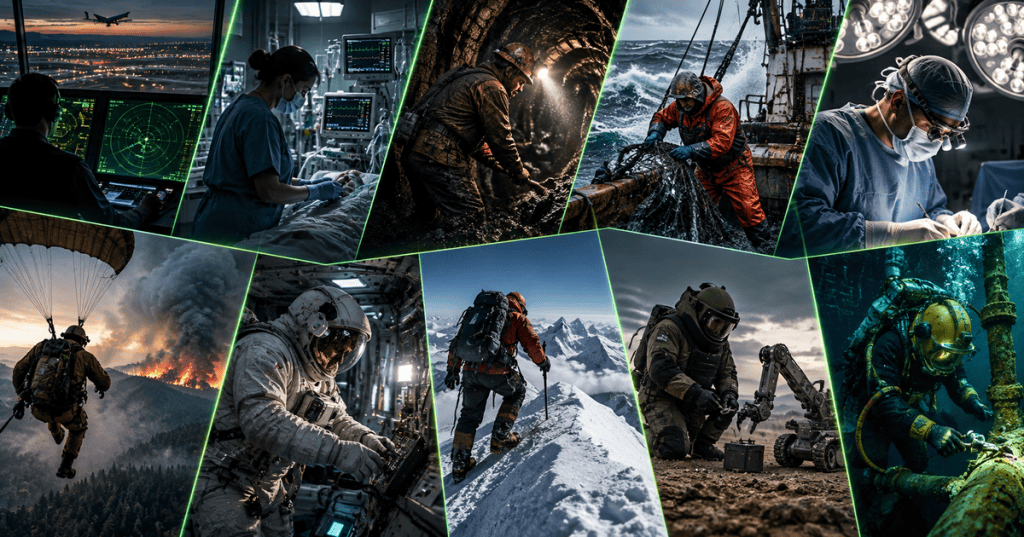
Some jobs test the body. Others test concentration, judgment, emotional control or the ability to keep functioning when a mistake could cost a life. This is BitcoinVersus.Tech’s 2026 editorial ranking of ten of the toughest jobs anywhere in the world.
This is not an official government ranking. We weighed six factors: physical strain, danger, environmental exposure, mental workload, training burden and the consequences of error. That produces a mix of careers that are physically punishing, mentally relentless—or both.
10. Air Traffic Controller
Main toughness: Mental. Air traffic controllers manage multiple aircraft, changing weather, spacing, altitude and runway movement while maintaining continuous situational awareness. The pressure is not about lifting heavy objects; it is about staying precise for hours when small errors can cascade quickly. In 2026, the FAA said chronic overtime can contribute to controller fatigue and burnout while it works to rebuild staffing.
The FAA describes the concentration, data processing and split-second decision-making expected from controllers.
GAMA highlighted the FAA’s controller hiring push going into 2026.
9. ICU Nurse
Main toughness: Mental + physical. ICU nurses may spend long shifts monitoring unstable patients, responding to alarms, administering complex medications and supporting families through the worst moments of their lives. A 2026 study of more than 4,000 adult ICU nurses examined the relationship between work environment, missed care, moral distress and burnout. The difficulty is sustained: technical precision, physical work and emotional resilience all have to coexist.
HonorHealth follows an ICU nurse through the demands of a critical-care shift.
8. Underground Miner
Main toughness: Physical + environmental. Underground miners work around heavy machinery in confined spaces where ventilation, rock stability, dust, water, fire and explosives all matter. The International Labour Organization continues to treat mining as a major occupational-safety priority worldwide. The job combines industrial skill with an environment that can become dangerous very quickly.
KCGM shows a working day underground at Mt Charlotte in Western Australia.
7. Commercial Fisher
Main toughness: Physical + environmental. Commercial fishers work on moving decks around cables, winches, heavy gear and unpredictable seas, often during long hours and poor weather. The ILO describes capture fishing as having one of the world’s highest occupational fatality rates. Fatigue is especially dangerous because the workplace itself never stops moving.
A working commercial fisherman documents a full day aboard a fishing vessel.
6. Trauma Surgeon
Main toughness: Mental + emotional. Trauma surgeons have to make high-consequence decisions with incomplete information while managing severe injuries, emergency operations and distressed families. The technical training takes years, but the harder part may be repeatedly entering situations where seconds matter. That same combination of medicine and resilience appears in career stories such as Laurent Duvernay-Tardif’s path into medicine.
UW Medicine follows the work of a trauma surgeon at Harborview Medical Center.
5. Smokejumper
Main toughness: Physical. Smokejumpers parachute into remote areas to attack wildfires before they grow. They may carry equipment over rough terrain and construct fireline for extremely long shifts in heat, smoke and steep country. Alaska wildfire officials noted in 2026 that 14- to 16-hour days building fireline are not uncommon. This job demands endurance before the firefighting even starts.
The U.S. Forest Service shows how experienced smokejumpers train the spotters who lead airborne wildfire missions.
4. Astronaut
Main toughness: Mental + physical + technical. Astronauts train across spacecraft systems, robotics, emergency procedures, survival, medicine and extreme environments. NASA’s medical standards account for high g-forces, hypobaric and hyperbaric exposure, microgravity and extravehicular activity. The rare people who reach the profession must combine technical judgment with physical conditioning and calm under pressure. Jonny Kim’s career is one example of how demanding the preparation can become.
NASA Johnson looks at how astronaut training prepares crews for missions where improvisation and precision both matter.
3. High-Altitude Mountain Guide
Main toughness: Physical + environmental + responsibility. High-altitude guides repeatedly operate in thin air, extreme cold, avalanche terrain and crevasse fields while carrying equipment and taking responsibility for clients. Research on Nepali high-altitude guides has documented respiratory and musculoskeletal problems as well as occupational accidents. On peaks such as Everest, the guide is not merely climbing—the guide is working.
Everest guide Pastemba Sherpa explains the equipment a guide carries toward the summit.
2. Explosive Ordnance Disposal Technician
Main toughness: Mental + physical. EOD technicians identify, evaluate and neutralize explosive threats. The work can involve bomb suits, robotics, X-ray systems, chemical detection and improvised devices. Technology helps create distance, but the technician still has to remain methodical when the object being investigated may be designed to kill the person approaching it.
U.S. Air Force Recruiting shows EOD technicians using modern tools to detect and defeat explosive threats.
1. Saturation Diver
Main toughness: Physical + mental + environmental. Our No. 1 job puts industrial workers into an environment humans cannot naturally survive. Saturation divers may live under pressure in a chamber complex for weeks, travel to the work site in a diving bell and perform heavy technical work deep underwater. The UK Health and Safety Executive says closed-bell divers can spend up to 28 days working and living in compression, and its offshore guidance addresses decompression illness, thermal stress and prolonged saturation exposure. HSE describes commercial diving as a high-hazard activity.
A short documentary examines the extreme failure scenarios saturation divers train to survive.
The ranking could change depending on what “tough” means. A smokejumper may face greater sustained physical punishment than an air traffic controller, while an air traffic controller may carry a heavier continuous cognitive load. A trauma surgeon’s environment is completely different from a mine or the North Sea, yet the consequences of fatigue and poor judgment can be equally serious. That is why this list rewards jobs that demand more than one kind of toughness.
For another career built around extreme responsibility, read Myron Rolle: From Florida State Safety to Pediatric Neurosurgeon.
BitcoinVersus.Tech Editor’s Note:
We volunteer daily to ensure the credibility of the information on this platform is Verifiably True. If you would like to support to help further secure the integrity of our research initiatives, please donate using the QR code provided

For best QR-code scanning results, please scan this donation code from a desktop or larger screen. Mobile screens may prevent camera recognition.


Leave a Reply