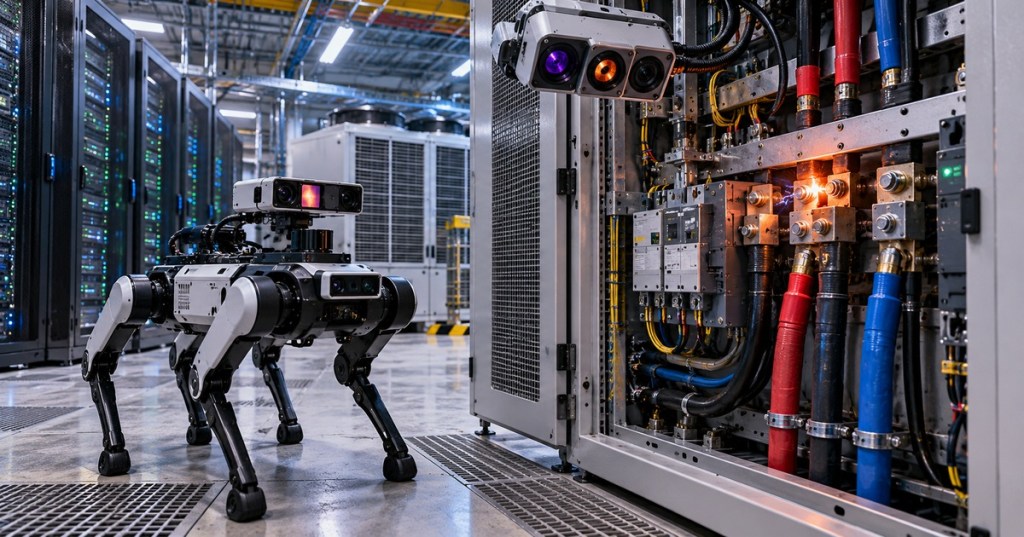
Shenzhen HQVT Technology is showing a multispectral AI safety system that combines ultraviolet, infrared and visible-light sensing to identify electrical discharge, abnormal heat and small flames in data centers before those signals become obvious to ordinary cameras.
The system is on display this week at the Hong Kong Electronics Fair, according to HQVT’s October 15 announcement. The company says the goal is to combine several physical signals instead of relying on visible-light video alone. A loose electrical connection, for example, may produce ultraviolet discharge or localized heating before smoke appears. That makes the idea relevant to the same electrical-fault problem covered in our report on TI’s nanosecond-scale data-center fault detection.
An ACN Newswire post on Reddit summarizes HQVT’s multispectral AI platform and its use across data centers, power systems and energy facilities.
How the sensing stack works
HQVT describes its approach as an “Optics-Sensor-Imaging-Computing” architecture. Ultraviolet sensing can reveal electrical discharge and early flame signatures, infrared sensing maps temperature and thermal anomalies, and visible-light imaging supplies scene context. AI software then analyzes the combined signals. The company’s Zhiyuan Edge Hub uses an NVIDIA Jetson processor to perform local inference near the equipment instead of sending every raw signal to a remote system.
That edge-processing model fits naturally into existing facility monitoring. Traditional BMS, EPMS and DCIM systems already collect electrical and environmental telemetry; multispectral sensors could add a new physical-perception layer alongside the alarm and trending workflows described in our data-center monitoring and controls guide.
A robot can carry the sensors
HQVT is also mounting its multispectral module on a quadruped inspection robot. That matters because fixed cameras and sensors cannot see every busway, cabinet, cable route or mechanical space. A mobile robot can move through an operating facility, revisit known inspection points and bring the sensing package closer to equipment that needs verification. The broader robot-dog category is already moving toward industrial inspection, as reflected in our Top 7 Robot Dogs in 2026.
Boston Dynamics demonstrates the same broader industrial-inspection model: a mobile quadruped repeatedly visiting equipment and collecting sensor data for condition monitoring.
The venue itself adds context. The Hong Kong Trade Development Council says the October 13–16 electronics fair and electronicAsia bring together more than 3,200 exhibitors from 15 countries and regions, with AI and robotics among the major themes.
The important distinction is that HQVT is presenting an early-warning and inspection system, not a guarantee against fires or outages. Its real value will depend on detection accuracy, false-alarm rates, integration with existing controls and reliability under continuous operation. But the technical direction is clear: data-center safety monitoring is moving beyond simple cameras and threshold alarms toward sensor fusion, edge inference and mobile inspection.
BitcoinVersus.Tech Editor’s Note:
We volunteer daily to ensure the credibility of the information on this platform is Verifiably True. If you would like to support to help further secure the integrity of our research initiatives, please donate using the QR code provided

For best QR-code scanning results, please scan this donation code from a desktop or larger screen. Mobile screens may prevent camera recognition.


Leave a Reply