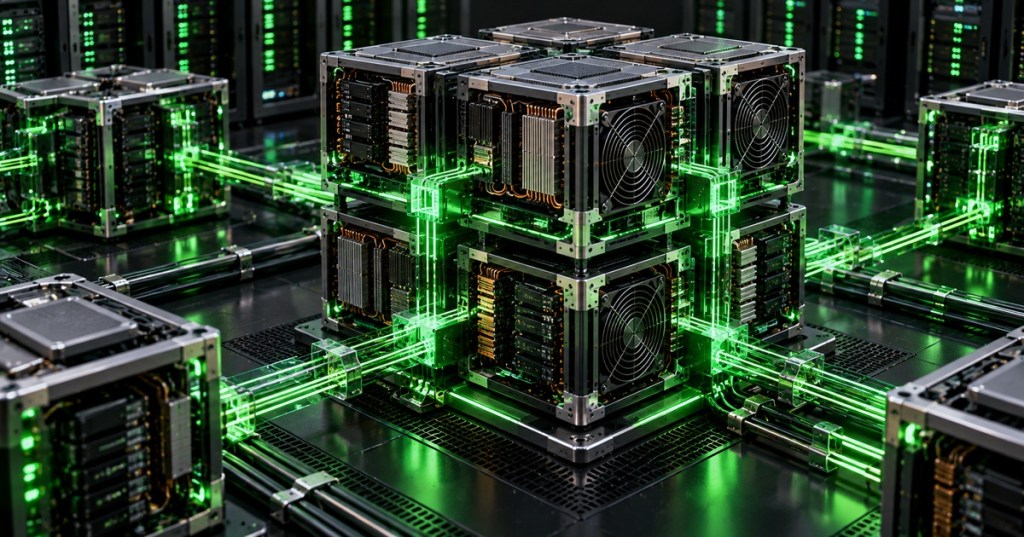
Mueon has raised $65 million in Series A funding to move its Cubelets architecture toward broader validation and production readiness for AI and hyperscale infrastructure.
Cubelets are modular 3D building blocks that combine compute, memory, interconnect, power delivery and thermal management into a denser system-level package. That approach fits the same broader trend BitcoinVersus.Tech has tracked in advanced AI packaging beyond reticle limits: the next scaling battle is increasingly about how silicon, memory and connectivity are physically assembled.
According to Mueon’s October 15 announcement, Maverick Silicon led the round with Intel Capital, Geodesic Alliances Fund, Oregon Venture Fund, M-Ventures, Wellington Capital, IQT and Defined participating. The raise brings Mueon’s total funding above $80 million.
Mueon CEO Wilfred Gomes joins other AI-chip founders in this Synopsys panel on building and scaling semiconductor startups.
Mueon says Cubelets can reduce the physical distance data must travel and target higher compute density without reproducing an entire rack’s cabling, power and cooling complexity at a smaller scale. That makes the architecture relevant to the same data-movement bottleneck behind projects putting new interconnect technology between AI chips and memory.
The company is targeting up to 10× gains in power and cost efficiency within the same rack footprint, but that figure remains a Mueon target rather than an independently published benchmark. The company says the new funding will support engineering growth, system validation and production readiness.
Intel Capital’s earlier technical overview describes the architecture as a system-level attempt to integrate compute, memory, power and thermals instead of optimizing each layer separately. If that approach works at production scale, it could attack the infrastructure side of the same problem behind rising AI data-center power demand.
BitcoinVersus.Tech Editor’s Note:
We volunteer daily to ensure the credibility of the information on this platform is Verifiably True. If you would like to support to help further secure the integrity of our research initiatives, please donate using the QR code provided

For best QR-code scanning results, please scan this donation code from a desktop or larger screen. Mobile screens may prevent camera recognition.


Leave a Reply