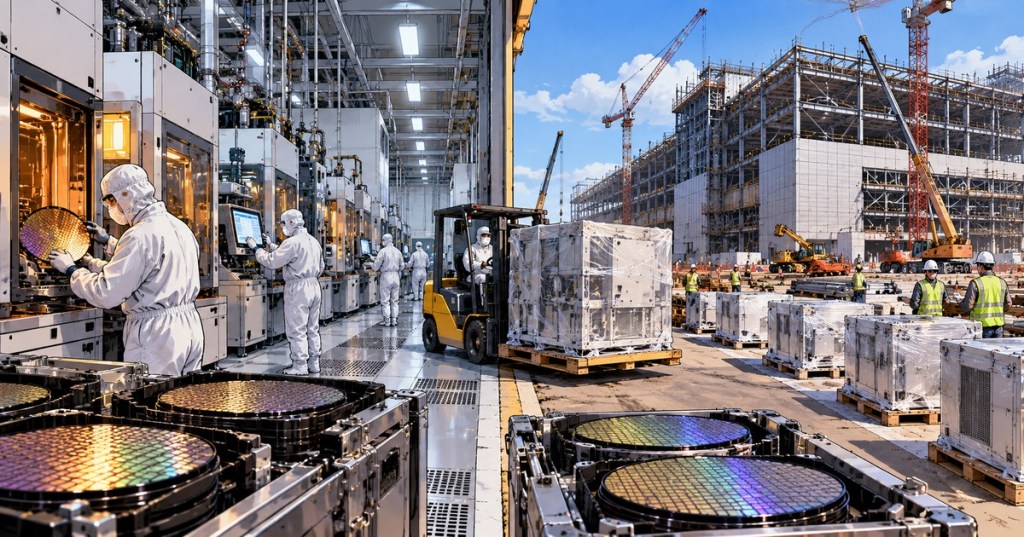
SK hynix’s reported plan for a new U.S. NAND factory is now tied to a dispute over how much American chipmaking equipment can move into its existing operation in Dalian, China. Reuters reported on October 15, citing two people familiar with the matter, that Solidigm has sought licenses for additional U.S.-made tools for Dalian’s unfinished Mod B space and that approval is linked to the proposed American factory. SK hynix later said the Mod B installation is proceeding in consultation with and under authorization from the U.S. government, and that it is not pursuing a production-capacity expansion.
The technical stakes center on NAND flash memory, the nonvolatile storage technology used in solid-state drives. Solidigm, SK hynix’s U.S.-based storage subsidiary, sells high-capacity enterprise SSDs into data-center workloads. Reuters said Mod B was built in 2023 but was not fully equipped after the memory downturn, leaving room for more tools as NAND demand recovered. That demand is increasingly connected to the same AI infrastructure cycle behind SK hynix’s push to put memory at the center of AI racks.
Market participants began debating the reported U.S.-factory and Dalian-license linkage shortly after the Reuters report circulated.
The policy backdrop is especially important here because the definition of “expansion” may determine what equipment can legally move. The U.S. Commerce Department’s Bureau of Industry and Security said in August 2025 that former foreign-owned validated end users would need export licenses for their Chinese fabs and that BIS intended to allow equipment needed to operate existing plants, while not intending to approve tools for capacity expansion or technology upgrades. That makes SK hynix’s denial of a capacity expansion central to the dispute.
Solidigm’s D5-P5336 video shows how dense NAND production ultimately becomes enterprise SSD capacity for large storage workloads.
No U.S. NAND-fab commitment or 2027 license decision has been publicly finalized. The reported talks instead show how semiconductor manufacturing, export controls and AI-driven storage demand are colliding in one negotiation. BitcoinVersus.Tech has seen the same pressure in domestic chip investment, including the recent $2 billion New York AI-packaging deal. Until Washington issues a license decision or Solidigm announces a factory, the U.S. project should be treated as a reported proposal rather than a committed build.
BitcoinVersus.Tech Editor’s Note:
We volunteer daily to ensure the credibility of the information on this platform is Verifiably True. If you would like to support to help further secure the integrity of our research initiatives, please donate using the QR code provided

For best QR-code scanning results, please scan this donation code from a desktop or larger screen. Mobile screens may prevent camera recognition.


Leave a Reply