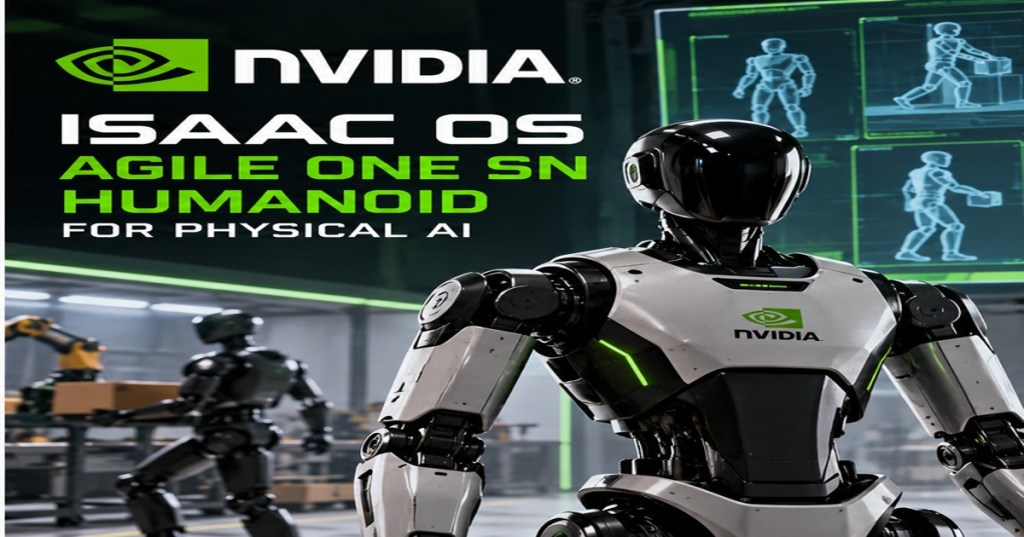
NVIDIA announced an expansion of its Isaac robotics platform at GTC Berlin on October 21, 2026, introducing the Isaac OS runtime, Isaac Lab 3.0 and Agile Robots’ Agile ONE SN reference humanoid. The official announcement positions the technologies as a connected development workflow for training, testing and deploying physical AI.
Key Takeaways
- Agile ONE SN combines a 31-degree-of-freedom humanoid body with NVIDIA Jetson Thor and Isaac GR00T.
- Isaac OS connects robot AI, sensors and controls for real-time execution.
- Isaac Lab 3.0 supports multi-GPU robot training using simulation and physics engines.
- The reference humanoid is scheduled for availability in early 2027.
A Reference Robot for Developers
Agile ONE SN stands 1.40 meters tall, weighs 40 kilograms and carries up to 3 kilograms per arm. Its five-finger hands provide tactile sensing and 1 kHz force control. Jetson Thor supplies onboard processing, while cameras, lidar and inertial sensors help the robot perceive its surroundings.
The hardware is intended as a reference platform rather than proof of autonomous, general-purpose labor at commercial scale. NVIDIA says the integrated workflow can reduce research setup time from weeks to days; that remains a company claim.
Training in Simulation, Running on Hardware
Isaac Lab 3.0 provides an open-source framework for learning robot skills in simulated environments. Isaac OS, built on Holoscan, aims to coordinate sensing, AI inference and controls with predictable timing. The distinction matters: a convincing simulation alone cannot guarantee reliable performance around people or industrial equipment.
NVIDIA also introduced simulation-ready factory assets and human-activity datasets to support training. ABB, KUKA, Sereact and other robotics partners are applying portions of the broader platform to industrial workflows.
In the official keynote recap, NVIDIA also demonstrated Microduck robots whose behaviors were developed in simulation and deployed to physical machines. The demonstration illustrates the intended workflow, not a guarantee that every trained behavior transfers successfully.
For robotics technicians and developers, the practical questions now center on repeatable skill transfer, sensor reliability, safety validation and real-world uptime. Those results will determine whether the new software and reference hardware shorten the path from laboratory experiments to useful industrial robots.
BitcoinVersus.Tech Editor’s Note: We volunteer daily to ensure the information on this platform is Verifiably True.
To donate 5,000 sats, open this page on another screen and scan the QR code below with your mobile Bitcoin wallet. If your wallet supports scanning a saved image, save the QR image and scan it from your phone.



Leave a Reply