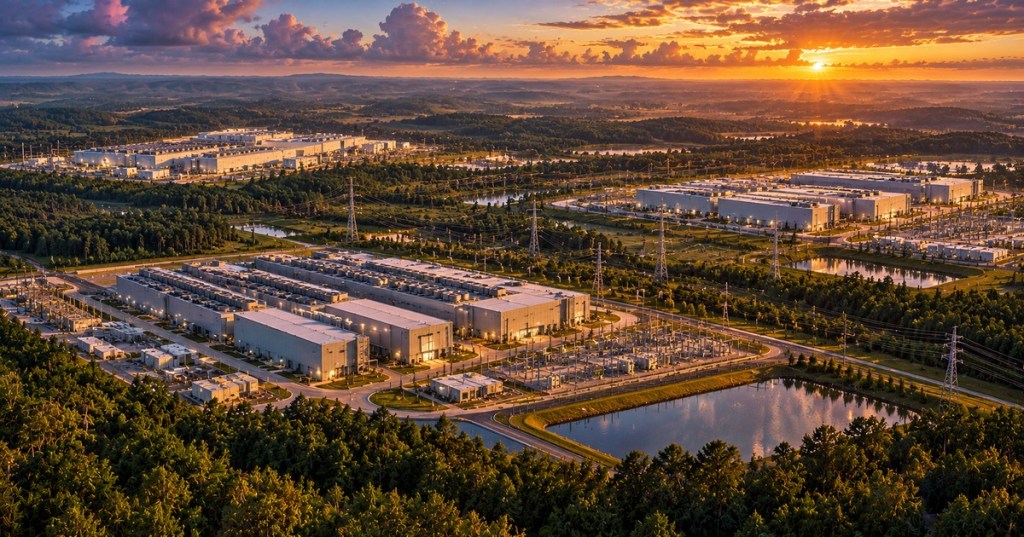
Georgia now has data-center proposals measured in gigawatts rather than megawatts. The largest has a formal 3.2 GW electricity-service agreement; another has county-approved land use and a preliminary 1.83 GW site-plan estimate; a third advertises a 1.4 GW concept in rural southwestern Georgia. Following our Florida Top 3 ranking, this report examines the biggest attributable, non-cancelled Georgia developments using information available through October 28, 2026. These capacity figures are development targets, not servers consuming that much power today.
Ranking method: We order the projects by their largest documented proposed electrical-service or total-facility power figures, and state precisely which source supplied each number. OpenAI’s 3,200 MW is a planned utility-service commitment; Bunkhouse’s 1,830 MW comes from an early site plan reported by the Atlanta Journal-Constitution; QTS’s 1,400 MW is a developer-published potential gross capacity. These measures are not guaranteed to use identical boundaries. We separately report IT computing load, local approvals, actual operating status and remaining permitting requirements. Nothing in this Top 3 should be summed as energized Georgia demand.
3. QTS Blakely Campus — 1,400 MW Potential Gross Capacity
The proposed QTS campus in Blakely, Early County, is a rare example of a developer publishing a direct, full-scale energy figure while acknowledging how early the project remains. QTS’s own site states 1,400 MW of potential gross capacity for the concept. Gross infrastructure capacity can include mechanical systems and other overhead outside the servers themselves. It is not a contracted 1.4 GW IT workload, an approved delivery schedule or an operating load.
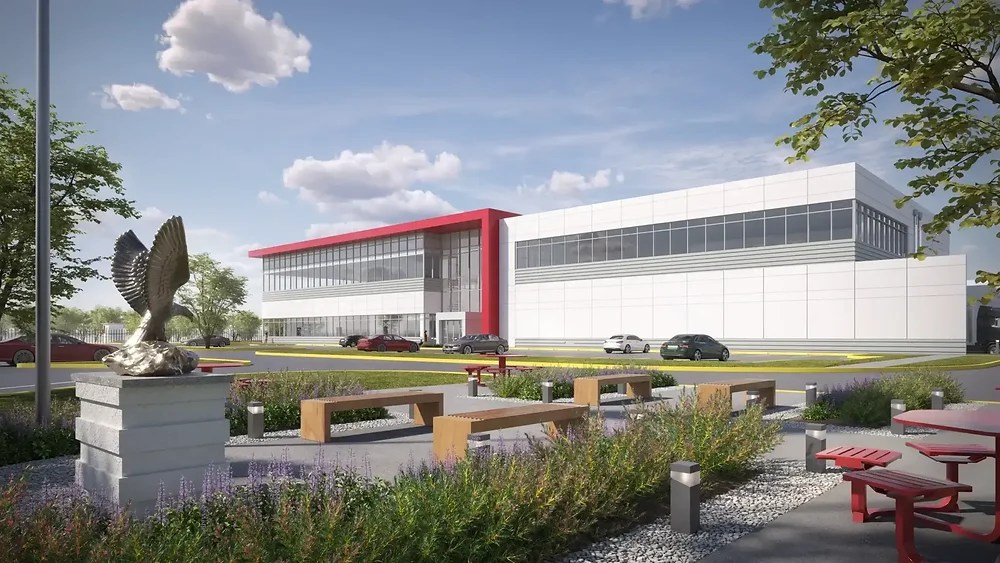
QTS describes the facility as a concept-stage development with no fixed construction start date. Zoning, environmental review, design and utility agreements remain essential steps. The company says it intends to procure normal operating power from its utility, with emergency backup generators and a phased construction schedule potentially extending five to ten years. According to QTS, the developer would pay required energy-infrastructure costs. For local residents, the important outstanding information is the exact electric-service agreement, the approved site plan, the number of buildings and the projected cooling-water demand—not merely the large capacity headline.
2. Project Bunkhouse, Bartow County — 1,830 MW Early Site-Plan Demand
The approximately 877-acre Project Bunkhouse site sits near Taff Road and Georgia Power’s Plant Bowen, northwest of Atlanta. An April 2025 Atlanta Journal-Constitution review of early plans reported 1,830 MW of possible power demand and three on-site substations. The initial state Development of Regional Impact filing, #4433, described a campus approaching 8.7 million square feet and a possible investment of $19 billion at full buildout.
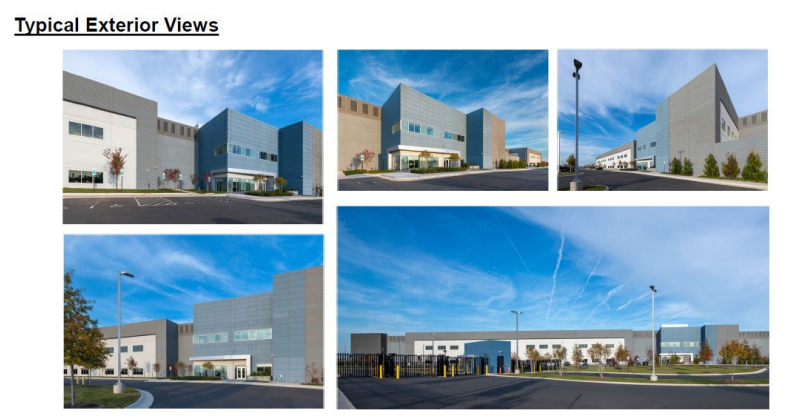
In June 2025, Bartow County’s sole commissioner approved the rezoning, with conditions and a final building-area cap of 8.3 million square feet. More recent official documentation gives a valuable correction: the county’s August 2026 policy statement calls Digital Realty’s Stilesboro investment approximately 1.3 GW of computing capacity, rather than 1.83 GW. These can describe different scopes—IT equipment versus overall site power—but the county document does not itself verify that a full 1.83 GW utility connection is approved. Readers should treat 1,830 MW as an early reported design scenario and 1,300 MW as the county’s later computing-capacity description, not competing measurements of today’s electricity draw.
The rezoning applicant was Taurus DC SPE LLC. County meeting records link the proposal to Digital Realty, and the county estimates more than 800 permanent jobs after completion. Water infrastructure is another unresolved issue: the regional filing projected roughly 625,000 gallons per day of water supply and wastewater demand, while indicating considerably less capacity was confirmed at that point. Bartow County subsequently adopted closed-loop or equivalent cooling requirements in July 2026. A land-use approval is meaningful progress, but full utility, building, environmental and occupancy milestones are separate.
1. OpenAI Project Camellia, Effingham County — 3,200 MW Utility Agreement
OpenAI’s Project Camellia, planned for the Savannah Gateway Industrial Hub in Effingham County, leads this ranking with an explicitly announced 3.2 GW electricity-service requirement. OpenAI says the power is expected in phases from 2028 through 2032. Georgia Power confirmed in August 2026 that the regulatory process cleared its large-load agreement, including up to 1,000 MW of flexible demand response that could be curtailed during high grid demand.
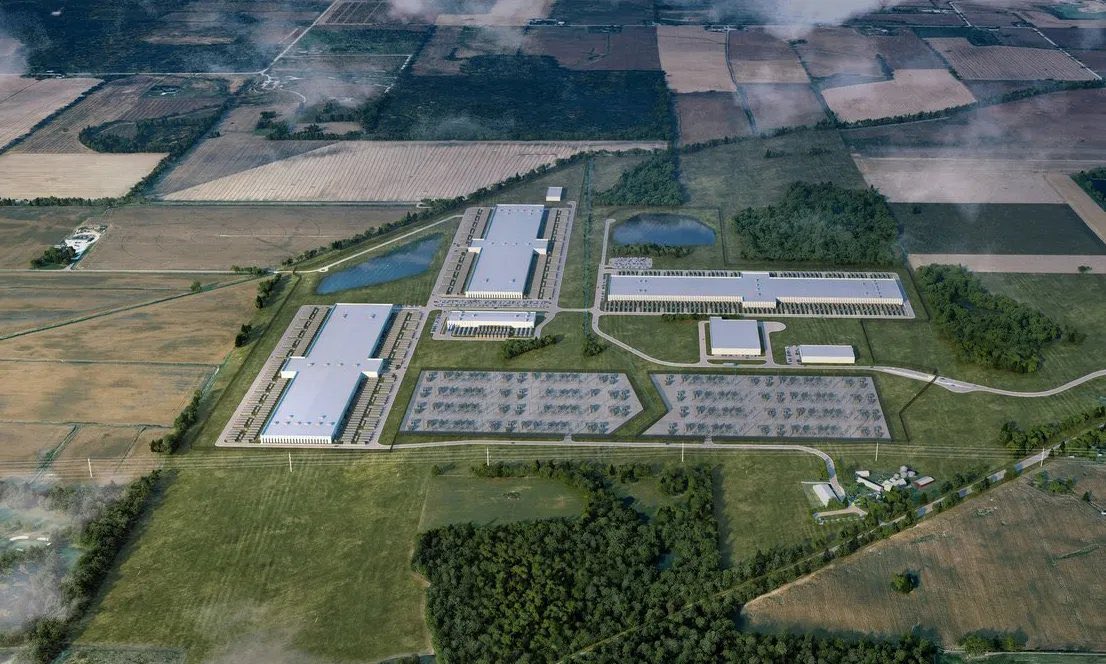
The July 22 Effingham County announcement describes at least $20 billion in private investment and an initial commitment to 400 long-term jobs. State regional-impact materials describe four major buildings and a peak electrical-load estimate near 3.21 GW, reflecting a slightly different modeling scope from the announced 3.2 GW agreement. OpenAI proposes closed-loop cooling to limit routine water consumption and has promised a community fund, education support and independent reporting. Those remain company commitments and projected benefits, rather than outcomes measured at a completed campus.
The electric contract is one milestone—not construction permission for every building. Effingham County continues to review site development, water, traffic and community impacts through its public Project Camellia resource center. A planned 2028 opening phase depends on successful permitting, financing, infrastructure delivery and commissioning. It is incorrect to describe Georgia as already operating a 3.2 GW OpenAI campus.
Why Some Other Gigawatt Claims Did Not Make the Top Three
The Project Arrowhead concept near Mystic in Irwin County has a documented 1.25 GW proposal and an estimated $6 billion development value, making it a close contender but below the three figures used above. Other trackers misleadingly list Project Indo in Cartersville at 2 GW; contemporary DataBank filing coverage instead describes 200 MW of planned computing capacity and a 288 MW grid-connection request. We exclude the unsupported 2 GW interpretation. Projects that have been denied or withdrawn are also excluded from this active-development comparison.
Georgia’s Real Constraint Is Deliverable Power
The difference between a power agreement, a zoning approval, a substation plan and an energized data hall is central to these rankings. Transformers, transmission capacity, fiber connections, backup power and cooling all have their own lead times. Bartow County’s policy statement explicitly distinguishes IT power from whole-site power using the industry metric power usage effectiveness. That same measurement issue appears in our coverage of America’s largest AI data-center megaprojects and the Delaware state comparison. None of these three proposed Georgia gigawatt figures is a verified current operational consumption measurement.
Editor’s Note: This ranking uses publicly attributed project-level power figures as of October 28, 2026. Planned utility service, reported site-plan demand, gross facility capacity and computing load are kept distinct in the text. The original 1200×630 cover, three sourced project images and donation QR are separate media assets; original technical diagrams are not included. Support BitcoinVersus.Tech’s independent infrastructure reporting with a 5,000-sat Bitcoin donation by scanning the QR code below.

Scan the QR code with your Bitcoin wallet while viewing this page on another screen.


Leave a Reply