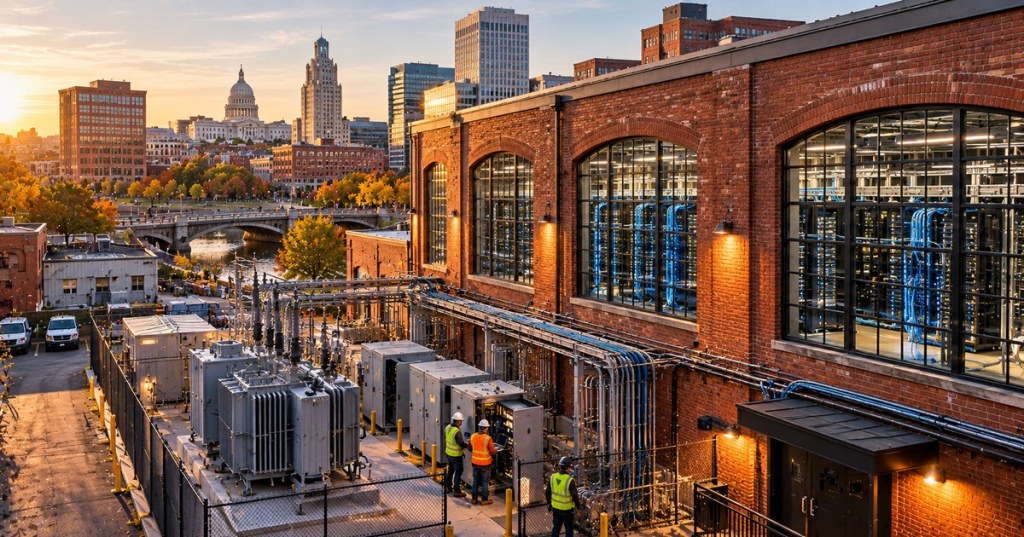
Rhode Island’s three largest publicly documented colocation facilities are measured in megawatts, not gigawatts. The available evidence points to a pair of roughly 1-megawatt sites on Carpenter Street in Providence and a smaller Lumen facility in the same city. They serve business networks, cloud applications and other essential digital services while proposals for much larger computing campuses encounter zoning and legal resistance elsewhere in the state.
The figures below rank three operating facilities for which independent public sources report a power figure, not every data center in Rhode Island. Prov.net PVD2 is reported at 1 MW of critical power, the former Crown Castle facility at 300 Carpenter Street at about 1 MW in a commercial directory, and Lumen Providence at 0.6 MW in the Baxtel market listing. Those two secondary estimates are not certified operator meter readings. Several other facilities—including Prov.net’s Westminster site and the Foundry—have no comparable published site-level megawatt figure and cannot responsibly be placed above or below them by IT power alone.
3. Lumen Providence — 0.6 MW Listed, Operating
Lumen’s Providence facility is part of the traditional carrier and network-colocation market that developed around downtown Providence. Data Center Map places its Providence 1 site at 375 Promenade Street. Research directories list it as operating and associate roughly 10,400 square feet of total building area with the site. The facility helps regional businesses connect computing equipment to telecom infrastructure rather than functioning as a hyperscale AI training campus.
The Baxtel Rhode Island market directory associates 0.6 MW of capacity with Lumen Technologies’ one operating state facility. Since this is a provider-level directory figure and no matching recent Lumen technical specification was established, it should be treated as a reported reference point, not a confirmed current IT load. The public record does not disclose how much of the rated capacity is occupied by paying customers.
Lumen’s comparatively modest published scale highlights a different kind of data center economy. Regional colocation can provide access to network services, redundant connections and equipment space close to customers without the acreage and new generating infrastructure associated with multi-gigawatt developments. More detailed current disclosures of server power and available white space would help compare this facility with Rhode Island’s other operators.
2. Crown Castle Providence, 300 Carpenter Street — Approximately 1 MW Reported
The operating colocation and network facility at 300 Carpenter Street is associated with former owner Crown Castle Fiber, whose fiber business was sold to a Zayo buyer in 2026. The facility’s source-linked project record identifies it as an active Providence site and notes the ownership transition, but does not confirm a new site-specific operating contract or publish a current electrical rating.
A separate commercial facility tracker reports approximately 1 MW and 12,023 square feet of building area. This is a secondary dataset estimate. It is not a company-authored assertion that one megawatt of servers is running today, nor does it establish that every square foot is dedicated to computing racks. Those limits matter because other industry records for this address explicitly say electrical capacity is not publicly reported.
Carpenter Street is an established part of Providence’s fiber and network infrastructure rather than a new land-intensive AI development. The value of this kind of site lies in resilient network connections and nearby businesses that need colocation, equipment management and diverse connectivity. The next meaningful disclosure would be a current operator facility sheet detailing installed power, leasable IT capacity and redundancy standards.
1. Prov.net PVD2, 304 Carpenter Street — 1 MW Critical Power
The best-documented operating capacity among the three belongs to Prov.net’s PVD2 facility at 304 Carpenter Street. In an October 18, 2021 announcement, global network provider Hurricane Electric described the facility as offering up to 15,000 square feet, 1 MW of critical power and 200 tons of N+1 cooling. The power rating describes designed critical-service capacity, not verified continuous consumption. Its site address and network presence remain listed by Hurricane Electric’s own point-of-presence directory.
Hurricane Electric’s arrival provided access to its international IP backbone through 100-gigabit, 10-gigabit and one-gigabit Ethernet connections. Those network links can support regional companies that need reliable connections, redundancy and low-latency access to services beyond Rhode Island. The site was described as part of Providence’s dense fiber corridor, a characteristic that can be more valuable to a local carrier hotel than a very large parcel of inexpensive land.
Providence colocation facility video, featured on the Prov.net/Alpha3 Cloud PVD2 gallery at Data Center Map.
The video is a facility reference, while the megawatt and cooling figures come from the dated network-provider announcement. The supplied figures should not be mistaken for a new 2026 expansion or proof that the building houses one megawatt of operational AI accelerators. It is an established regional computing site whose network presence remains independently identifiable.
Why the Westminster Technology Center and Other Facilities Are Not Ranked by Power
Rhode Island has several other documented data centers. Prov.net’s PVD1 at 1155 Westminster Street grew out of the former Crest Craft jewelry factory, whose conversion was reported by Data Center Knowledge in May 2007. The property measured about 40,000 square feet in total, but only approximately 10,000 square feet was then described as occupied by hosting customers. Its current site-level IT megawatts and usable white space have not been established. Counting the entire former factory as a 40,000-square-foot live server hall would exaggerate the actual evidence.
Another Providence facility, historically listed as Crown Castle RI1 at 235 Promenade Street, has approximately 5,184 square feet of fully built-out whitespace in Data Center Map, but no verified current power specification in that listing. Building floor area, leasable server space, utility connection size and actual operating IT draw are different metrics. A large office or industrial building with a small data hall cannot be ranked as if every floor were full of servers.
Other reported facilities support institutional computing, lottery systems, enterprise IT and regional networks. The lack of megawatt disclosure should not be interpreted as zero capacity or proof that the three ranked sites have the highest actual power demand in the state. It means Rhode Island does not yet have a sufficiently complete and comparable public database to publish a definitive statewide power leaderboard.
A Proposed Smithfield Data Center Faces a Zoning Ban and Litigation
The clearest recent large-development dispute is in Smithfield, where Hanton City Investments and ROK LLC pursued a proposed corporate complex near 364 George Washington Highway that could include data processing. The developers filed a major land-development application on May 4, 2026. A day later, the town council voted 4–1 for a zoning amendment that lists data centers as not permitted; the restriction took effect in June. Ocean State Media documented both the developer’s anticipated tax-revenue benefits and objections about power, water and land use.
The town subsequently deemed the application incomplete. The developers dispute that decision and the legality of the ban in litigation, arguing that filing before the ordinance took effect preserves a route to review. An October 8 status review reported that a local appeal hearing was moved to January 2027. There is no disclosed project-specific MW rating, no final construction permit and no completed data center to rank as a functioning facility.
Smithfield Planning Board’s March 19, 2026 public meeting on data center zoning. Town meeting recording linked by Rhode Island Current.
Supporters of a potential business park point to new commercial tax receipts and the possibility of using industrial infrastructure rather than relying solely on residential property taxes. Opponents are concerned about the power grid, water supply, wooded land and the prospect of new development arriving before clear local standards exist. The key question is whether the legal process ultimately allows a complete, technically detailed application to be evaluated. Neither side’s projections establish the computing load of a facility that has not yet been built.
What Rhode Island’s Smaller Data Center Market Means
Rhode Island’s established colocation sites have a practical role in the regional internet economy. Healthcare organizations, universities, government agencies and local businesses need dependable data services even when no gigawatt-scale AI campus is planned nearby. A small network-connected data center is not simply a miniature version of a hyperscale facility: its customers, latency requirements, revenue structure, equipment density and operating model may differ substantially.
The state’s main challenge is improving project transparency without treating every new server installation as a giant industrial load. For future development proposals, meaningful disclosures should separate server IT load, total facility power, backup generation, peak water demand and the costs of utility upgrades. Local bans and large-load tariff proposals should be evaluated against the actual applications and laws in force rather than assumed to approve or prohibit every existing facility.
The series has covered far larger developments in Pennsylvania, Oregon and Ohio. Rhode Island offers a useful contrast: reliable regional connectivity can matter even when the public record does not support a large-project leaderboard. BitcoinVersus.Tech’s data center capacity planning lesson explains why rated power and actual utilization cannot be treated as the same number.
BitcoinVersus.Tech
BitcoinVersus.Tech Editor’s Note: We volunteer daily to ensure the credibility of the information on this platform is Verifiably True. If you would like to support our work and help further secure the integrity of our research initiatives, please scan the QR code below to donate 5,000 sats. For best results, scan the QR code from a laptop or larger screen.
Bitcoin address: 3C9o19EH5HSiwEPyCTmEKzxhNCbo2X6TTb. Confirm the destination address before sending.

BitcoinVersus.tech is not a financial advisor. This media platform reports on financial subjects purely for informational purposes.


Leave a Reply