
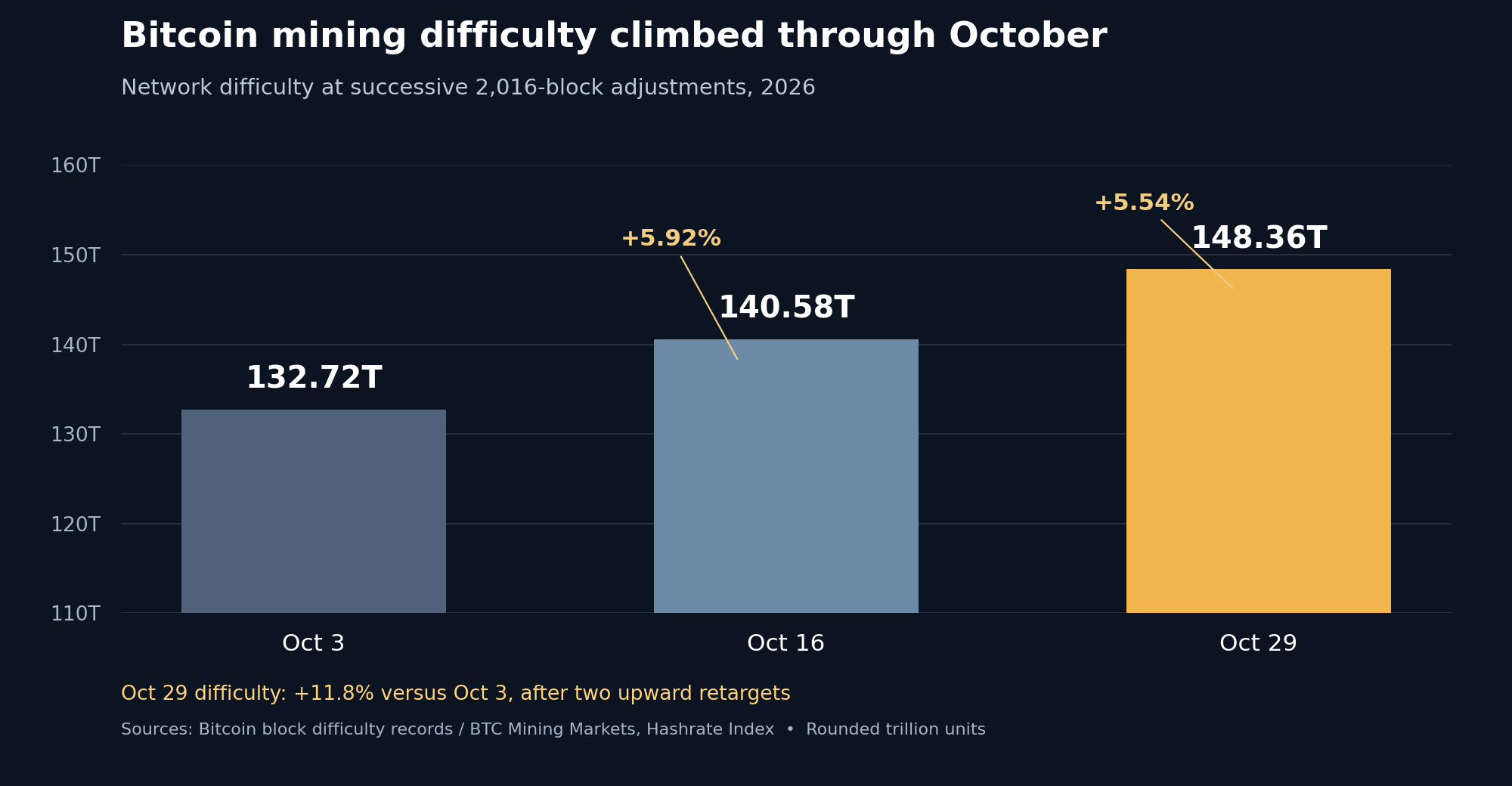
Bitcoin’s mining difficulty jumped 5.54% to 148.36 trillion at block 973,728 on October 29, 2026, as recovering network computing power increased competition for block rewards. The adjustment, recorded at 19:14 UTC, followed a 5.92% rise on October 16 and marked the network’s strongest month of difficulty growth this year, squeezing miners already facing weak revenue per unit of processing power. Bitcoin Mining Markets’ block-data review confirms the two consecutive increases.
The latest adjustment raised difficulty from 140.58 trillion, while the October 3 level was approximately 132.72 trillion. As a result, unchanged mining hardware now earns roughly 10.5% less expected Bitcoin per hash than at the beginning of the month, if block rewards and other inputs remain constant. This is a change in expected BTC production, not a prediction of the Bitcoin dollar price.
Network Hashrate Returns Above One Zettahash
Hashrate Index’s October 30 analysis says the seven-day average network hashrate crossed 1,000 EH/s on October 11 and reached 1,088 EH/s on October 26. The recovery follows an extended downturn as operators weathered weak margins and some publicly traded miners shifted resources toward artificial-intelligence infrastructure. Difficulty is still below its October 2025 record of 155.97 trillion, but the gap has narrowed to about 4.9%.
Real Vision analyst Jamie Coutts discusses the rebound in Bitcoin hashrate and the implications for mining competition.
Bitcoin automatically recalibrates mining difficulty every 2,016 blocks to maintain a roughly 10-minute average block interval. When deployed computing power grows, the target adjusts upward. Our earlier October 23 report covered the preceding 140.58-trillion level; this week’s new adjustment is the next confirmed step.
At $33 Hashprice, Efficiency Becomes Critical
A October 31 network snapshot placed hashprice, the estimated gross revenue from one petahash per second each day, near $33. At a modeled $33.02 hashprice and a 2% pool fee, a 25 J/TH mining fleet produces about $32.36 daily revenue per PH/s. At $0.06/kWh, it consumes $36 in electricity, leaving an estimated $3.64 daily electricity-only shortfall. A 20 J/TH fleet at the same tariff spends $28.80 on power, leaving about $3.56 before additional costs.
These examples exclude repairs, staff, financing, site infrastructure and downtime; actual miner earnings vary with Bitcoin price, fees and uptime. The distinction helps explain the growing value of the most efficient ASICs and negotiated electricity contracts.
In an October 12 Early Riders interview, Upstream Data’s Steve Barbour explains mining economics, ASIC depreciation and the competition for electricity. The interview predates the October 29 difficulty adjustment.
The next scheduled retarget comes at block 975,744, expected around November 12–13; its direction will depend on actual block-production speed. For miners, the immediate calculation is whether electricity costs and operating efficiency can keep pace with a network that is growing faster than revenue per unit of hashrate.
BitcoinVersus.Tech
BitcoinVersus.Tech Editor’s Note: We volunteer daily to ensure the credibility of the information on this platform is Verifiably True. If you would like to support our work and help further secure the integrity of our research initiatives, please scan the QR code below to donate 5,000 sats. For best results, scan the QR code from a laptop or larger screen.
Bitcoin address: 3C9o19EH5HSiwEPyCTmEKzxhNCbo2X6TTb. Confirm the destination address before sending.
To scan the QR code below, open this page on another screen and scan it with your mobile Bitcoin wallet. If your wallet supports scanning a saved image, you can save the QR image and scan it from your phone instead.

BitcoinVersus.tech is not a financial advisor. This media platform reports on financial subjects purely for informational purposes.


Leave a Reply