
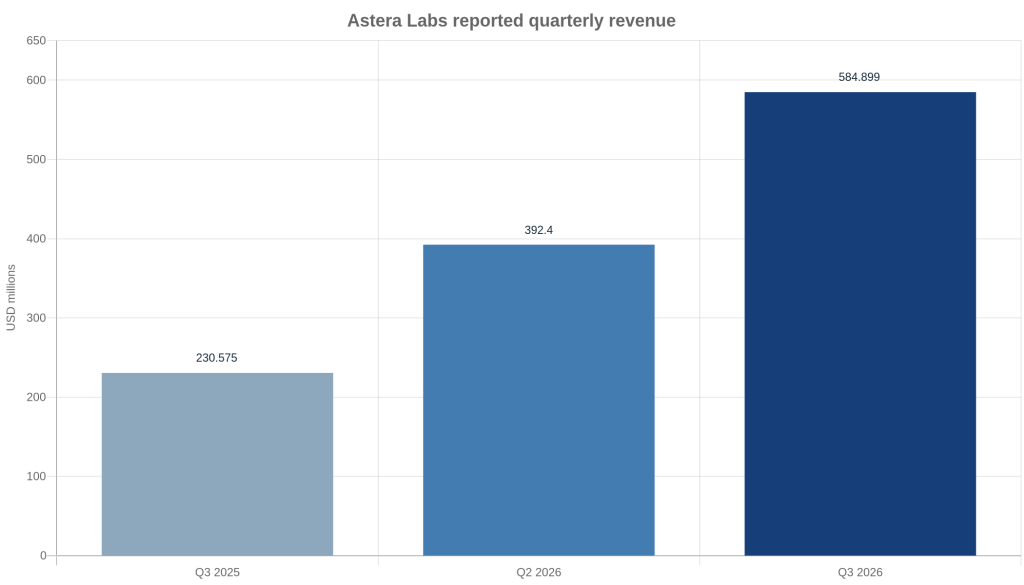
Astera Labs reported $584.9 million in third-quarter revenue on November 3, 2026, as the Scorpio X-Series 320-lane fabric switch entered high-volume production and became the San Jose semiconductor company’s largest product family by revenue. Sales increased 49% from the preceding quarter and 154% from a year earlier, according to the official earnings release. The result provides a new commercial milestone beyond earlier product demonstrations, although Astera did not disclose separate Scorpio revenue or unit shipments.
The company reported $392.4 million in the second quarter of 2026 and $230.6 million in the year-earlier quarter. Gross margin was 72.3% under generally accepted accounting principles, while operating income reached $179.1 million. Net income was $182.9 million. Earlier Leo X-Series memory-controller coverage provides background on the broader product strategy, but the earnings filing does not separately allocate revenue to the new memory products. Those are reported financial results rather than forecasts, and the quarter does not show how much switch hardware went into production customer clusters versus distributors or system integrators.
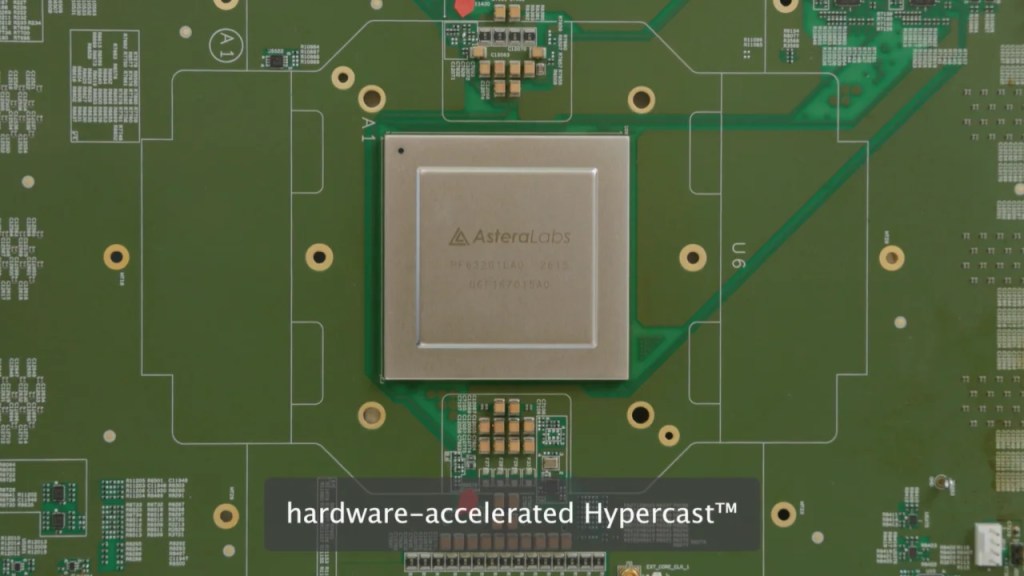
Why 320 lanes matter for AI racks
A fabric switch moves data among accelerators, memory and other components inside an AI system. A higher lane count can reduce how many separate switches and hops a designer needs, but 320 physical lanes do not mean 320 GPUs. Actual network topology depends on lane allocation, endpoints, link speeds, protocol support and system design. BitcoinVersus.Tech previously covered Astera’s Orion architecture for up to 160 accelerators, a reference design rather than an installed customer fleet.
Astera says Scorpio X-Series uses hardware-accelerated Hypercast and In-Network Compute to improve collective operations. Company demonstrations cite up to 2× acceleration in selected collective workloads and a separate 30% bandwidth gain under an eight-GPU test configuration. Neither result guarantees the same performance increase in every model, accelerator combination or production cluster. The official Scorpio demonstration explains the switch’s single-hop data movement; it is supplied as a source link rather than an unverified embedded player.
Revenue growth moves beyond one chip
The expanded portfolio also includes Aries 7 signal conditioners, which extend PCIe 7 connectivity over copper and optical links. The company expects initial Aries 7 sampling during the fourth quarter of 2026, not full-volume shipments of every new product. Earlier coverage of Astera’s planned 50-meter optical links explains why retiming, cable integrity and latency matter as AI systems span multiple racks.
Memory technology is another extension. Leo X-Series controllers pair with Scorpio switches to support fabric-attached KV-cache-intensive inference. Astera reports up to 62% faster time-to-first-token and up to 22% more tokens per second in internal tests, not independent cross-vendor benchmarks. Related CXL memory pooling developments show why separating memory expansion from processor sockets is becoming important in server design.
What investors and operators should watch
Management forecast $730 million to $750 million in fourth-quarter revenue, a range implying roughly 25%–28% sequential growth from the reported September quarter. The estimate is a company outlook rather than an achieved result. Astera also expects OEM and ODM partners to begin offering Orion system designs in the first quarter of 2027. The broader PCIe-over-optics effort with Lumentum and Corning remains relevant to longer-distance connections between densely packed compute racks.
Execution risks include concentrated hyperscale demand, design qualification, supply constraints and customers changing GPU or interconnect architectures. The next measurable tests are actual fourth-quarter sales, Scorpio shipment concentration, new system adoption and whether internal performance claims translate into documented customer efficiency.
Editor’s Note. All financial figures are reported by Astera Labs in its November 3, 2026 earnings filing. The official X post and product demo are earlier demonstrations, not independent proof of customer-level performance. The cover is an editorial illustration; the revenue chart reflects recorded quarters while the fourth-quarter guidance is a forecast.

Scan the donation code from another device if your phone cannot scan its own screen.
We volunteer daily to improve the credibility of the information on this platform. If you would like to support the research, please donate here: 3C9o19EH5HSiwEPyCTmEKzxhNCbo2X6TTb
BitcoinVersus.tech is not a financial advisor. This media platform reports on technical and financial subjects purely for informational purposes.


Leave a Reply