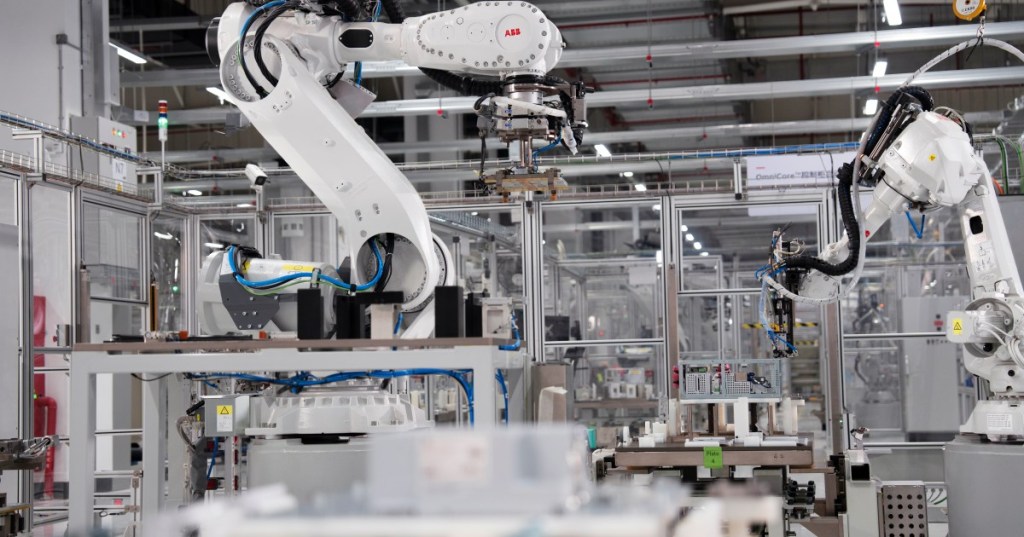
China’s foreign-investment security review office has prohibited SoftBank from acquiring ABB Robotics’ business in China, threatening the companies’ planned $5.375 billion global transaction. SoftBank said November 6 that regulators notified it on November 4, 2026; ABB confirmed the restriction November 5. Both companies say they remain in discussions. The announcement does not establish that the entire worldwide sale has been formally canceled.
The blocked transfer targets a significant part of ABB’s industrial automation footprint. Robotics systems combine articulated arms, controllers, sensors and software to automate tasks from vehicle assembly to warehouse sorting. SoftBank planned to link ABB’s established robot hardware and manufacturing expertise with AI and computing investments.
The deal was meant to accelerate physical AI
The companies announced the transaction October 8, 2025, valuing the robotics unit at $5.375 billion in enterprise value, not necessarily cash paid at closing. ABB said the division generated $2.3 billion in 2024 revenue, about 7% of group sales, and employed approximately 7,000 people. The buyer was to assume a business with industrial customers, equipment, proprietary controls and service obligations, not merely an AI software application.
SoftBank chief Masayoshi Son described physical AI as a strategic frontier. Integrating perception, planning and actuation could let robots adapt to changing objects and workflows. Previous BitcoinVersus.Tech reporting examined ABB’s AI Robot Trainer for fashion logistics and NVIDIA’s expanding robotics software stack. The commercial potential still depends on reliability, safety, installation cost and measurable customer productivity.
Why the Shanghai operation matters
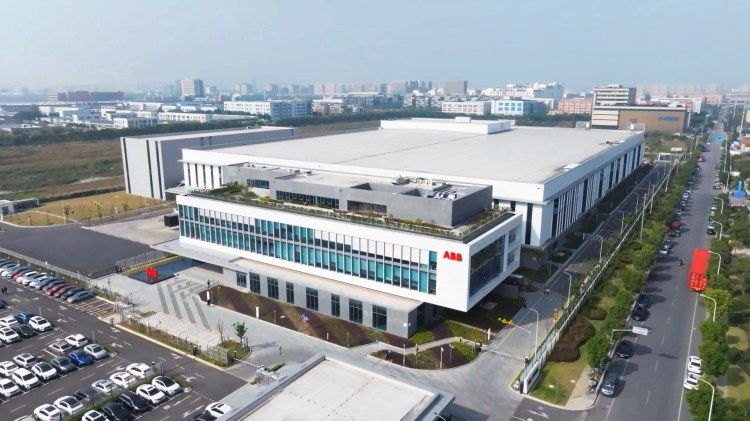
ABB opened its $150 million Shanghai megafactory in December 2022. The 67,000-square-meter complex includes an 8,000-square-meter research center for machine vision, digital twins, autonomous mobility and robotics software. The original announcement described a local-for-local manufacturing strategy for Chinese customers, making a Chinese ownership restriction material to the proposed international acquisition.
Regulators have not publicly provided a detailed written rationale in the companies’ announcements. Reuters, citing Financial Times reporting, said scrutiny included supply-chain security and concerns over potentially sensitive robotics data and intellectual property. Those reported concerns should not be presented as the regulator’s formally stated findings.
Negotiations continue, but closing is uncertain
The prohibition is broader than routine antitrust review: it comes from China’s Office of the Working Mechanism for Foreign Investment Security Review. SoftBank is responsible for obtaining regulatory clearances, according to both companies. Neither November statement announced a revised deal structure, divestiture, exemption or confirmed closing date. Any proposed workaround would need to account for Chinese operations, customer support, intellectual property and relevant approvals.
The interruption also exposes a strategic difference between acquiring robotics hardware and financing AI systems: robot suppliers depend on local factories, servicing networks and regulatory permissions. Earlier BitcoinVersus.Tech coverage of SoftBank’s AI fundraising provides financing background, while its industrial-robot overview compares the machinery and automation categories underlying the market.
Customers and investors should watch for formal statements from ABB, SoftBank and Chinese regulators identifying any approved restructuring. Until then, ABB’s China operation remains a functioning robotics business, the global purchase is unresolved, and the announced $5.375 billion enterprise value is a deal term rather than proof of completed ownership transfer.
We volunteer daily to ensure the credibility of the information on this platform is Verifiably True. If you would like to support our work and help further secure the integrity of our research initiatives, please scan the QR code below to donate 5,000 sats.

To scan on mobile, open the article on another screen and scan the original QR code using a compatible Bitcoin wallet. Verify the destination 3C9o19EH5HSiwEPyCTmEKzxhNCbo2X6TTb before sending 5,000 sats.
Editor’s Note: The regulatory decision was confirmed against ABB’s November 5 statement, SoftBank’s November 6 disclosure, and the October 2025 agreement announcement. The dated factory footage and photographs are supplied by ABB Robotics; media depict ABB hardware and facilities, not the regulatory decision itself. Reported motives remain attributed to secondary reporting; no definitive transaction outcome is assumed. BitcoinVersus.tech is not a financial advisor. This media platform reports on financial subjects purely for informational purposes.


Leave a Reply