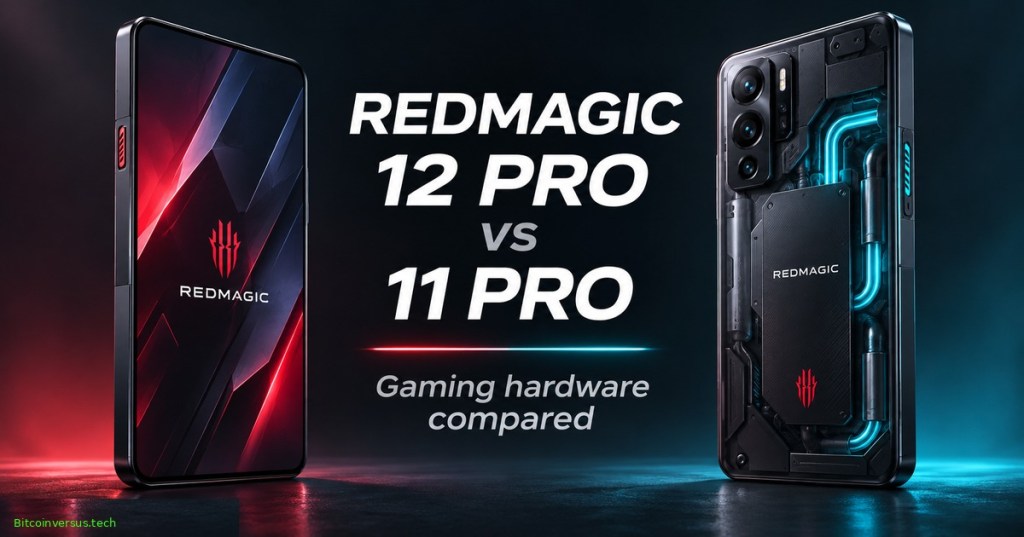
A viral teardown has put REDMAGIC’s new liquid-cooled gaming phone under the microscope. In the November 7 video above, JerryRigEverything examines the REDMAGIC 12 Pro hardware and its internal cooling layout. The relevant comparison is with the REDMAGIC 11 Pro: both are 6.85-inch gaming phones with flowing liquid cooling, yet the newer model raises battery capacity, display refresh and fan speed while reducing its maximum RAM configuration. The 12 Pro is scheduled for general sale on November 18, 2026.
Gaming phones attempt to sustain processor performance during prolonged workloads, when heat and battery limits can throttle clock speeds. REDMAGIC combines a vapor chamber, flowing coolant, liquid-metal interfaces and a small active fan. The camera footage reveals component packaging but does not establish quantitative thermal efficiency, gaming frame rates or long-term reliability.
What the official specifications show
REDMAGIC lists the 12 Pro at 8,400 mAh, up from 7,500 mAh. The gain is 12.0% in rated battery capacity, not a measured 12% improvement in play time. Maximum display refresh increases from 144 to 185 Hz, a 28.5% increase in potential screen updates. Cooling-fan ceiling rises from 24,000 to 25,500 RPM, or 6.25%. All three comparisons use matched specifications from the same manufacturer, not mixed independent benchmarks.
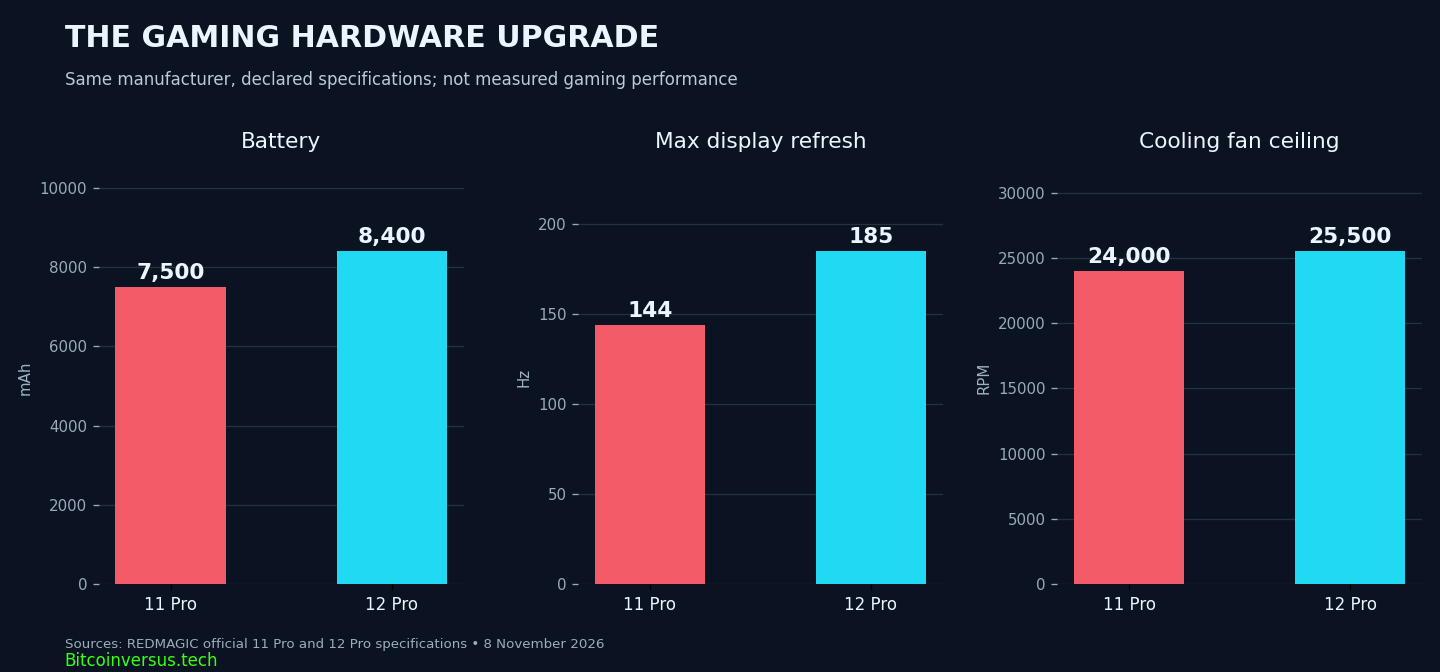
The new phone uses Snapdragon 8 Elite Extreme Gen 6 and REDMAGIC’s RedCore R5; the predecessor uses Snapdragon 8 Elite Gen 5 and RedCore R4. Different chip generations do not establish a defensible percentage CPU or GPU advantage without the same benchmark, software and cooling conditions. Display resolution remains 2,688 × 1,216 on both models. Both list up to 80 W wired and 80 W wireless charging.
The tradeoffs hidden behind the faster display
The 12 Pro weighs 223 g against 230 g, a 3.0% reduction, and measures 8.55 mm thick against 8.90 mm, making it 3.9% thinner. The 11 Pro, however, offers a listed 24 GB maximum RAM configuration; the 12 Pro’s published options top out at 16 GB, a one-third reduction in the maximum selectable amount. Available RAM can matter for intensive multitasking, though system RAM, VRAM and storage serve different purposes.
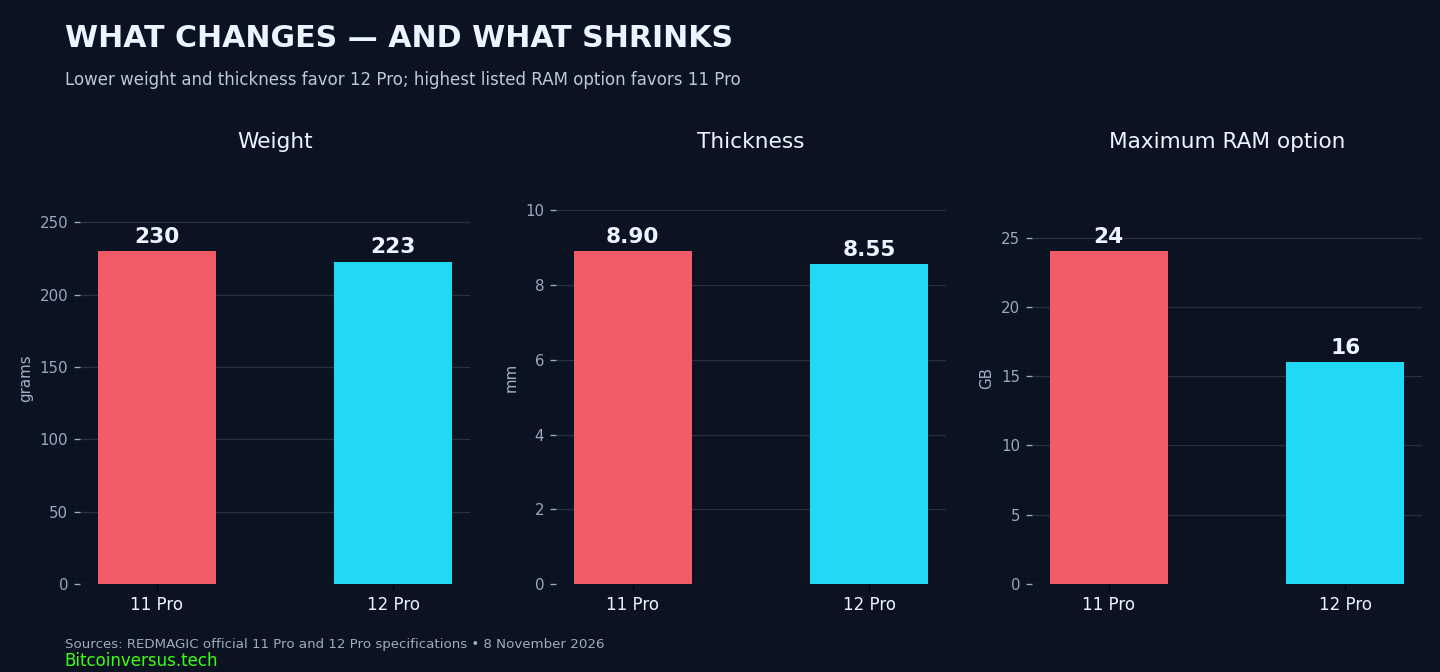
An analog 3.5 mm headphone jack appears on the 11 Pro sheet but is absent from the 12 Pro port list. A 520 Hz shoulder-trigger specification remains common to both. REDMAGIC calls the new system AquaCore 3.0 with dual-loop cooling, while the 11 Pro already offered flowing liquid cooling. For perspective, liquid cooling in compact mining hardware addresses the same basic need to remove heat, although cooling architectures and load profiles differ.
Where either model makes sense
The 12 Pro has the stronger published battery, refresh and fan specifications, plus a lighter chassis. A 185 Hz panel cannot create 185 frames per second in games that do not render or expose that rate. Higher fan RPM is likewise not proof of greater heat removal without airflow, noise and stabilized temperature measurements. REDMAGIC’s launch page lists a starting global price of $899, with November 18 general sales; regional prices can differ.
The 11 Pro remains attractive on paper to buyers who need its higher RAM option or headphone jack. Its American store page shows a $749 listing but says the model is out of stock, so the two prices are not simultaneous purchasable offers. Related reporting has examined mobile ray-tracing technology and phone controllers for cloud gaming, where game compatibility and network latency can outweigh a headline display figure.
Verdict
REDMAGIC 12 Pro wins the manufacturer-spec upgrade in battery capacity, refresh rate, fan ceiling and portability. The 11 Pro retains measurable configurability and wired-audio advantages. No universal gaming-performance winner can be established from specification sheets or a single teardown. Matched, independently repeated long-session frame-rate, power, noise and thermal tests would settle the performance question.
Primary sources: 11 Pro technical sheet; 12 Pro technical sheet; November launch pricing and dates; 11 Pro inventory listing. All percentage changes are calculated from listed values.
BitcoinVersus.Tech Editor’s Note
Specification comparisons are based on REDMAGIC’s published global product pages as of November 8, 2026, not independently measured endurance or sustained frame-rate tests. JerryRigEverything’s November 7 video provides a physical teardown, not a standardized comparison against the 11 Pro. The cover is an original editorial illustration rather than a certified photograph of either phone. Chart baselines begin at zero.
We volunteer daily to ensure the information on this platform is Verifiably True. If you would like to support the research, please scan QR code.
Support independent reporting
An optional 5,000-satoshi donation can be made by scanning the original BitcoinVersus.Tech QR with a compatible Bitcoin wallet. On a phone, open the QR on another screen or use a wallet that supports scanning saved images. Verify the receiving Bitcoin address 3C9o19EH5HSiwEPyCTmEKzxhNCbo2X6TTb and amount before confirming a transfer.

BitcoinVersus.tech is not a financial advisor. This media platform reports on financial subjects purely for informational purposes.


Leave a Reply