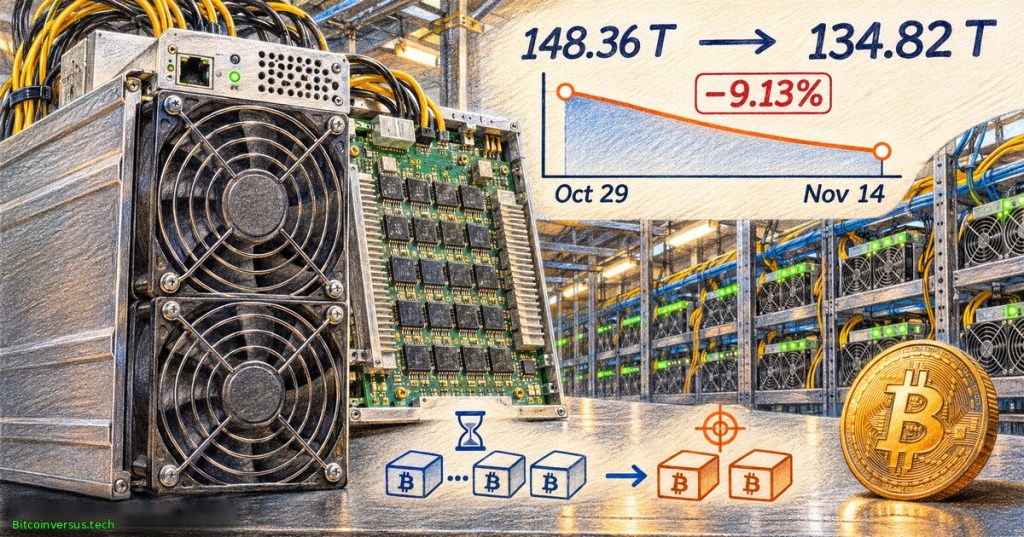
Bitcoin’s mining difficulty fell 9.13% to 134.82 trillion at block 975,744 on November 14, 2026, down from 148.36 trillion after the October 29 adjustment. The decline is the network’s largest since a 10.09% reduction on June 14, according to historical adjustment records. Rather than signaling a change to Bitcoin’s monetary rules, the retarget automatically makes valid proof-of-work hashes more likely after blocks arrived slower than the network’s intended pace.
The change is visible in mempool.space’s mining history, with matching figures in Newhedge’s difficulty-adjustment records. The new target took effect at about 05:02 UTC. Difficulty measures how hard it is to find a Bitcoin block; it does not measure a particular miner’s power efficiency, electricity rate or number of operating ASICs.
A 2,016-block reset, not a protocol emergency
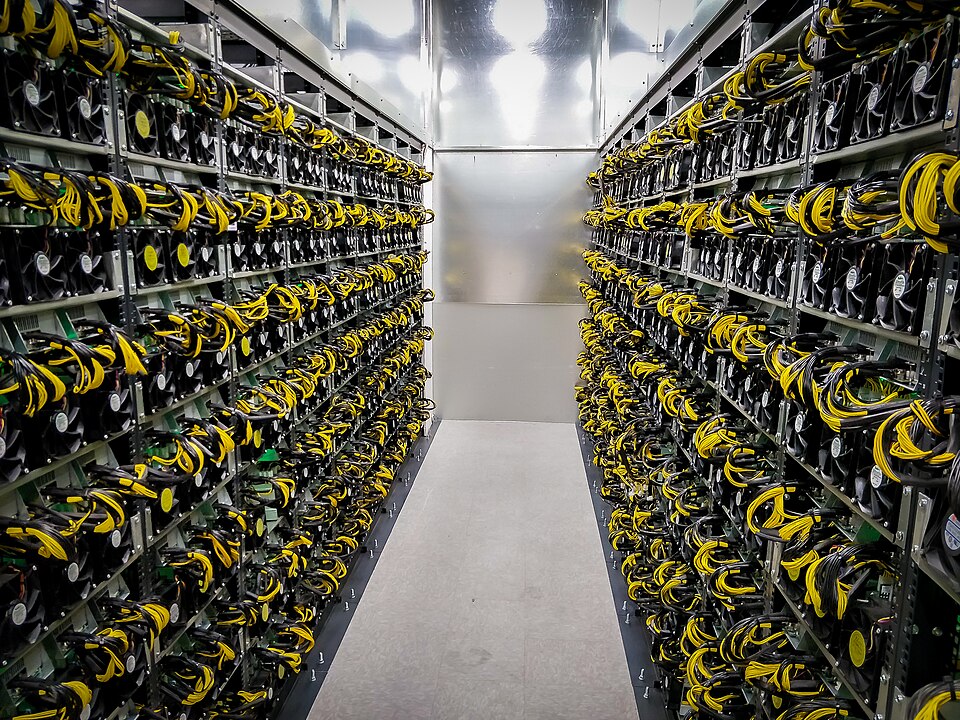
Bitcoin Core recalculates the proof-of-work target after each 2,016-block period, aiming for an average of roughly 10 minutes between blocks. When the previous period takes longer than intended, difficulty falls. Every validating node independently applies the same consensus rule; a miner cannot vote the target down or alter the subsidy by disconnecting equipment. Blockstream’s protocol explanation describes the mechanism.
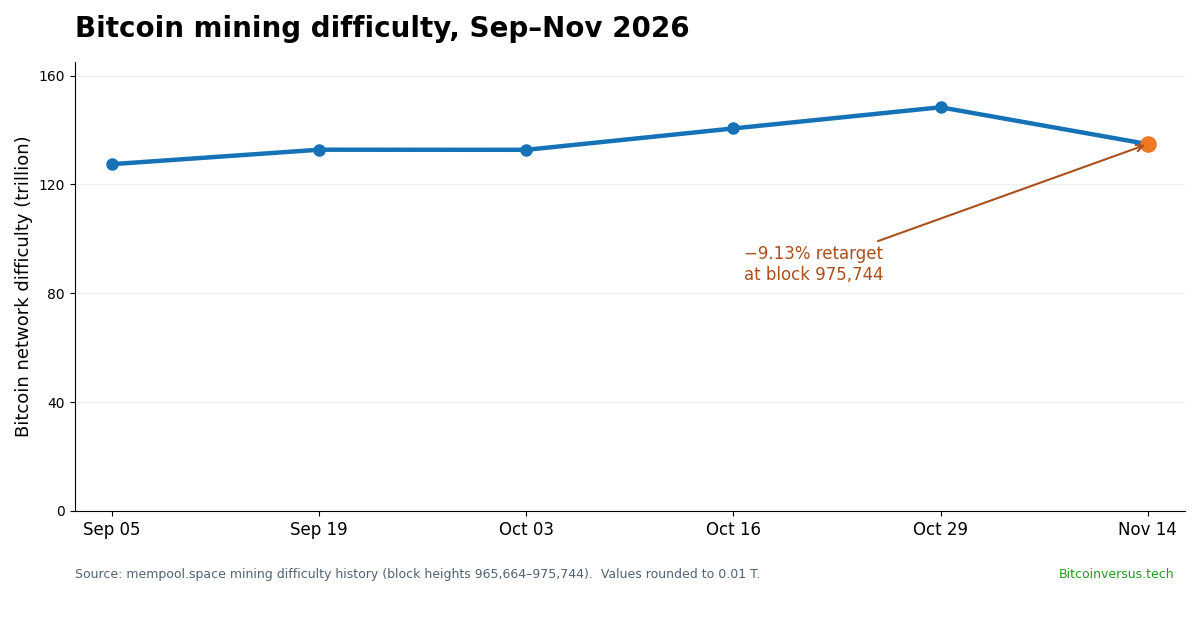
Across recent adjustments, the sequence was 127.45 trillion on September 5, 132.76 trillion on September 19, 132.72 trillion on October 3, 140.58 trillion on October 16, 148.36 trillion on October 29 and 134.82 trillion on November 14. The latest decline reverses the October increase but leaves difficulty above early-September levels. Faster and slower block intervals are evidence about aggregate hashing conditions, not a real-time census of switched-off machines.
Why the same ASIC could earn 10.04% more Bitcoin
For unchanged hashrate and network rules, expected block-finding probability is inversely proportional to difficulty. Using the exact recorded targets, 148,364,561,003,867 ÷ 134,823,837,323,272 = 1.10043. The lower difficulty therefore raises expected subsidy-only Bitcoin per unit of hashrate by about 10.04%, assuming conditions remain constant. The current block subsidy remains 3.125 BTC before transaction fees.
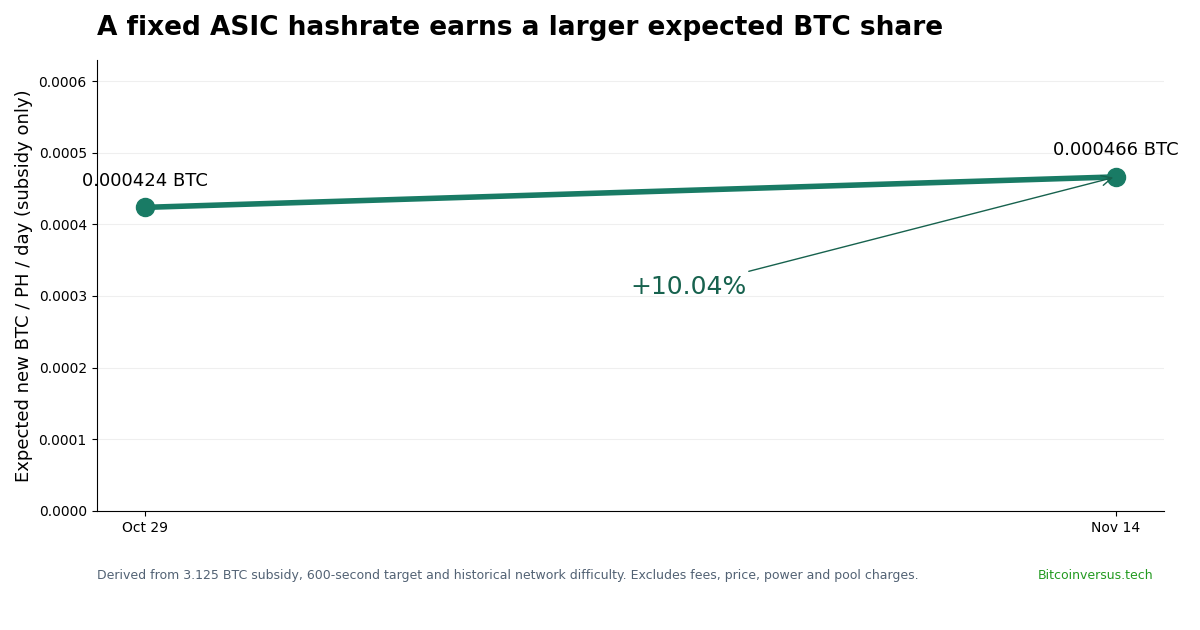
The calculation is an expectation over many hashes, not a payout guarantee for a solo miner or a forecast of daily revenue in dollars. Pool fees, uptime, electricity consumption, Bitcoin’s price and later hashrate growth can outweigh the protocol-level gain. BitcoinVersus.Tech’s analysis of ASIC efficiency versus whole-site efficiency explains why a machine’s rated joules per terahash cannot substitute for measured facility power costs.
Fleet economics and the limits of inference
Public mining-company disclosures provide useful context, but no single operator caused the adjustment. MARA recently reported 435,000 mining rigs, while Bitdeer reported falling joules per hash alongside higher aggregate electricity consumption. Separately, IREN disclosed a sharp reduction in installed mining capacity as it reallocates infrastructure toward AI. Such business changes cannot be mapped directly to Bitcoin’s November 14 difficulty change without matched operational timing and independent network measurements.
Mining difficulty adjusts the number of expected hashes required for a valid block, not the computational work already spent or the electrical energy needed by each ASIC per hash. A lower setting may relieve revenue pressure for efficient operators; older machines can still remain unprofitable. Future network difficulty will be determined by block times during the next epoch, not by any prediction market or a fixed forecast.
Primary data and methodology: Mempool mining difficulty records and Newhedge historical adjustment values; Blockstream’s explanation of Bitcoin’s consensus retarget. The modeled per-PH/s daily subsidy uses 3.125 × 86,400 × 1015 ÷ (difficulty × 232), excluding fees. Rounded chart labels may differ slightly from calculations using full integer difficulty values.
Editor’s Note: The November 14, 2026 retarget at block 975,744 and the 9.13% change were checked against public mining-history records. The 10.04% gain is a mathematical expectation for unchanged hashrate and block subsidy, not realized profit or a price prediction. The featured 1200 × 630 colored-pencil image is an original conceptual depiction of ASIC equipment, not a verified mine. The in-story Mirabel photograph is archival, with attribution and CC BY-SA 4.0 licensing; the two other in-story media are original source-labeled line charts. No contemporary official YouTube video or social post with independently confirmed identity and playable embedding was established, so no video is presented as verified. Actual mobile layout and external video playback were not tested.

BitcoinVersus.Tech is volunteer-run and publishes independent educational technology reporting. An optional 5,000-satoshi donation supports ongoing research. Scan the original QR from a second screen with a compatible Bitcoin wallet; on mobile, use a wallet that supports scanning a saved image. Independently verify the recipient address 3C9o19EH5HSiwEPyCTmEKzxhNCbo2X6TTb and the payment amount before sending. Bitcoin transfers are generally irreversible.
We volunteer daily to ensure information on the BitcoinVersus.Tech platform is Verifiably True. Coverage is educational and informational and does not constitute financial or investment advice.


Leave a Reply