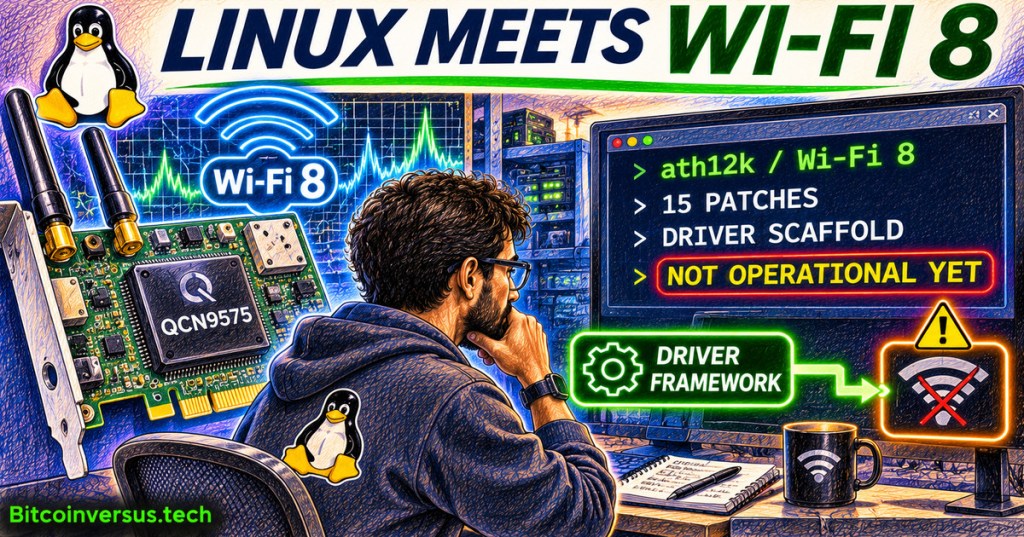
Qualcomm engineers have submitted a 15-patch Linux driver series for the QCN9575, a new Wi-Fi 8 radio chipset, but the code does not yet make the hardware operational. Posted to the Linux wireless mailing list on November 12, 2026, the proposal lays groundwork inside the open-source ath12k driver for a future 802.11bn device. The developer explicitly left out the PCI device identifier, preventing a physical QCN9575 adapter from matching the driver until additional work arrives.
Qualcomm’s verified April 2026 demonstration of Wi-Fi 8 networking hardware at Mobile World Congress. The router and FastConnect 8800 featured in the video are not a demonstration of QCN9575 Linux driver functionality. Credit: Qualcomm / YouTube.
What the new Linux code actually adds
According to Qualcomm engineer Madhavan Ganesan’s original patch cover letter, QCN9575 supports the 2.4 GHz, 5 GHz and 6 GHz frequency bands across as many as two radios. It belongs to a new hardware family distinct from earlier Wi-Fi 7 targets, including QCN9274 and IPQ5424.
The proposed changes establish a dedicated wifi8/ source directory, hardware parameter tables, PCI register mappings, a new firmware-download method and related messaging infrastructure. The QCN9575 needs additional copy-engine channels and firmware communications endpoints, so the driver must account for differences instead of assuming Wi-Fi 7 register layouts apply.
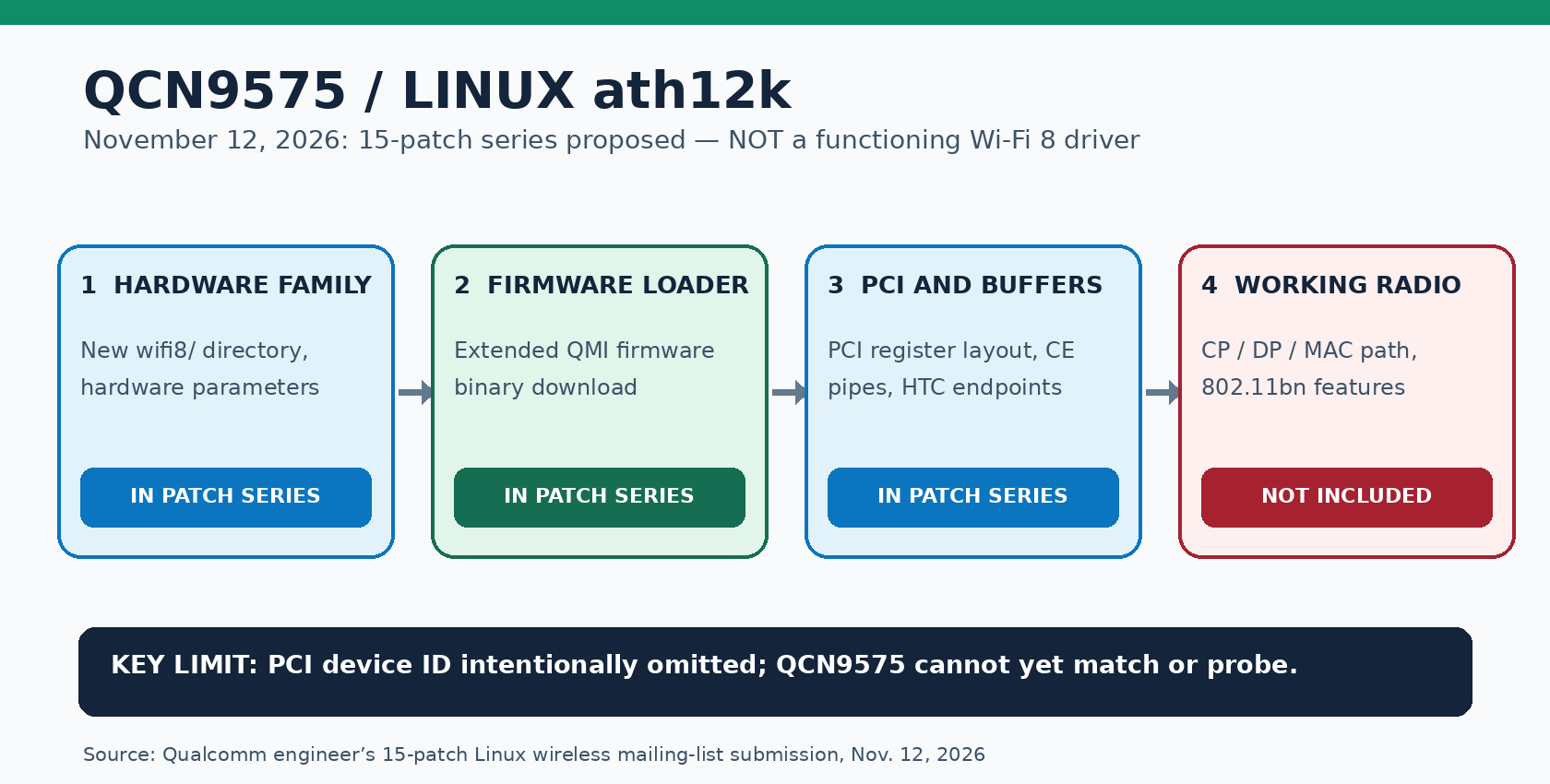
The final patch 15/15 specifies PCI interrupt vectors—three for MHI, five for copy engines and eight for the datapath—and introduces a QCN9575 initialization entry point. Yet the submission says control-plane, data-plane and MAC support still require a follow-up series. Its PCI ID table deliberately excludes QCN9575, so the initial code cannot attach to a real card.
Why a driver proposal is not a working network adapter
A device driver must recognize a chip, load compatible firmware, initialize the radio, exchange data with the operating system and support the relevant wireless protocols. A source-tree directory or PCI probe function is only one part of that sequence. Network technicians can review how operating-system drivers communicate with hardware and the role of firmware to understand why the missing components matter.
The patch submission also does not announce an accepted Linux kernel merge, retail Linux compatibility, shipping QCN9575 adapter or measured wireless throughput. Its author lists existing Wi-Fi 7 test hardware for regression checks, rather than a verified successful connection using the new Wi-Fi 8 device.
Wi-Fi 8 is still a draft standard
IEEE calls the next generation 802.11bn Ultra High Reliability. Its working group reported that Draft 2.0 passed initial ballot during 2026, with thousands of technical comments still being resolved. Final standard approval is expected in 2028 rather than completed today. The emphasis is more consistent coverage, responsiveness and interference handling—not merely a larger theoretical headline speed.
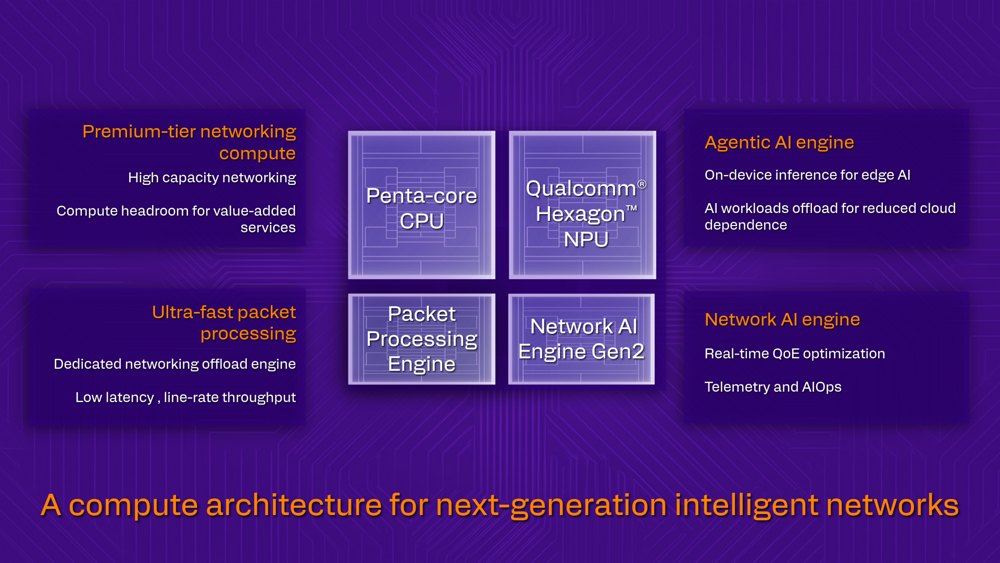
Qualcomm has separately shown commercial-oriented Wi-Fi 8 networking products, and BitcoinVersus.Tech has covered gFiber’s planned AI-enabled Wi-Fi 8 gateway and Qualcomm’s combined 5G and Wi-Fi 8 platform. Those announcements concern different hardware products and do not establish working QCN9575 support in mainline Linux.
For IT administrators, buying Wi-Fi 8-branded equipment before finalized interoperability testing carries driver, firmware and compatibility uncertainty. Existing Linux network-management commands cannot compensate for missing device initialization. A project’s patch submission is a meaningful engineering milestone, but production readiness requires accepted code, real-hardware testing and sustained maintenance.
Bottom line: Qualcomm’s November 12 submission makes Linux Wi-Fi 8 development more concrete. It is early driver infrastructure, not a functioning QCN9575 adapter. The next meaningful evidence will be follow-up datapath patches and a verified Linux connection on real hardware.
Primary sources: Qualcomm’s complete 15-patch submission, November 12, 2026; PCI initialization patch and excluded device ID; QCN9575 copy-engine and messaging support; IEEE 802.11 working-group status; Qualcomm Wi-Fi 8 technology overview; verified Qualcomm hardware video. Product capabilities, standardization timelines and pending driver features are distinguished from measured deployments.
Editor’s Note: The November 12 Qualcomm Linux submission is proposed source code, not confirmed merged kernel support. The PCI device ID was intentionally left out, preventing QCN9575 hardware from binding until later patches; 802.11bn protocol support and the control/data/MAC path remain incomplete. The original 1200 × 630 colored-pencil featured cover is conceptual rather than a photograph of a real QCN9575 board. The original flow diagram explains pending work; the Qualcomm portfolio image depicts different networking hardware. The YouTube video is an authentic earlier Qualcomm Wi-Fi 8 showcase but does not verify QCN9575 Linux operation. Rendered iframe, playback and mobile-layout results are separately identified in the publishing audit.

BitcoinVersus.Tech is volunteer-run and publishes independent educational technology reporting. An optional 5,000-satoshi donation supports ongoing research. Scan the original QR from a second screen with a compatible Bitcoin wallet; on mobile, use a wallet that supports scanning a saved image. Independently verify the recipient address 3C9o19EH5HSiwEPyCTmEKzxhNCbo2X6TTb and the payment amount before sending. Bitcoin transfers are generally irreversible.
We volunteer daily to ensure information on the BitcoinVersus.Tech platform is Verifiably True. Coverage is educational and informational and does not constitute financial or investment advice.


Leave a Reply