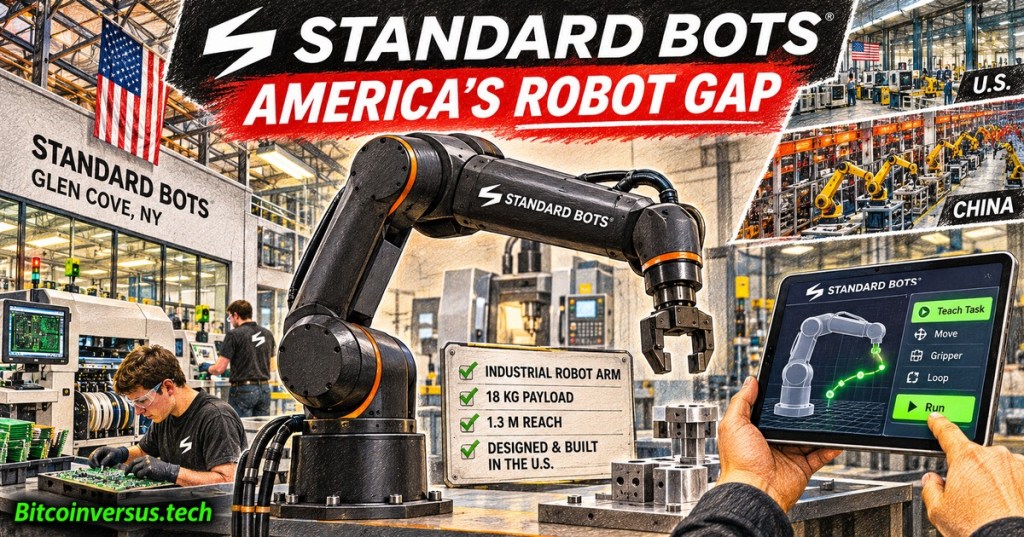
The American robotics startup Standard Bots is making an industrial-policy argument from a factory in Glen Cove, New York: manufacturing competitiveness depends increasingly on how easily ordinary plants can deploy robots. In a documentary released October 29, 2026, co-founder and CEO Evan Beard showed how the company assembles industrial arms and circuit boards while pursuing faster, software-led deployment. Its ambition is significant, although national robot-installation figures reveal how much ground American manufacturers must cover.
Watch EO Studio’s 23-minute ODDS documentary, “Inside the Startup Trying to Bring Manufacturing Back to the US,” featuring Evan Beard and factory production. Published October 29, 2026. Credit: EO Studio / YouTube.
Seven years to sell the first hundred
Beard told EO that it took seven years to sell Standard Bots’ first 100 robots. At one low point, friends staged an intervention urging him to abandon the company. He now claims annual growth of five to ten times, but the interview does not supply audited shipments or revenue, so the pace remains a management statement rather than independently verified performance.
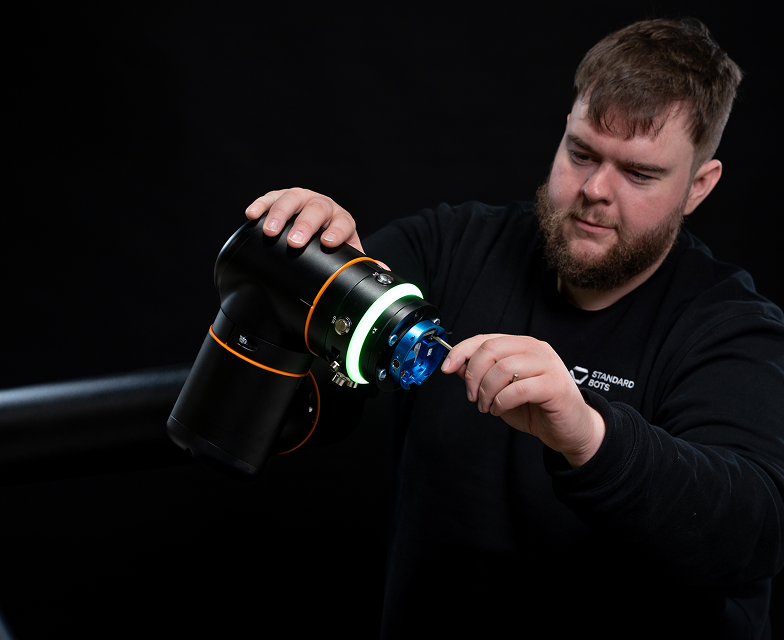
The production story is more tangible. Beard described in-house surface-mount electronics manufacturing and said the Glen Cove operation is expanding from 30,000 to 70,000 square feet. The company states it designs and assembles robots and actuators in New York, with a longer-term goal of deeper domestic manufacturing. Assembly in America and a completely American-origin parts supply chain are not equivalent.
China installed about nine robots for every U.S. installation
The International Federation of Robotics recorded about 354,000 industrial robot installations in China during 2025, compared with nearly 38,500 in the United States. Dividing 354,000 by 38,500 gives approximately 9.2. China represented 59% of global new installations, while the U.S. ranked second by annual deployment volume.
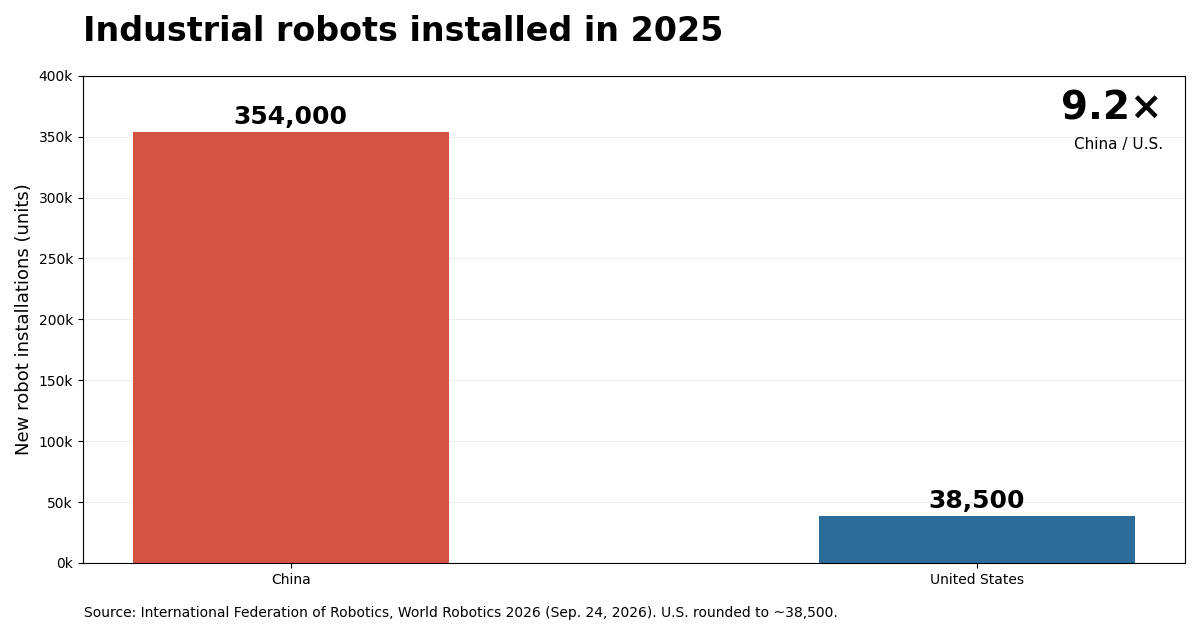
The comparison illustrates a deployment gap, not an equivalent measure of manufacturing productivity or industrial competitiveness. Industry composition, existing robot fleets, output value and labor intensity also matter. The U.S. added approximately 12% more robots than a year earlier, meaning its installation rate was growing even as China’s total remained much larger.
An iPad interface is not the same as autonomous production
Beard argues that robot programming should resemble operating a consumer device rather than writing complex industrial code. Standard Bots’ Core arm has a company-listed payload of 18 kilograms and reach of 1.3 meters; its starting price is $39,500. The interface supports no-code routines and optional machine vision, while AI skills can locate parts and respond to operator instructions.
A demonstration that teaches a robot a task in minutes does not eliminate fixture design, functional-safety assessments, repeatability testing, protective measures or integration with equipment. Reliable production must account for failed picks, unexpected objects and changing factory conditions. In earlier coverage of Standard Bots’ October AI-skills launch, separate perception, agent and inspection features illustrated the gradual nature of factory intelligence.
The next computing platform—and its limits
Beard compares robotics with previous computing-platform shifts, arguing that widely deployable automation could increase worker productivity and help sustain manufacturing jobs. The employment outcome is not guaranteed. Machines may reduce exposure to hazardous tasks and support higher-value work, but adoption can also displace specific roles and impose retraining costs.
The broader hardware contest includes industrial robot platforms, increasingly automated warehouse systems, and the labor questions examined in 26 years of robot adoption data. Standard Bots’ principal test is whether easier programming translates into sustained production uptime and economical deployments beyond demonstrations.
Editor’s Note: Original sources include EO Studio’s October 29, 2026 ODDS documentary featuring Evan Beard, Standard Bots’ product and AI pages, and the International Federation of Robotics’ September 24 World Robotics 2026 release. The China–U.S. comparison uses 2025 annual new installations; national totals do not measure robot stock or output per worker. Expansion, sales growth, component localization and deployment-speed statements are attributed to company leadership unless independently confirmed. The cover is an original illustrated composition, not a documentary photograph; the in-story factory photograph is credited to Standard Bots. The data chart is original.

To donate 5,000 satoshis, scan the QR with a compatible Bitcoin wallet. On mobile, open the image with a wallet’s supported saved-image scanner or display the code on a second screen. Verify the recipient before sending funds.
We volunteer daily to ensure the information on this platform is Verifiably True. If you would like to support the research, please scan QR code.


Leave a Reply