
The United States added 8.3 gigawatts of utility-scale battery nameplate capacity during January through June 2026, according to the Energy Information Administration. The national operational fleet rose from 43.6 GW at year-end 2025 to nearly 52 GW. Those figures measure batteries placed in service, not installations awaiting permits or grid connections.
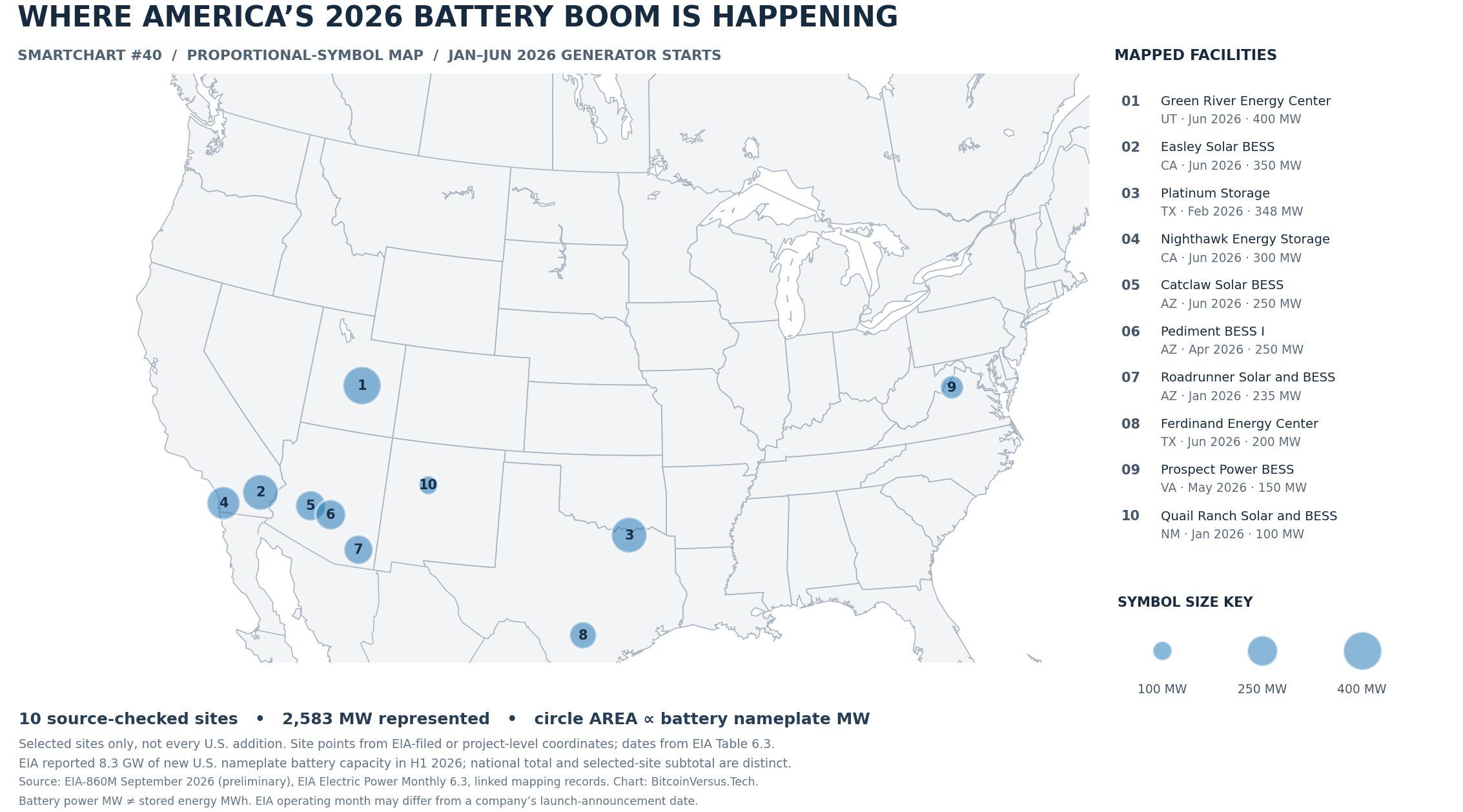
BitcoinVersus.Tech used SmartChart’s proportional-symbol format to show where ten substantial new generators entered operation. The verified sample contains 2,583 MW of battery capacity across Arizona, California, Texas, Utah, New Mexico and Virginia. The points illustrate real facilities, but the sample is not every U.S. addition and should not be used to rank states nationally.
Arizona, California and the Southwest
The Arizona sample includes Catclaw Solar’s 250 MW battery, Pediment BESS I at 250 MW and Roadrunner’s 235 MW battery, totaling 735 MW. Roadrunner’s solar unit began operating in 2025, but its battery generator started in January 2026. The map counts only the newly commissioned battery equipment, not older photovoltaic capacity.
California contributes Easley Solar’s 350 MW storage generator and the 300 MW Nighthawk facility near Poway. EIA lists Nighthawk’s generator operating month as June; developer Arevon publicly announced its opening in August. Both dates are documented milestones, not evidence of two different batteries.
Official Arevon video: “Nighthawk Energy Storage Project Ribbon-Cutting.” Real project footage, not a survey of all mapped facilities.
Texas, Utah, New Mexico and Virginia
In Texas, Platinum Storage contributes 348 MW and Ferdinand Energy Center adds 200 MW. Platinum’s equipment has a 348 MW nameplate rating but a lower 300 MW net summer rating. The symbols consistently show nameplate capacity, avoiding a misleading combination of different electrical ratings.
The sample’s largest individual battery is Green River Energy Center in Utah at 400 MW. Its separate 400 MW solar generator is excluded. Quail Ranch contributes 100 MW of batteries in New Mexico, while Prospect Power BESS adds a 150 MW point in Virginia, extending the sample beyond the Southwest.
Source feed: EIA’s official X account. The timeline provides ongoing energy statistics, rather than a single post verifying the map.
Why circle area must scale with megawatts
SmartChart #40 locates each plant using reported latitude and longitude. A 400 MW circle covers four times the area of a 100 MW circle; its radius increases by a factor of two, not four. The figure therefore communicates plant-scale capacity at actual mapped locations. At hybrid sites, project coordinates represent the development, not the position of every battery cabinet.
The underlying dataset pairs EIA-860M preliminary nameplate capacity with generator operating months in Electric Power Monthly Table 6.3. Reporting can be revised. The table of new generators supplies net summer MW, a separate metric, so the map relies on plant-level nameplate values.
Official Arevon video: “A Leader in America’s Critical Energy Storage Future.” Company perspective, not independent EIA validation.
Battery power is not stored energy
MW measures power delivery; MWh measures stored energy. Arevon lists Nighthawk at 300 MW and 1,200 MWh, equivalent to four hours of theoretical full-power discharge before operating restrictions and losses. Batteries shift electricity through time and support grid services, but do not create electricity from fuel or sunlight.
Earlier BitcoinVersus.Tech reporting documented national storage energy through September, solar-plus-storage growth, the largest existing facilities and planned Arkansas installations. The present map instead isolates selected 2026 battery generator starts.
The next step is a complete national plant-level map with every newly operating generator, validated coordinates and one consistent capacity definition. Until then, these ten sites establish locations, dates and power ratings without overstating geographic coverage.
Sources: EIA August 7 analysis; EIA-860M September inventory; EIA operating additions; Arevon announcement; Platinum facility record; Pediment facility record.


Leave a Reply